


Nonendemic HPV-positive nasopharyngeal carcinoma: association with poor prognosis
- PMID: 24521676
- PMCID: PMC3989890
- DOI: 10.1016/j.ijrobp.2013.11.246
Nonendemic HPV-positive nasopharyngeal carcinoma: association with poor prognosis
Abstract
Purpose: To investigate the relationship between human papillomavirus (HPV) and Epstein-Barr virus (EBV) in nonendemic nasopharyngeal carcinoma (NPC) and assess the prognostic implications of viral status.
Methods and materials: Paraffin-embedded tumor specimens from 62 patients with primary NPC diagnosed between 1985 and 2011 were analyzed for EBV and high-risk HPV. EBV status was determined by the use of in situ hybridization for EBV encoded RNA. HPV status was assessed with p16 immunohistochemistry and multiplex polymerase chain reaction MassArray for determination of HPV type. Proportional hazards models were used to compare the risk of death among patients as stratified by viral status.
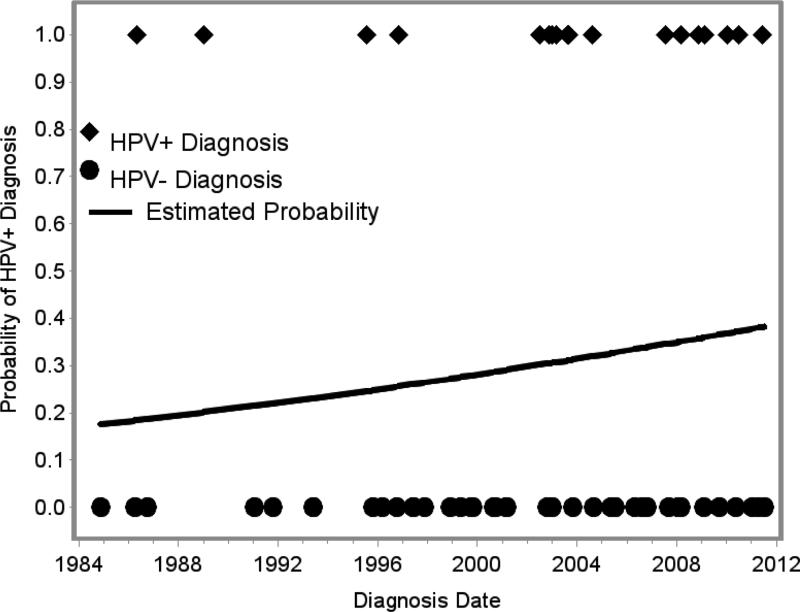
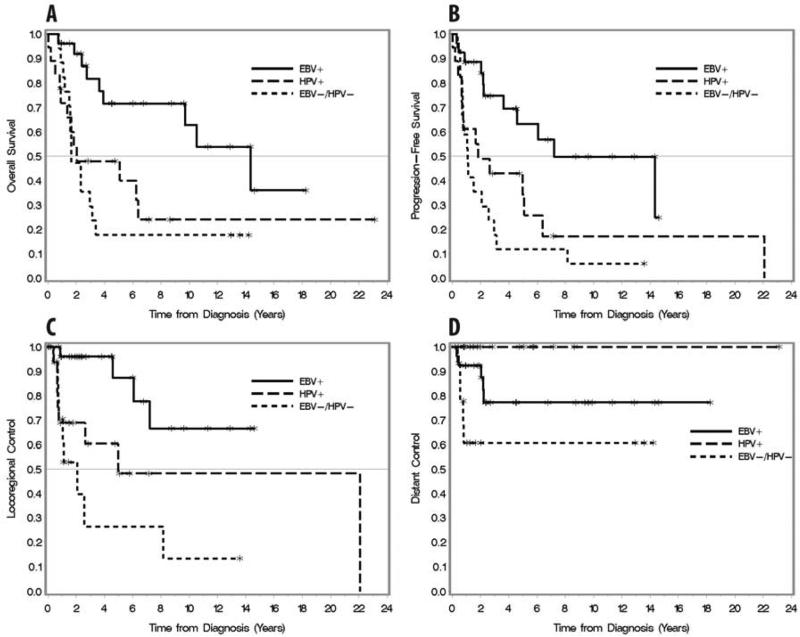
Results: Of 61 evaluable tumors, 26 (43%) were EBV-positive/HPV-negative, 18 (30%) were HPV-positive/EBV-negative, and 17 (28%) were EBV/HPV-negative. EBV and HPV infection was mutually exclusive. HPV positivity was significantly correlated with World Health Organization grade 2 tumors, older age, and smoking (all P<.001). The racial distribution of the study population was 74% white, 15% African American, and 11% Asian/Middle Eastern. Among HPV-positive patients, 94% were white. At a median follow-up time of 7 years, HPV-positive and EBV/HPV-negative tumors exhibited worse outcomes than did EBV-positive tumors, including decreased overall survival (hazard ratio [HR] 2.98, P=.01; and HR 3.89, P=.002), progression-free survival (HR 2.55, P=.02; and HR 4.04, P<.001), and locoregional control (HR 4.01, P=.03; and HR 6.87, P=.001).
Conclusion: In our Midwestern population, high-risk HPV infection may play an etiologic role in the development of nonendemic, EBV-negative NPC. Compared with EBV-positive NPC, HPV-positive and EBV/HPV-negative NPC are associated with worse outcomes. A larger confirmatory study is needed to validate these findings.
Published by Elsevier Inc.
Figures
References
-
- Howlander N, Noone AM, M. K, et al. Seer cancer statistics review, 1975-2009 (vintage 2009 populations) National Cancer Institute; Bethesda, MD: http://seer.cancer.gov/csr/1975_2009_pops09/, based on November 2011 SEER data submission, posted to the SEER website, April 2012.
-
- Niedobitek G, Hansmann ML, Herbst H, et al. Epstein-barr virus and carcinomas: Undifferentiated carcinomas but not squamous cell carcinomas of the nasopharynx are regularly associated with the virus. J Pathol. 1991;165:17–24. - PubMed
-
- Nicholls JM, Agathanggelou A, Fung K, et al. The association of squamous cell carcinomas of the nasopharynx with epstein-barr virus shows geographical variation reminiscent of burkitt's lymphoma. J Pathol. 1997;183:164–168. - PubMed
-
- Chang ET, Adami HO. The enigmatic epidemiology of nasopharyngeal carcinoma. Cancer Epidemiol Biomarkers Prev. 2006;15:1765–1777. - PubMed
-
- Vaughan TL, Shapiro JA, Burt RD, et al. Nasopharyngeal cancer in a low-risk population: Defining risk factors by histological type. Cancer Epidemiol Biomarkers Prev. 1996;5:587–593. - PubMed
Publication types
MeSH terms
Substances
Grants and funding
LinkOut - more resources
Full Text Sources
Other Literature Sources
