. 2014 Apr;70(4):637-643.
doi: 10.1016/j.jaad.2013.11.031. Epub 2014 Feb 9.

Relationships among primary tumor size, number of involved nodes, and survival for 8044 cases of Merkel cell carcinoma

Affiliations

Relationships among primary tumor size, number of involved nodes, and survival for 8044 cases of Merkel cell carcinoma

Jayasri G Iyer et al. J Am Acad Dermatol. 2014 Apr.

Abstract

Background: The effects of primary tumor size on nodal involvement and of number of involved nodes on survival have not, to our knowledge, been examined in a national database of Merkel cell carcinoma (MCC).

Objective: We sought to analyze a retrospective cohort of patients with MCC from the largest US national database to assess the relationships between these clinical parameters and survival.

Methods: A total of 8044 MCC cases in the National Cancer Data Base were analyzed.

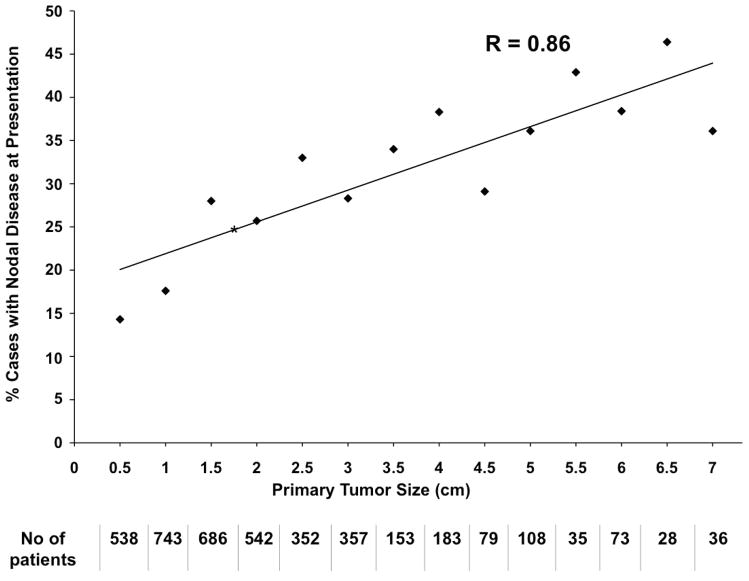
Results: There was a 14% risk of regional nodal involvement for 0.5-cm tumors that increased to 25% for 1.7-cm (median-sized) tumors and to more than 36% for tumors 6 cm or larger. The number of involved nodes was strongly predictive of survival (0 nodes, 76% 5-year relative survival; 1 node, 50%; 2 nodes, 47%; 3-5 nodes, 42%; and ≥6 nodes, 24%; P < .0001 for trend). Younger and/or male patients were more likely to undergo pathological nodal evaluation.

Limitations: The National Cancer Data Base does not capture disease-specific survival. Hence, relative survival was calculated by comparing overall survival with age- and sex-matched US population data.

Conclusion: Pathologic nodal evaluation should be considered even for patients with small primary MCC tumors. The number of involved nodes is strongly predictive of survival and may help improve prognostic accuracy and management.

Keywords: Merkel cell carcinoma; National Cancer Data Base; average tumor size; neuroendocrine carcinoma of the skin; nodal spread; prognosis; regional node metastasis; sentinel lymph node biopsy.


Conflict of interest statement

AUTHORS’ DISCLOSURES OF POTENTIAL CONFLICTS OF INTEREST: The author(s) indicated no potential conflicts of interest.

Figures

Figure 1
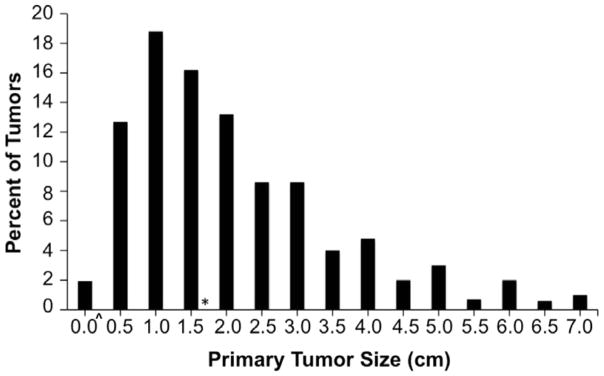
Figure 1. Size Distribution of Primary MCC Tumors among 5,722 cases
Primary tumor sizes from 5,722 cases were rounded to the nearest 0.5 cm (e.g. 0.8 – 1.2 cm tumors are shown as 1.0 cm). The median tumor size was 1.7 cm (shown by asterisk). ^Among 109 cases depicted as “0.0 cm”, 56 cases were 0.2 cm and 53 cases were 0.1 cm.
Figure 2
Figure 2. Relationship of Primary Tumor Size to Regional Nodal Disease
Among 4,027 evaluable patients, the percentage with clinically or pathologically involved lymph nodes at presentation is shown relative to primary tumor size (Pearson correlation coefficient (R) = 0.86 with 95% confidence interval of 0.61–0.95), p<0.001). The number of patients presenting with each primary tumor size is shown below the X axis. An asterisk (*) at 1.7 cm indicates the median tumor size at presentation. 114 cases are in the “0 cm” bin (56 cases were 0.2 cm, 53 cases were 0.1 cm, and 5 cases were recorded as 0.0 cm; these may have represented ‘unknown primary’ or in situ tumors). 21% of these 114 cases with “0” cm size in fact had nodal disease at presentation.
Figure 3
Figure 3. Relationship between number of positive regional nodes at diagnosis and survival
Overall survival (3a) and relative survival (3b) is plotted for 1,305 patients who had no distant metastasis at the time of diagnosis and for whom nodal status at presentation was available. Percent surviving is indicated below ‘Years from Diagnosis” for each number of positive nodes.
Figure 4
Figure 4. Proportion of patients who underwent pathological regional nodal evaluation
Among patients with no distant metastatic disease at presentation, more men underwent pathological nodal staging of their lymph nodes than women in each age category. Pathological staging of nodes decreased with advancing age for both sex. Error bars represent binomial standard error. Data from 4,809 males and 3,036 females are shown. The frequency of pathologic node evaluation was significantly different as a function of age and sex (young versus old male, p<0.0001; young female versus old female, p<0.0001; young male versus young female, p = 0.008; old male versus old female p<0.0001).

References

    1. Lemos BD, Storer BE, Iyer JG, Phillips JL, Bichakjian CK, Fang LC, et al. Pathologic nodal evaluation improves prognostic accuracy in Merkel cell carcinoma: analysis of 5823 cases as the basis of the first consensus staging system. J Am Acad Dermatol. 2010;63:751–761. - PMC - PubMed
    1. Stokes JB, Graw KS, Dengel LT, Swenson BR, Bauer TW, Slingluff CL, Jr, et al. Patients with Merkel cell carcinoma tumors < or = 1.0 cm in diameter are unlikely to harbor regional lymph node metastasis. J Clin Oncol. 2009;27:3772–3777. - PMC - PubMed
    1. Fields RC, Busam KJ, Chou JF, Panageas KS, Pulitzer MP, Kraus DH, et al. Recurrence and survival in patients undergoing sentinel lymph node biopsy for merkel cell carcinoma: analysis of 153 patients from a single institution. Ann Surg Oncol. 2011;18:2529–2537. - PMC - PubMed
    1. Schwartz JL, Griffith KA, Lowe L, Wong SL, McLean SA, Fullen DR, et al. Features predicting sentinel lymph node positivity in Merkel cell carcinoma. J Clin Oncol. 2011;29:1036–1041. - PMC - PubMed
    1. Balch CM, Soong SJ, Atkins MB, Buzaid AC, Cascinelli N, Coit DG, et al. An evidence-based staging system for cutaneous melanoma. CA Cancer J Clin. 2004;54:131–149. quiz 182–134. - PubMed

Publication types

MeSH terms