. 2014 Feb 13:4:4089.
doi: 10.1038/srep04089.

Species identification through mitochondrial rRNA genetic analysis

Affiliations

Species identification through mitochondrial rRNA genetic analysis

Li Yang et al. Sci Rep. .

Abstract

Inter-species and intraspecific variations in mitochondrial DNA (mtDNA) were observed in a bioinformatics analysis of the mitochondrial genomic sequences of 11 animal species. Some highly conserved regions were identified in the mitochondrial 12S and 16S ribosomal RNA (rRNA) genes of these species. To test whether these sequences are universally conserved, primers were designed to target the conserved regions of these two genes and were used to amplify DNA from 21 animal tissues, including two of unknown origin. By sequencing these PCR amplicons and aligning the sequences to a database of non-redundant nucleotide sequences, it was confirmed that these amplicons aligned specifically to mtDNA sequences from the expected species of origin. This molecular technique, when combined with bioinformatics, provides a reliable method for the taxonomic classification of animal tissues.


Conflict of interest statement

The authors declare no competing financial interests.

Figures
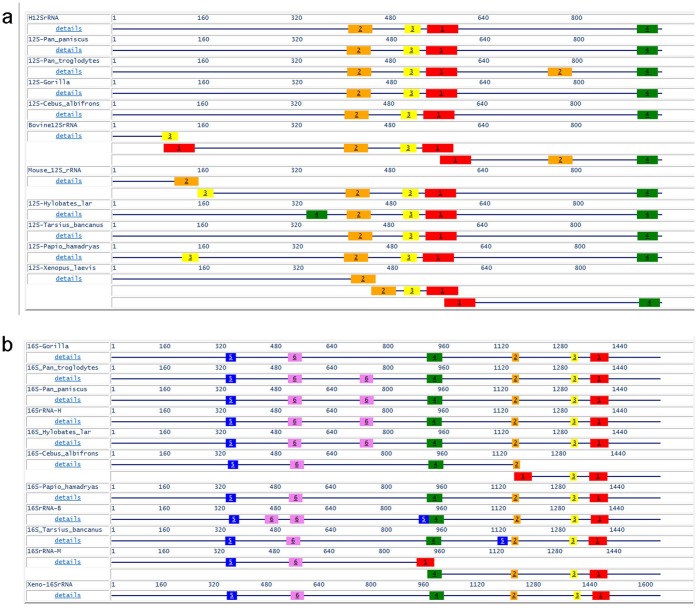
Figure 1
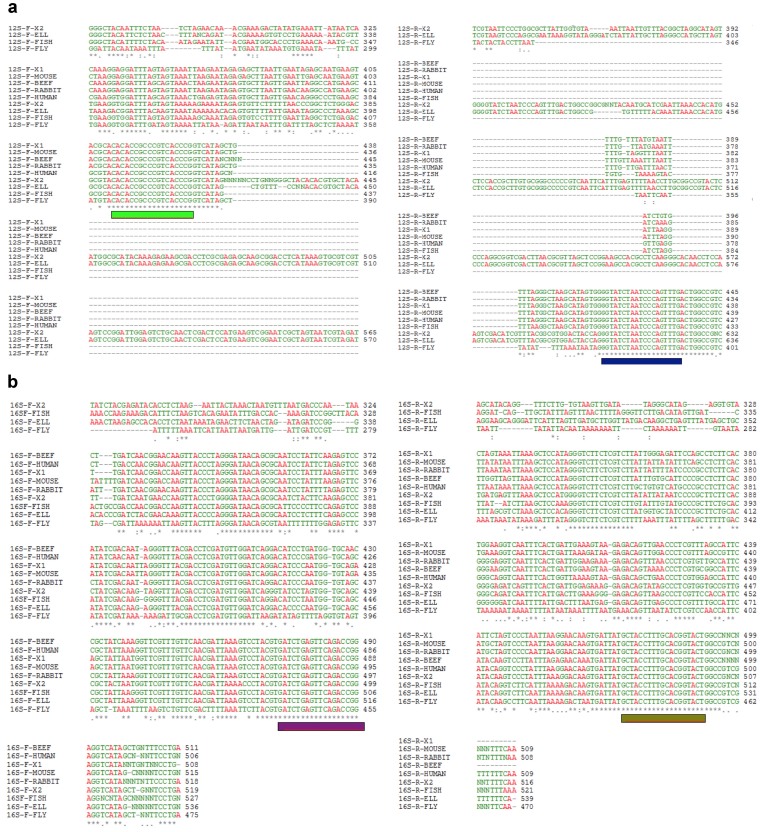
Figure 1. The locations of highly conserved regions in the mitochondrial 12S rRNA gene (1a) and the 16S rRNA gene (1b).
The conserved motifs are marked with colored numbers.
Figure 2
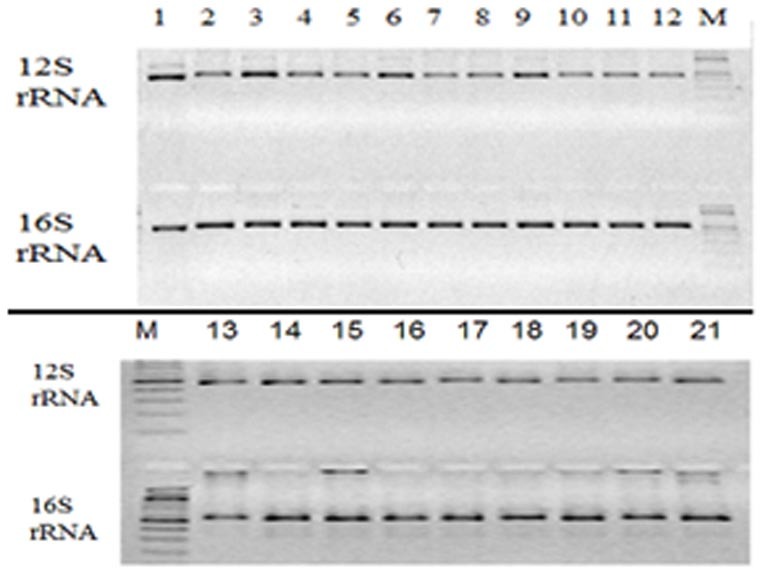
Figure 2. PCR amplicons in the mitochondrial 12S and 16S rRNA genes from DNA samples, including a fly sample; commercial eel, shrimp, fish, chicken, pig, cow, and rabbit samples; mouse and human cells; 2 double-blinded (×1 and ×2) samples; and alligator, cat, deer, dog, donkey, duck, equine, pigeon, and turkey DNA.
The samples are respectively labeled as 1, 2, 3, 4, 5, 6, 7, 8, 9, 10, 11, 12, 13, 14, 15, 16, 17, 18, 19, 20, and 21. M indicates the 100-bp DNA ladder.
Figure 3
Figure 3. The partial alignment sequences for the PCR amplicons of the mitochondrial 12S rRNA (Figure 2a) and 16S rRNA (Figure 2b) genes from 9 animal species, including the fly and 2 double-blinded samples (×1 and ×2).
The locations of the universal primers were located in the 12S and 16S rRNA forward and reverse sequences and are marked with colored bars.
Figure 4
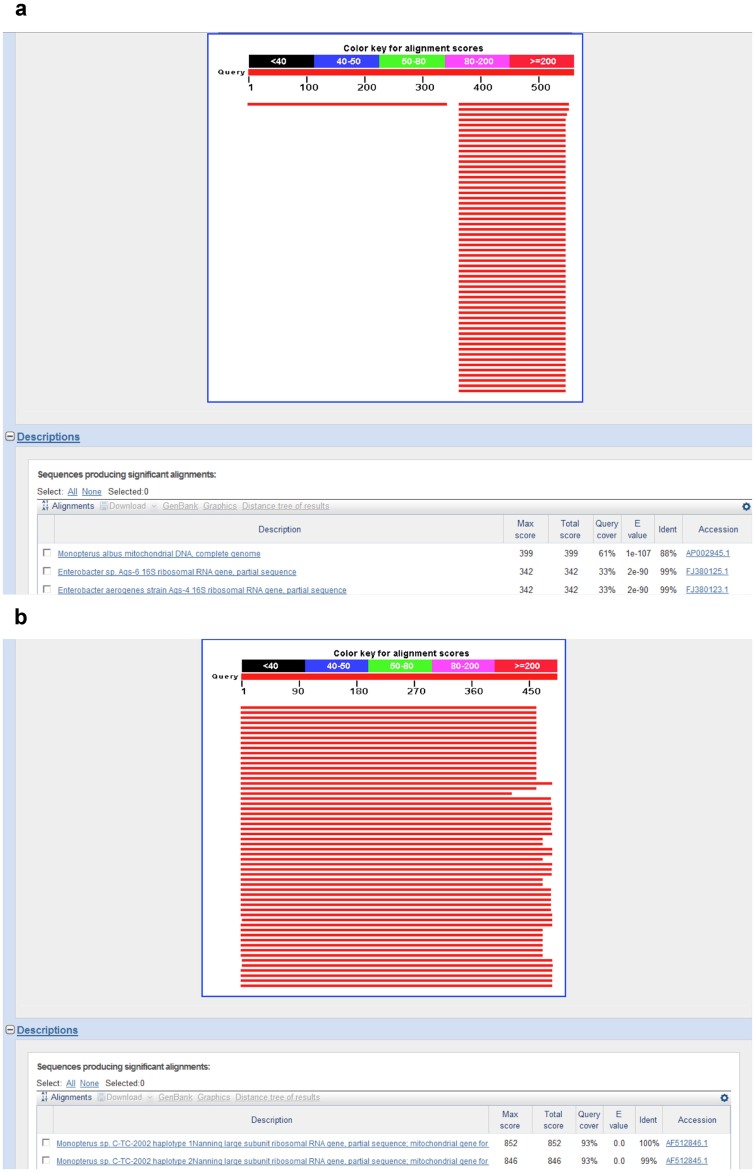
Figure 4. BLAST result profiles using the PCR amplicons of the eel mitochondrial 12S rRNA and 16S rRNA genes (Figure 4a and 4b, respectively).
The profiles indicate that the full PCR amplicon of the eel mitochondrial 12S rRNA gene only matches the Monopterus albus mtDNA although the identity is only 88%. The partial sequence of this amplicon (approximately 200 bp) matched the mitochondrial genomes of many other species. The full PCR amplicons of the eel mitochondrial 16S rRNA gene matched the Monopterus albus ribosomal RNA gene with 100% identity (Table 4). Therefore, the eel species was Monopterus albus.
Figure 5
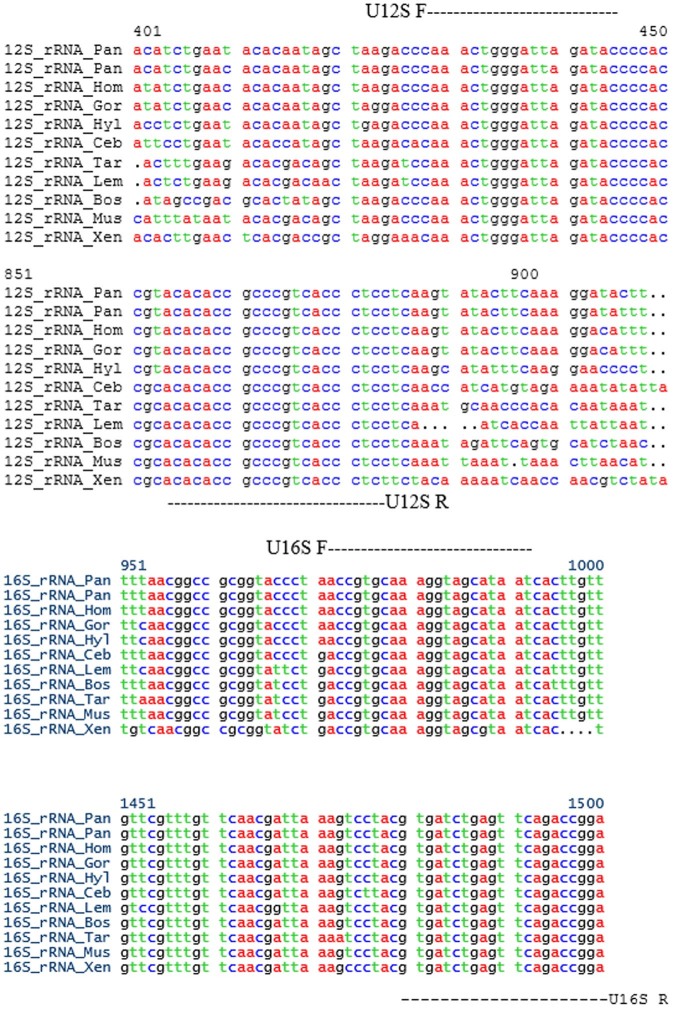
Figure 5. The PileUp results from the GenBank data of the mitochondrial 12S rRNA and 16S rRNA genes from 11 animal species.
The locations of the universal primers are indicated by the non-continuous lines.

References

    1. Bataille M., Crainic K., Leterreux M., Durigon M. & de Mazancourt P. Multiplex amplification of mitochondrial DNA for human and species identification in forensic evaluation. Forensic Sci Int 99, 165–70 (1999). - PubMed
    1. Wolf C., Rentsch J. & Hübner P. PCR-RFLP analysis of mitochondrial DNA: a reliable method for species identification. J Agric Food Chem 47, 1350–5 (1999). - PubMed
    1. Birstein V. J. & DeSalle R. Molecular phylogeny of Acipenserinae. Mol. Phylogenet. Evol 9, 141–155 (1998). - PubMed
    1. Brown J. R., Beckenbach K., Beckenbach A. T. & Smith M. J. Length variation, heteroplasmy and sequence divergence in the mitochondrial DNA of four species of sturgeon (Acipenser). Genetics 142, 525–35 (1996). - PMC - PubMed
    1. Burgener M. & Hubner P. Mitochondrial DNA enrichment for species identification and evolutionary analysis. Z. Lebensm. Unters. Forsch 207, 261–263 (1998).