The drinking water disparities framework: on the origins and persistence of inequities in exposure
- PMID: 24524500
- PMCID: PMC4025716
- DOI: 10.2105/AJPH.2013.301664
The drinking water disparities framework: on the origins and persistence of inequities in exposure
Abstract
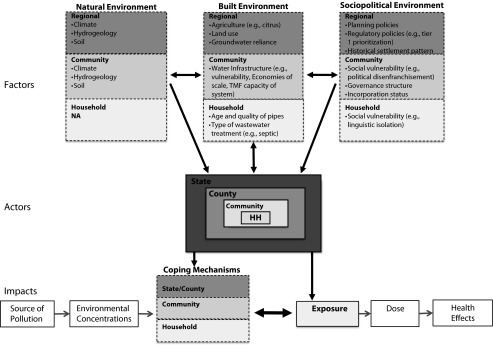
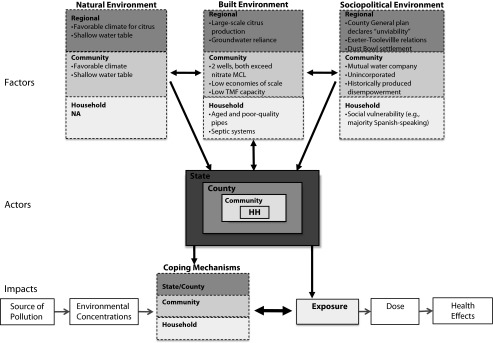
With this article, we develop the Drinking Water Disparities Framework to explain environmental injustice in the context of drinking water in the United States. The framework builds on the social epidemiology and environmental justice literatures, and is populated with 5 years of field data (2005-2010) from California's San Joaquin Valley. We trace the mechanisms through which natural, built, and sociopolitical factors work through state, county, community, and household actors to constrain access to safe water and to financial resources for communities. These constraints and regulatory failures produce social disparities in exposure to drinking water contaminants. Water system and household coping capacities lead, at best, to partial protection against exposure. This composite burden explains the origins and persistence of social disparities in exposure to drinking water contaminants.
Figures
Comment in
-
Delivering Fresh Water: Critical Infrastructure, Environmental Justice, and Flint, Michigan.Am J Public Health. 2016 Aug;106(8):1358-60. doi: 10.2105/AJPH.2016.303235. Am J Public Health. 2016. PMID: 27400348 Free PMC article. No abstract available.
References
-
- Dubrovsky NM, Burow KR, Clark GM . Menlo Park, CA: US Geological Survey; 2010. The quality of our nation’s waters—nutrients in the nation’s streams and groundwater, 1992–2004.
-
- Olmstead SM. Thirsty colonias: rate regulation and the provision of water service. Land Econ. 2004;80(1):136–150.
-
- Heaney C, Wilson SM, Wilson O, Cooper J, Bumpass N, Snipes M. Use of community-owned and -managed research to assess the vulnerability of water and sewer services in marginalized and underserved environmental justice communities. J Environ Health. 2011;74(1):8–17. - PubMed
-
- Wilson SM, Heaney CD, Cooper J, Wilson O. Built environment issues in unserved and underserved African-American neighborhoods in North Carolina. Environ Justice. 2008;1(2):63–72.
-
- Murphy M, Lewis L, Sabogal RI, Bell C. Survey of unregulated drinking water sources on Navajo nation. Oral presentation at: American Public Health Association 137th Annual Meeting and Exposition; November 10, 2009; Philadelphia, PA.
Publication types
MeSH terms
Substances
LinkOut - more resources
Full Text Sources
Other Literature Sources
Medical