Longitudinal changes of cardiac structure and function in CKD (CASCADE study)
- PMID: 24525033
- PMCID: PMC4073437
- DOI: 10.1681/ASN.2013080899
Longitudinal changes of cardiac structure and function in CKD (CASCADE study)
Abstract
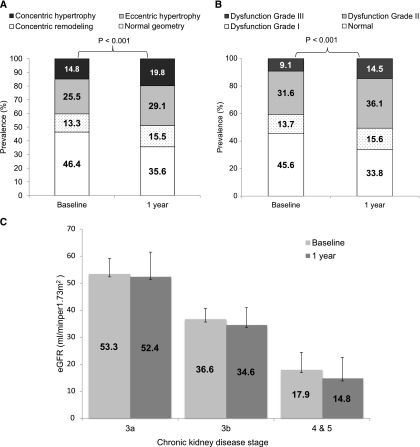
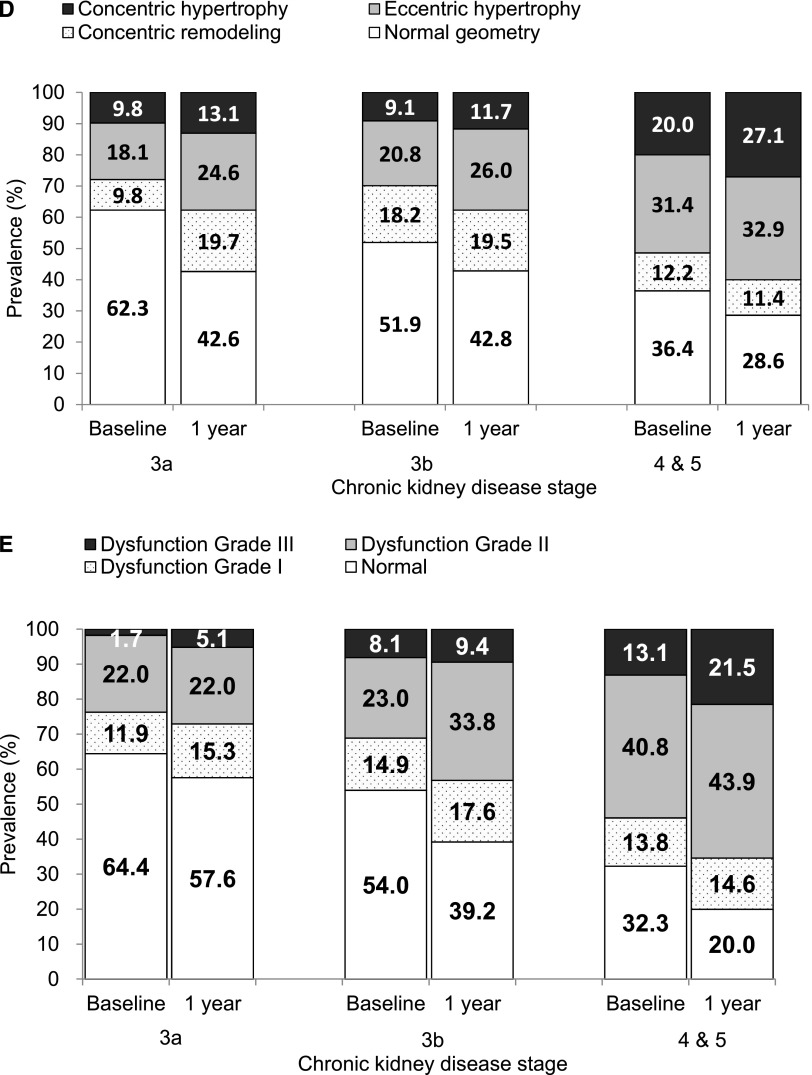
Little is known regarding the natural longitudinal changes in cardiac structure and function in CKD. We hypothesized that baseline CKD stage is associated with progressive worsening in cardiac structure and function. We conducted a prospective longitudinal study, recruiting 300 patients with stages 3-5 CKD from a major regional tertiary center and university teaching hospital in Hong Kong. Baseline CKD stages were studied in relation to natural longitudinal changes in echocardiographic and tissue Doppler imaging-derived parameters. Over 1 year, the prevalence of left ventricular (LV) hypertrophy increased from 40.3% to 48.9%, median left atrial volume index increased 4.8 (interquartile range [IQR], 2.1, 7.7) ml/m(2) (P<0.001), peak systolic mitral annular velocity decreased 0.5 (IQR, -1.5, 0.5) cm/s (P<0.001), early diastolic mitral annular velocity decreased 0.5 (IQR, -1.5, 0.5) cm/s (P<0.001), and eGFR declined 2.0 (IQR, -5.0, 0.0) ml/min per 1.73 m(2). CKD stages 4 and 5 were associated with more baseline abnormalities in cardiac structure and function and predicted greater longitudinal progression in LV mass index (odds ratio [OR], 3.02; 95% confidence interval [95% CI], 1.39 to 6.58), volume index (OR, 2.58; 95% CI, 1.18 to 5.62), and left atrial volume index (OR, 2.61; 95% CI, 1.20 to 5.69) and worse diastolic dysfunction grade (OR, 3.17; 95% CI, 1.16 to 8.69) compared with stage 3a in the fully adjusted analysis. In conclusion, more advanced CKD at baseline may be associated with larger longitudinal increases in LV mass and volume and greater deterioration in diastolic function.
Keywords: chronic kidney disease; echocardiography; heart disease; left ventricular hypertrophy.
Copyright © 2014 by the American Society of Nephrology.
Figures
References
-
- Go AS, Chertow GM, Fan D, McCulloch CE, Hsu CY: Chronic kidney disease and the risks of death, cardiovascular events, and hospitalization. N Engl J Med 351: 1296–1305, 2004 - PubMed
-
- Sarnak MJ, Levey AS, Schoolwerth AC, Coresh J, Culleton B, Hamm LL, McCullough PA, Kasiske BL, Kelepouris E, Klag MJ, Parfrey P, Pfeffer M, Raij L, Spinosa DJ, Wilson PW, American Heart Association Councils on Kidney in Cardiovascular Disease, High Blood Pressure Research, Clinical Cardiology, and Epidemiology and Prevention : Kidney disease as a risk factor for development of cardiovascular disease — A statement from the American Heart Association councils on kidney in cardiovascular disease, high blood pressure research, clinical cardiology, and epidemiology and prevention. Circulation 108: 2154–2169, 2003 - PubMed
-
- Herzog CA, Asinger RW, Berger AK, Charytan DM, Díez J, Hart RG, Eckardt KU, Kasiske BL, McCullough PA, Passman RS, DeLoach SS, Pun PH, Ritz E: Cardiovascular disease in chronic kidney disease. A clinical update from Kidney Disease: Improving Global Outcomes (KDIGO). Kidney Int 80: 572–586, 2011 - PubMed
-
- Matsushita K, van der Velde M, Astor BC, Woodward M, Levey AS, de Jong PE, Coresh J, Gansevoort RT, Gansevoort RT, Chronic Kidney Disease Prognosis Consortium : Association of estimated glomerular filtration rate and albuminuria with all-cause and cardiovascular mortality in general population cohorts: A collaborative meta-analysis. Lancet 375: 2073–2081, 2010 - PMC - PubMed
Publication types
MeSH terms
LinkOut - more resources
Full Text Sources
Other Literature Sources
Medical
Research Materials
Miscellaneous