


Regulation of Macrophage Polarization and Wound Healing
- PMID: 24527272
- PMCID: PMC3623587
- DOI: 10.1089/wound.2011.0307
Regulation of Macrophage Polarization and Wound Healing
Abstract
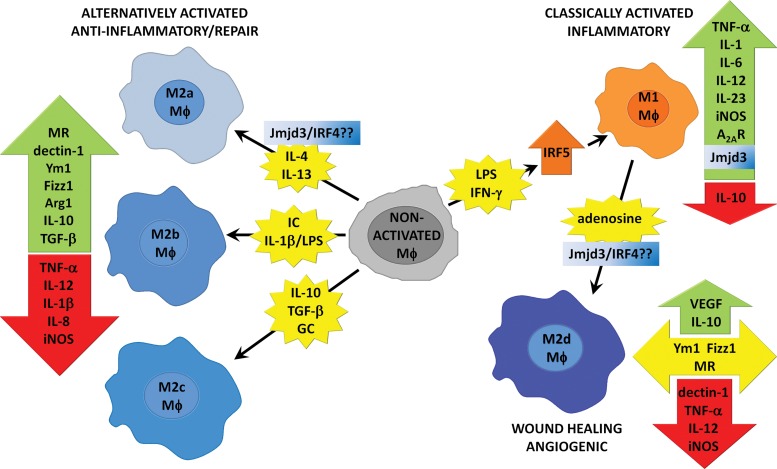
Background: Macrophages (Mφs) participate in wound healing by coordinating inflammatory and angiogenic processes. Mφs respond to environmental cues by adopting either "classically" activated (M1) proinflammatory or "alternatively" activated (M2a, M2b, M2c, M2d) wound healing phenotypes.
The problem: Mφ polarization is essential for wound healing and aberrations in this process are linked to several pathologies. It is important to elucidate molecular mechanisms underlying Mφ polarization.
Basic/clinical science advances: Mφs are categorized as proinflammatory (M1) or anti-inflammatory/wound healing (M2). M1 Mφs are observed in initial tissue damage responses, are induced by exogenous pathogen-associated molecular patterns or endogenous damage-associated molecular patterns, and exhibit increased phagocytosis and pro-inflammatory cytokine production, facilitating innate immunity and wound debridement. M2 Mφs predominate later in repair, express vascular endothelial growth factor, transforming growth factor beta, and interleukin 10 (IL-10), are activated by varied stimuli, assist in the resolution of inflammation, and promote tissue formation and remodeling. Recent work has characterized a novel "M2d" phenotype resulting from adenosine-dependent "switching" of M1 Mφs that exhibits a pattern of marker expression that is distinct from canonical IL-4/IL-13-dependent M2a Mφs. Recent studies have demonstrated important roles for specific transcriptional elements in M1 and M2a Mφ polarization, notably members of the interferon regulatory factor family interferon regulatory factor 5 (IRF5) and IRF4, respectively. The role of these IRFs in M2d polarization and wound healing remains to be determined.
Clinical care relevance: Knowledge of microenvironmental signals and molecular mechanisms that mediate Mφ polarization should permit their manipulation to regulate important physiological processes and resolve pathological conditions.
Conclusion: Proper Mφ polarization is essential to effective wound healing, and distinct phenotypes, such as the angiogenic M2d Mφ, may be of critical importance to this process. The IRF5 transcription factor has been shown to play a key role in M1 Mφ activation and the Jumonji domain containing-3-IRF4 pathway has been implicated in M2 Mφ activation.
Figures

References
Publication types
LinkOut - more resources
Full Text Sources
Other Literature Sources
