


Mesenchymal Stem Cell Therapy for Cutaneous Wounds
- PMID: 24527299
- PMCID: PMC3623581
- DOI: 10.1089/wound.2011.0294
Mesenchymal Stem Cell Therapy for Cutaneous Wounds
Abstract
Background: Mesenchymal stem cell (MSC) treatment of wounds results in accelerated wound closure, increased granulation tissue formation, and increased angiogenesis. These adult stem cells exert their therapeutic effects primarily by secreting soluble factors that regulate cellular responses to cutaneous injury.
The problem: There is an urgent need for novel therapies for the treatment of wounds with delayed healing. Current treatment options for chronic nonhealing wounds and burns are limited and not always effective, despite significant advances in wound care including application of bioengineered skin equivalents and growth factors.
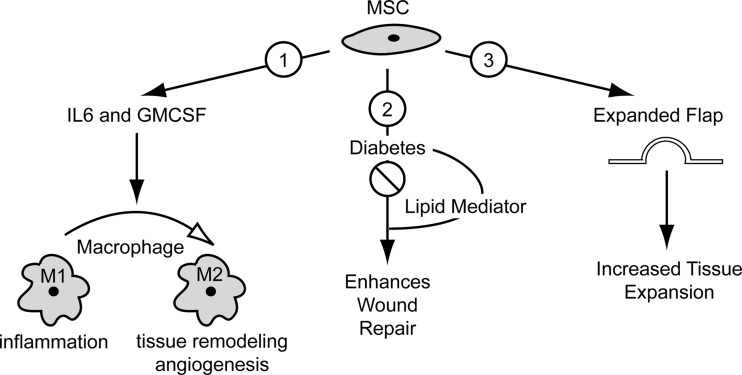
Basic/clinical science advances: The three target articles advance the field by addressing critical gaps in knowledge about MSC function and mechanism during wound healing. The first target article provides the first evidence that MSCs regulate macrophage phenotype in wounds. The second target article demonstrates that diabetes mellitus impairs the ability of MSCs to promote wound healing and this can be rescued by a novel lipid mediator deficit in diabetic wounds. The final target article reports that the surgical technique of tissue expansion is enhanced by MSCs.
Clinical care relevance: MSC therapy suppresses inflammation in wounds and may be more effective when used in conjunction with other therapeutics that modulate the diabetic wound environment. It also shows potential as an adjunctive therapy for surgical tissue expansion.
Conclusion: MSCs represent promising emerging therapies for wounds with delayed healing such as chronic nonhealing wounds and burns.

References
-
- U.S. National Institutes of Health Registry of Clinical Trials. http://clinicaltrials.gov http://clinicaltrials.gov
-
- Butler KL. Goverman J. Ma H. Fischman A. Yu YM. Bilodeau M. Rad AM. Bonab AA. Tompkins RG. Fagan SP. Stem cells and burns: review and therapeutic implications. J Burn Care Res. 2010;31:874. - PubMed
-
- Francois S. Bensidhoum M. Mouiseddine M. Mazurier C. Allenet B. Semont A. Frick J. Sache A. Bouchet S. Thierry D. Gourmelon P. Gorin N-C. Chapel A. Local irradiation not only induces homing of human mesenchymal stem cells at exposed sites but promotes their widespread engraftment to multiple organs: a study of their quantitative distribution after irradiation damage. Stem Cells. 2006;24:1020. - PubMed
-
- Benderitter M. Gourmelon P. Bey E. Chapel A. Clairand I. Prat M. Lataillade JJ. New emerging concepts in the medical management of local radiation injury. Health Phys. 2010;98:851. - PubMed
Publication types
LinkOut - more resources
Full Text Sources
