Review
. 2013 Jun;2(5):215-224.
doi: 10.1089/wound.2012.0406.

Critical Role of Transforming Growth Factor Beta in Different Phases of Wound Healing

Affiliations
Review

Critical Role of Transforming Growth Factor Beta in Different Phases of Wound Healing

Mohammadreza Pakyari et al. Adv Wound Care (New Rochelle). 2013 Jun.

Abstract

Significance: This review highlights the critical role of transforming growth factor beta (TGF-β)1-3 within different phases of wound healing, in particular, late-stage wound healing. It is also very important to identify the TGF-β1-controlling factors involved in slowing down the healing process upon wound epithelialization.

Recent advances: TGF-β1, as a growth factor, is a known proponent of dermal fibrosis. Several strategies to modulate or regulate TGF's actions have been thoroughly investigated in an effort to create successful therapies. This study reviews current discourse regarding the many roles of TGF-β1 in wound healing by modulating infiltrated immune cells and the extracellular matrix.

Critical issues: It is well established that TGF-β1 functions as a wound-healing promoting factor, and thereby if in excess it may lead to overhealing outcomes, such as hypertrophic scarring and keloid. Thus, the regulation of TGF-β1 in the later stages of the healing process remains as critical issue of which to better understand.

Future directions: One hypothesis is that cell communication is the key to regulate later stages of wound healing. To elucidate the role of keratinocyte/fibroblast cross talk in controlling the later stages of wound healing we need to: (1) identify those keratinocyte-released factors which would function as wound-healing stop signals, (2) evaluate the functionality of these factors in controlling the outcome of the healing process, and (3) formulate topical vehicles for these antifibrogenic factors to improve or even prevent the development of hypertrophic scarring and keloids as a result of deep trauma, burn injuries, and any type of surgical incision.


Figures

None
Aziz Ghahary, PhD
Figure 1.
Figure 1.
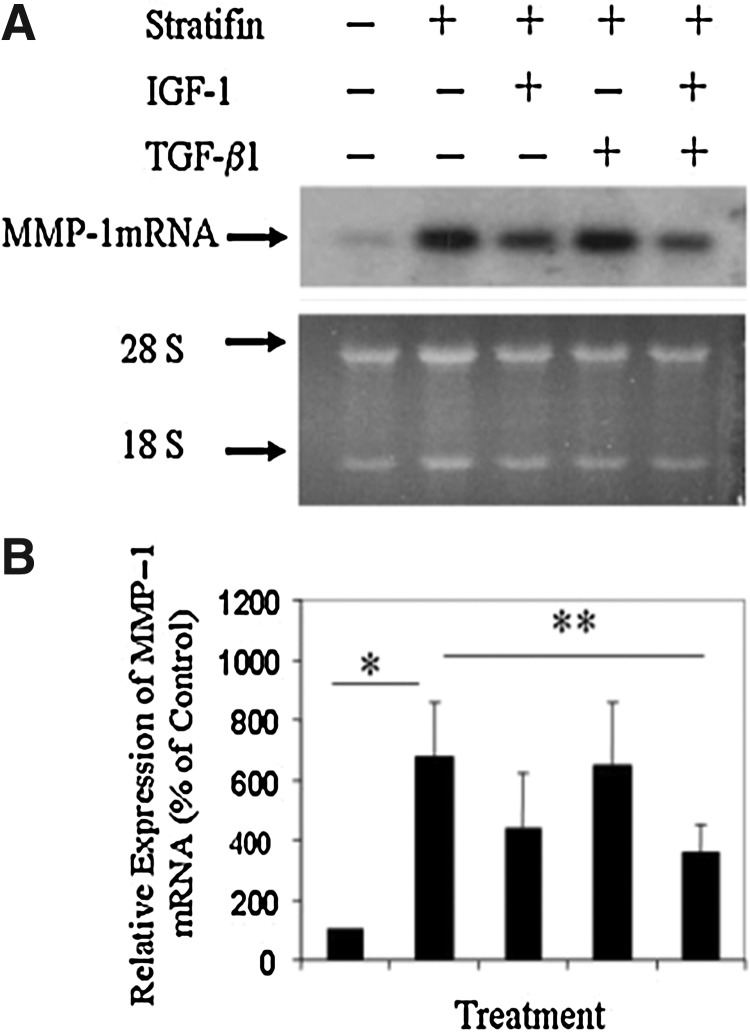
Quantitative analysis of the stratifin-stimulated matrix metalloproteinase (MMP)–1 mRNA in fibroblasts in the presence and absence of insulin-like growth factor (IGF)–1 and transforming growth factor (TGF)–β1. Three different strains of primary dermal fibroblasts isolated from 3 different individuals were either left untreated or treated for 24 h with stratifin—alone, or in the presence of IGF-1 (100 ng/mL), TGF-β1 (100 pg/mL), or both. Cells were then harvested, total RNA was extracted, and the expression of MMP-1 mRNA was evaluated by Northern blot analysis. (A) The representative pattern of MMP-1 mRNA, as well as that of 18S ribosomal RNA, which was used as loading control. (B) The expression of MMP-1 mRNA was then quantified by densitometry, and the mean±SD obtained from three separate experiments was then expressed as percentage of their corresponding controls. Significant difference was found in comparing *between untreated and stratifin-treated samples (data on lane 1 vs. 2) and **between the stratifin-treated and stratifin+TGF-β1+IGF-1–treated cells (data on lane 2 vs. 5).
Figure 2.
Figure 2.
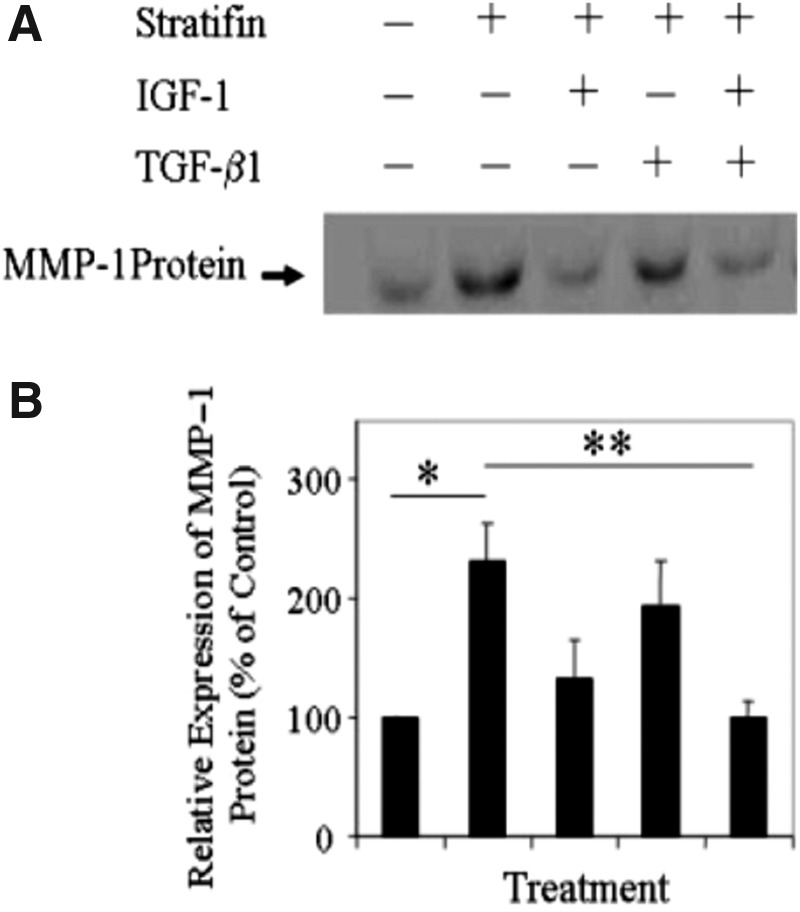
Quantitative analysis of the stratifin-stimulated MMP-1 protein in fibroblasts in the presence and absence of IGF-1 and TGF-β1. As in Figure 1, three different strains of primary dermal fibroblasts isolated from 3 different individuals were left untreated or treated for 48 h with stratifin—alone, or in the presence of IGF-1 (100 ng/mL), TGF-β1 (100 pg/mL), or both. Total cellular protein was then extracted and lysate (40 μg/lane) from each treatment was subjected to SDS-PAGE analysis. (A) The levels of MMP-1 protein were then evaluated by Western blot analysis. The blot represents three separate experiments. (B) The levels of MMP-1 protein were then quantified by densitometry, and the mean±SD obtained from three separate experiments were then expressed as percentage of their corresponding controls. Significant difference was found in comparing *between untreated and stratifin-treated samples (data on lane 1 vs. 2) and **between the stratifin-treated and stratifin+TGF-β1+IGF-1–treated cells (data on lane 2 vs. 5). SDS-PAGE, sodium dodecyl sulfate polyacrylamide gel electrophoresis.
Figure 3.
Figure 3.
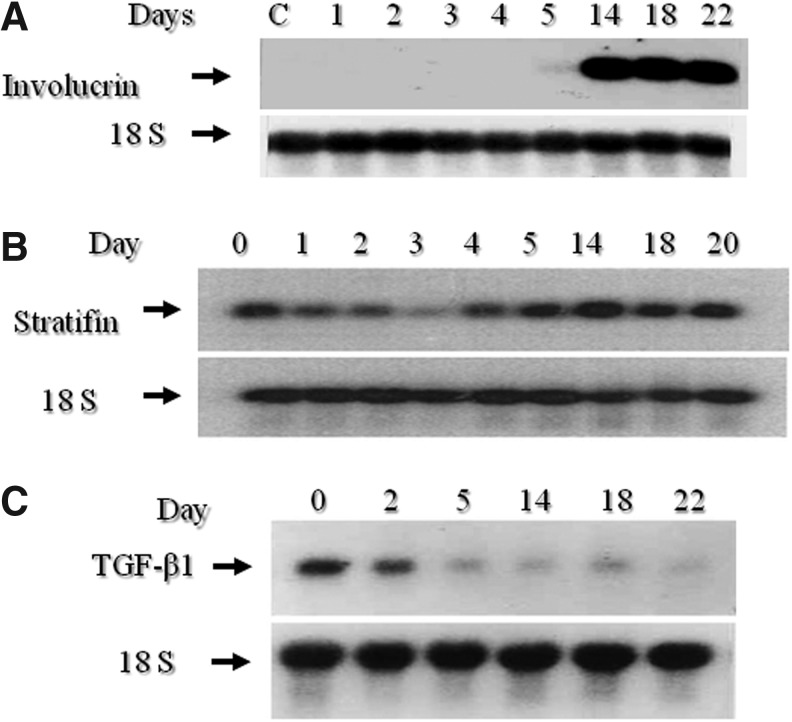
Differentiation of keratinocytes is associated with an increase in the mRNA expression of stratifin while decreasing the expression TGF-β1 mRNA. Keratinocytes were cultured in test medium consisting of 49% keratinocytes serum free medium, 49% Dulbecco's modified Eagle's medium, and 2% fetal bovine serum for different durations. Keratinocytes were then harvested and evaluated for the mRNA expression for (A) involucrin as an index for keratinocyte differentiation, (B) stratifin, and (C) TGF-β1. Each blot was then evaluated for the expression of 18S RNA, which was used as a loading control.

References

    1. Guo S. Dipietro LA. Factors affecting wound healing. J Dent Res. 2010;89:219. - PMC - PubMed
    1. Murphy JE. Robert C. Kupper TS. Interleukin-1 and cutaneous inflammation: a crucial link between innate and acquired immunity. J Invest Dermatol. 2000;114:602. - PubMed
    1. Richardson M. Acute wounds: an overview of the physiological healing process. Nurs Times. 2004;100:50. - PubMed
    1. Zaja-Milatovic S. Richmond A. CXC chemokines and their receptors: a case for a significant biological role in cutaneous wound healing. Histol Histopathol. 2008;23:1399. - PMC - PubMed
    1. Behm B. Babilas P. Landthaler M. Schreml S. Cytokines, chemokines and growth factors in wound healing. J Eur Acad Dermatol Venereol. 2012;26:812. - PubMed