


Tea consumption and prostate cancer: an updated meta-analysis
- PMID: 24528523
- PMCID: PMC3925323
- DOI: 10.1186/1477-7819-12-38
Tea consumption and prostate cancer: an updated meta-analysis
Abstract
Objectives: Tea is supposed to have chemopreventive effect against various cancers. However, the protective role of tea in prostate cancer is still controversial. The aim of this study is to elucidate the association between tea consumption and prostate cancer risk by meta-analysis.
Methods: A total of 21 published articles were retrieved via both computerized searches and review of references. Estimates of OR/RR for highest versus non/lowest tea consumption levels were pooled on the basis of random effect model or fixed effect model as appropriate. Stratified analyses on tea type, population and study design were also conducted.
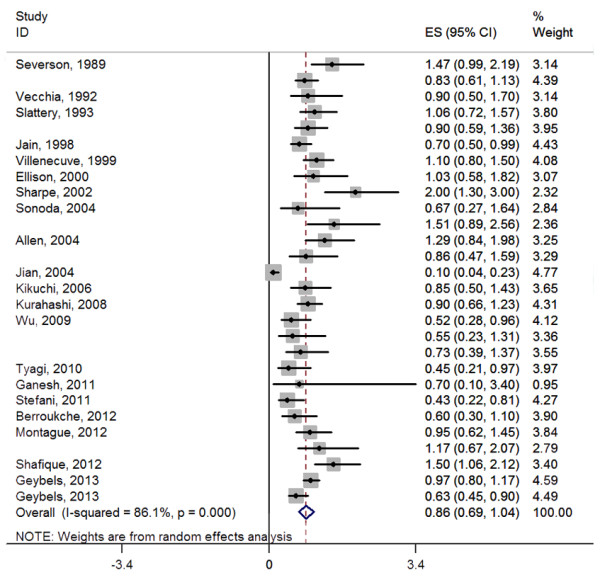
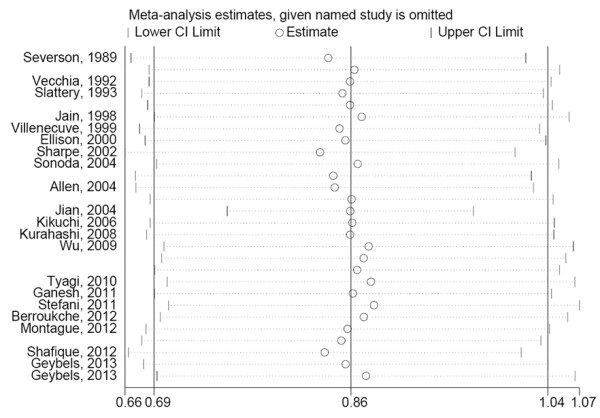
Results: No statistical significance was detected between tea consumption and prostate cancer risk in meta-analysis of all included studies (odds ratio (OR) = 0.86, 95% CI (0.69-1.04)). Furthermore, stratified analyses on population (Asian, OR = 0.81, 95% CI (0.55-1.08); non-Asian, OR = 0.89, 95% CI (0.72-1.07)) and tea type (green tea, OR = 0.79, 95% CI (0.43-1.14); black tea, OR = 0.88, 95% CI (0.73-1.02)) also yielded non-significant association. Only the case-control study subgroup demonstrated a borderline protective effect for tea consumption against prostate cancer (OR = 0.77, 95% CI (0.55-0.98)).
Conclusion: Our analyses did not support the conclusion that tea consumption could reduce prostate cancer risk. Further epidemiology studies are needed.
Figures
References
Publication types
MeSH terms
Substances
LinkOut - more resources
Full Text Sources
Other Literature Sources
Medical
