Review
. 2014 Feb 14:13:44.
doi: 10.1186/1475-2840-13-44.

Cardiovascular microRNAs: as modulators and diagnostic biomarkers of diabetic heart disease

Affiliations
Review

Cardiovascular microRNAs: as modulators and diagnostic biomarkers of diabetic heart disease

Shruti Rawal et al. Cardiovasc Diabetol. .

Abstract

Diabetic heart disease (DHD) is the leading cause of morbidity and mortality among the people with diabetes, with approximately 80% of the deaths in diabetics are due to cardiovascular complications. Importantly, heart disease in the diabetics develop at a much earlier stage, although remaining asymptomatic till the later stage of the disease, thereby restricting its early detection and active therapeutic management. Thus, a better understanding of the modulators involved in the pathophysiology of DHD is necessary for the early diagnosis and development of novel therapeutic implications for diabetes-associated cardiovascular complications. microRNAs (miRs) have recently been evolved as key players in the various cardiovascular events through the regulation of cardiac gene expression. Besides their credible involvement in controlling the cellular processes, they are also released in to the circulation in disease states where they serve as potential diagnostic biomarkers for cardiovascular disease. However, their potential role in DHD as modulators as well as diagnostic biomarkers is largely unexplored. In this review, we describe the putative mechanisms of the selected cardiovascular miRs in relation to cardiovascular diseases and discuss their possible involvement in the pathophysiology and early diagnosis of DHD.


Figures
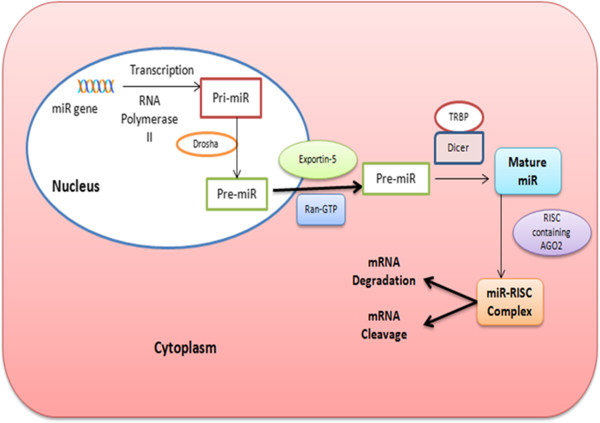
Figure 1
Figure 1
miR biogenesis and mRNA silencing mechanisms.
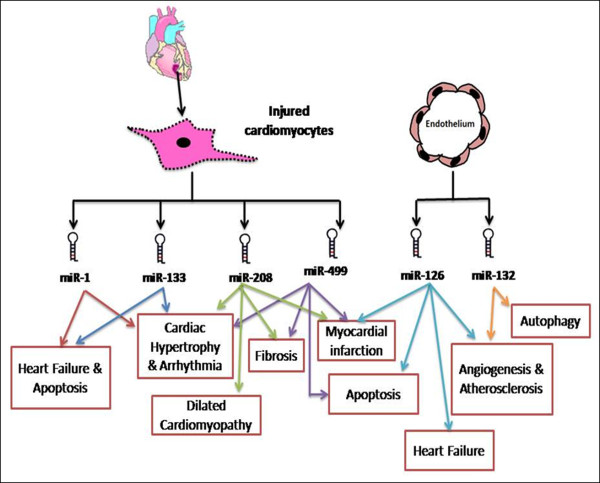
Figure 2
Figure 2
Pathological roles of cardiovascular miRs in heart diseases.
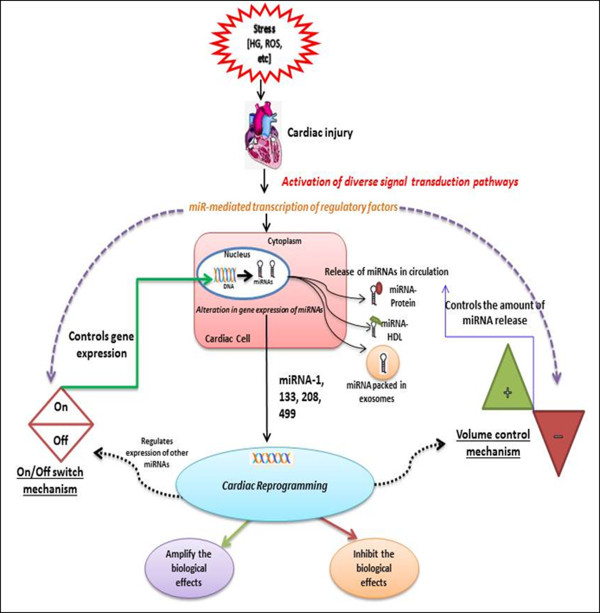
Figure 3
Figure 3
Proposed mechanism of modulated expression and release of cardiovascular miRs under pathophysiological conditions.
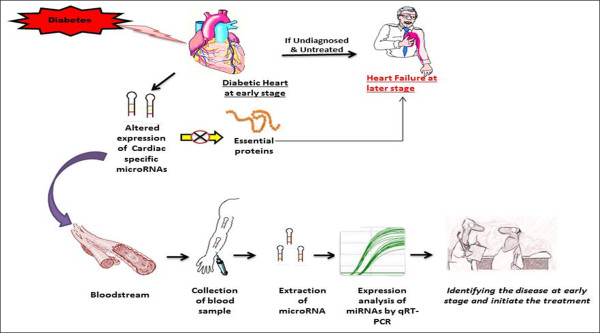
Figure 4
Figure 4
Supporting the hypothesis that miRs could be a potential diagnostic biomarker for early diagnosis of diabetic heart disease. Heart disease in diabetes develops at a much earlier stage before it is clinically diagnosed and if undiagnosed and untreated, it may lead to HF at later stage. Diabetes is associated with marked molecular changes in the heart produced by miRs. These molecular changes occur before any structural and functional alteration in diabetic heart. Altered expression of miRs in diabetic heart inhibits the synthesis of essential proteins required for the normal cardiac physiology. Parallel to this, these cardiovascular miRs are also released into the bloodstream, where they can be easily detected as biomarkers for DHD.

References

    1. Whiting DR, Guariguata L, Weil C, Shaw J. IDF diabetes atlas: global estimates of the prevalence of diabetes for 2011 and 2030. Diab Res Clin Prac. 2011;94:311–321. doi: 10.1016/j.diabres.2011.10.029. - DOI - PubMed
    1. Hayat SA, Patel B, Khattar RS, Malik RA. Diabetic cardiomyopathy: mechanisms, diagnosis and treatment. Clin Sci. 2004;107:539–557. doi: 10.1042/CS20040057. - DOI - PubMed
    1. Bartel DP. MicroRNAs: genomics, biogenesis, mechanism, and function. Cell. 2004;116:281–297. doi: 10.1016/S0092-8674(04)00045-5. - DOI - PubMed
    1. Kim DH, Saetrom P, Snove O Jr, Rossi JJ. MicroRNA-directed transcriptional gene silencing in mammalian cells. Proc Natl Acad Sci U S A. 2008;105:16230–16235. doi: 10.1073/pnas.0808830105. - DOI - PMC - PubMed
    1. Lee RC, Feinbaum RL, Ambros V. The C. elegans heterochronic gene lin-4 encodes small RNAs with antisense complementarity to lin-14. Cell. 1993;75:843–854. doi: 10.1016/0092-8674(93)90529-Y. - DOI - PubMed

Publication types