


Review
doi: 10.1016/j.chom.2014.01.004.
Innate resistance against Toxoplasma gondii: an evolutionary tale of mice, cats, and men
Affiliations
- PMID: 24528860
- PMCID: PMC4006104
- DOI: 10.1016/j.chom.2014.01.004
Item in Clipboard
Review
Innate resistance against Toxoplasma gondii: an evolutionary tale of mice, cats, and men
Cell Host Microbe.
.
Abstract
Recent studies have revealed remarkable species specificity of the Toll-like receptors (TLRs) TLR11 and TLR12 and the immunity-related GTPase (IRG) proteins that are essential elements for detection and immune control of Toxoplasma gondii in mice, but not in humans. The biological and evolutionary implications of these findings for the T. gondii host-pathogen relationship and for human disease are discussed.
Copyright © 2014 Elsevier Inc. All rights reserved.
Figures
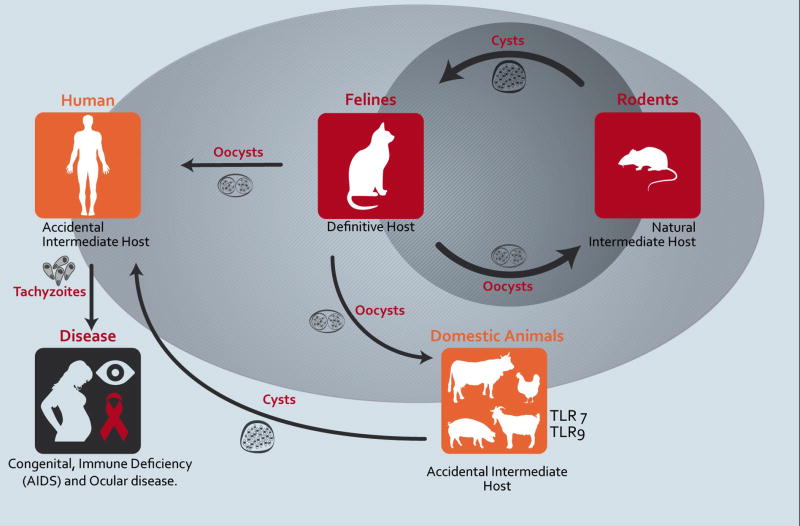
Felines and rodents are the definitive and natural intermediate hosts for T. gondii, respectively. After sexual reproduction in intestinal epithelial cells, the oocysts are formed and shed to the environment in cat feces. Once in the environment the oocysts sporulate and become highly infective to a wide variety of vertebrates, including rodents and accidental intermediate hosts such as humans. The parasite life cycle is completed, when the cat eats its prey, most often small rodents, and become infected by ingestion of the dormant Toxoplasma cysts. While most infections are asymptomatic, toxoplasma infection is a threat when congenitally transmitted to the fetus in immunologically naïve pregnant women or in immunocompromised individuals.
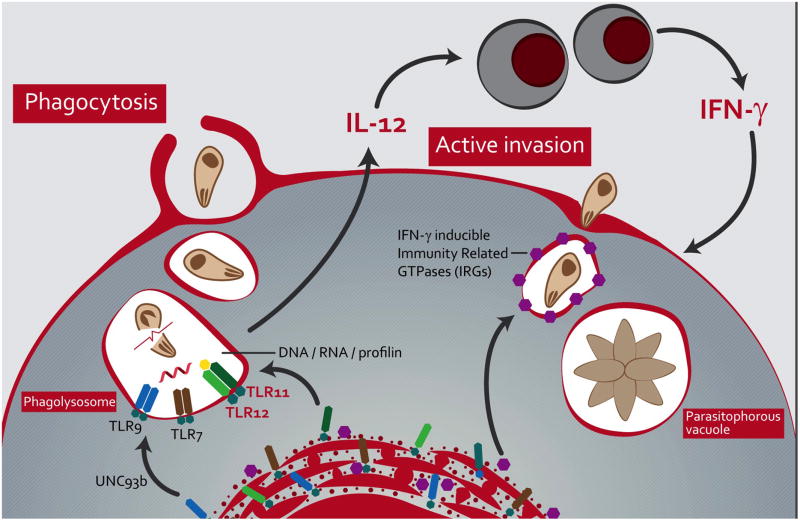
Uptake of parasite debris or alternatively, destruction of engulfed tachyzoites leads to activation of TLR7, TLR9 as well as TLR11/TLR12 heterodimers by Toxoplasma RNA, DNA and profilin (PRF) released in phagolysosomes. The activation of these innate immune receptors, and in particular TLR11 and TLR12, induces the production of IL-12 by dendritic cells and consequent induction of IFNγ by NK cells and T lymphocytes. IFNγ then leads to expression of IRG proteins that are recruited to the parasitophorous vacuole and destroy T. gondii tachyzoites that have actively invaded the host cells.
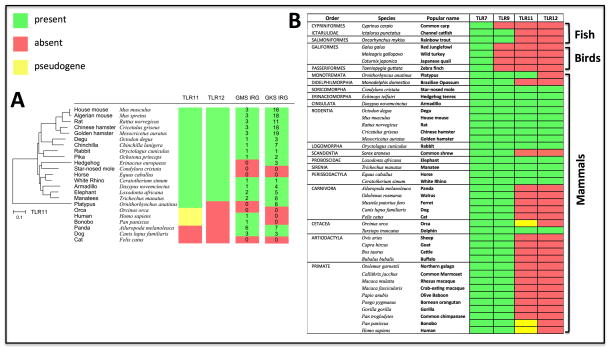
(A) Phylogenetic tree of TLR11 and overlapping expression of TLR12 as well as IRG GMS and IRG GKS gene families. (B) Ubiquitous versus confined distribution of TLR7/TLR9 and TLR11/TLR12 genes in vertebrate genomes, respectively. TLRs 7, 9, 11 and 12 coding sequences were downloaded from Genbank from species that have complete genome sequences. Retrieved sequences from mammals, fishes and birds were analyzed by ORFfinder (http://www.ncbi.nlm.nih.gov/gorf/gorf.html ) to identify pseudogenes by looking for frameshifts or premature stop codons. Multiple and global sequence alignments for each TLR were performed by Muscle. Neighbor-joining trees were designed by MEGA 5.2.2 from Muscle alignments.
References
-
- Andrade WA, do Souza MC, Ramos-Martinez E, Nagpal K, Dutra MS, Melo MB, Bartholomeu DC, Ghosh S, Golenbock DT, Gazzinelli RT. Combined action of nucleic acid-sensing Toll-like receptors and TLR11/TLR12 heterodimers imparts resistance to Toxoplasma gondii in mice. Cell Host Microbe. 2013;13:42–53. - PMC - PubMed
-
- Bela SR, Dutra MS, Mui E, Montpetit A, Oliveira FS, Oliveira SC, Arantes RM, Antonelli LR, McLeod R, Gazzinelli RT. Impaired innate immunity in mice deficient in interleukin-1 receptor-associated kinase 4 leads to defective type 1 T cell responses, B cell expansion, and enhanced susceptibility to infection with Toxoplasma gondii. Infect Immun. 2012;80:4298–4308. - PMC - PubMed
-
- Elmore SA, Jones JL, Conrad PA, Patton S, Lindsay DS, Dubey JP. Toxoplasma gondii: epidemiology, feline clinical aspects, and prevention. Trends Parasitol. 2010;26:190–196. - PubMed
Publication types
MeSH terms
Substances
Grants and funding
LinkOut - more resources
Full Text Sources
Other Literature Sources
Medical
Miscellaneous
