


A primary-school-based study to reduce the prevalence of childhood obesity--the EdAl (Educació en Alimentació) study: a randomized controlled trial
- PMID: 24529258
- PMCID: PMC3926975
- DOI: 10.1186/1745-6215-15-58
A primary-school-based study to reduce the prevalence of childhood obesity--the EdAl (Educació en Alimentació) study: a randomized controlled trial
Abstract
Background: Obesity is one of the main determinants of avoidable disease burden.To implement a program by university students acting as "health promoting agents" (HPAs) and to evaluate the effects on obesity prevalence of the primary-school-based program that promotes healthy lifestyle, including dietary and physical activity recommendations over 28 months.
Methods: Two school clusters were randomly assigned to intervention (24 schools, 1,222 pupils) or control (14 schools, 717 pupils); 78% of pupils were Western European. Mean age (±SD) was 8.4±0.6 years (49.9% females) at baseline. Generalized linear mixed models were used to analyze differences in primary outcome between both groups. Data collected included body mass index (BMI) every year. Dietary habits and lifestyle questionnaires were filled in by the parents at baseline and at the end of the study. The interventions focused on eight lifestyle topics covered in 12 activities (1 hour/activity/session) implemented by HPAs over 3 school academic years.
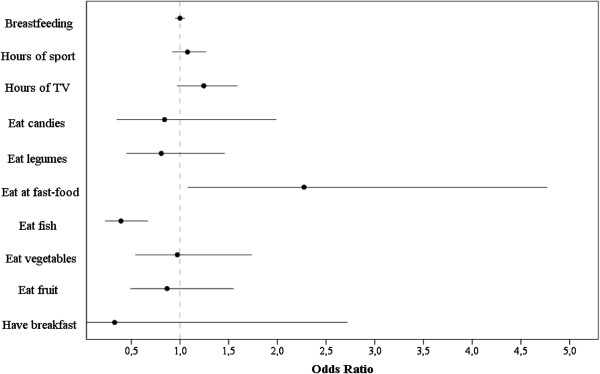
Results: At 28 months, obesity prevalence in boys was decreased -2.36% in the intervention group (from 9.59% to 7.23%) and increased 2.03% (from 7.40% to 9.43%) in the control group; the difference was 4.39% (95% CI 3.48 to 5.30; P=0.01). The boys in the intervention group had an effective reduction of -0.24 units in the change of BMI z-score (from 0.01 to -0.04), compared to control (from -0.10 to 0.09); 5.1% more intervention pupils undertook physical activity>5 hours/week than control pupils (P=0.02).Fish consumption was a protector (odds ratio 0.39; 95% CI 0.23 to 0.67) while "fast-food" consumption was a risk factor for childhood obesity (odds ratio: 2.27; 95% CI 1.08 to 4.77).
Conclusions: Our school-based program, conducted by HPA students, successfully reduced childhood obesity prevalence in boys.
Trial registration: International Standard Randomized Controlled Trial Number: ISRCTN29247645.
Figures

References
Publication types
MeSH terms
Associated data
LinkOut - more resources
Full Text Sources
Other Literature Sources
Medical
Research Materials
