


Recovery time, quality of life, and mortality in hemodialysis patients: the Dialysis Outcomes and Practice Patterns Study (DOPPS)
- PMID: 24529994
- PMCID: PMC4069238
- DOI: 10.1053/j.ajkd.2014.01.014
Recovery time, quality of life, and mortality in hemodialysis patients: the Dialysis Outcomes and Practice Patterns Study (DOPPS)
Abstract
Background: There is limited information about the clinical and prognostic significance of patient-reported recovery time.
Study design: Prospective cohort study.
Setting & participants: 6,040 patients in the DOPPS (Dialysis Outcomes and Practice Patterns Study).
Predictor: Answer to question "How long does it take you to recover from a dialysis session?" categorized as follows: fewer than 2, 2-6, 7-12, or longer than 12 hours.
Outcomes & measurements: Cross-sectional and longitudinal associations between recovery time and patient characteristics, hemodialysis treatment variables, health-related quality of life (HRQoL), and hospitalization and mortality.
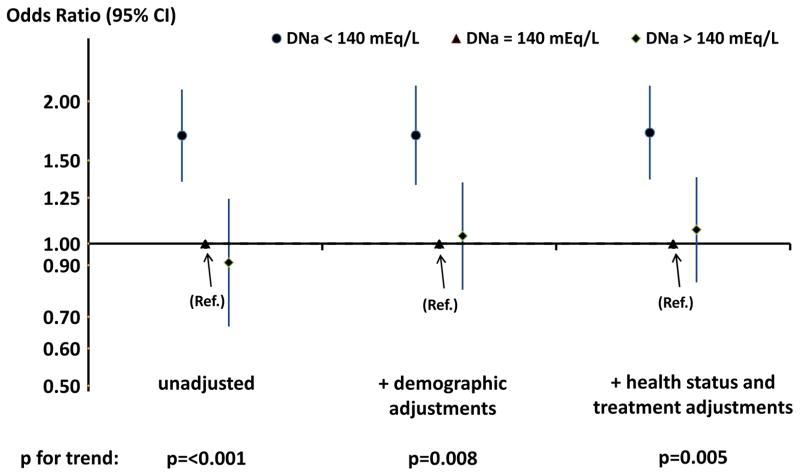
Results: 32% reported recovery time shorter than 2 hours; 41%, 2-6 hours; 17%, 7-12 hours; and 10%, longer than 12 hours. Using proportional odds (ordinal) logistic regression, shorter recovery time was associated with male sex, full-time employment, and higher serum albumin level. Longer recovery time was associated with older age, dialysis vintage, body mass index, diabetes, and psychiatric disorder. Greater intradialytic weight loss, longer dialysis session length, and lower dialysate sodium concentration were associated with longer recovery time. In facilities that used uniform dialysate sodium concentrations for ≥90% of patients, the adjusted OR of longer recovery time, comparing dialysate sodium concentration<140 vs 140 mEq/L, was 1.72 (95% CI, 1.37-2.16). Recovery time was correlated positively with symptoms of kidney failure and kidney disease burden score and inversely with HRQoL mental and physical component summary scores. Using Cox regression, adjusting for potential confounders not influenced by recovery time, it was associated positively with first hospitalization and mortality (adjusted HRs for recovery time>12 vs 2-6 hours 1.22 [95% CI, 1.09-1.37] and 1.47 [95% CI, 1.19-1.83], respectively).
Limitations: Answers are subjective and not supported by physiologic measurements.
Conclusions: Recovery time can be used to identify patients with poorer HRQoL and higher risks of hospitalization and mortality. Interventions to reduce recovery time and possibly improve clinical outcomes, such as increasing dialysate sodium concentration, need to be tested in randomized trials.
Keywords: DOPPS (Dialysis Outcomes and Practice Patterns Study); Hemodialysis; patient-reported outcomes; quality of life.
Copyright © 2014 National Kidney Foundation, Inc. Published by Elsevier Inc. All rights reserved.
Figures
Comment in
-
Dialysis recovery time: more than just another serum albumin.Am J Kidney Dis. 2014 Jul;64(1):7-9. doi: 10.1053/j.ajkd.2014.04.008. Am J Kidney Dis. 2014. PMID: 24954453 No abstract available.
References
-
- Fukuhara S, Lopes AA, Bragg-Gresham JL, et al. Worldwide Dialysis Outcomes and Practice Patterns Study. Health-related quality of life among dialysis patients on three continents: the Dialysis Outcomes and Practice Patterns Study. Kidney Int. 2003 Nov;64(5):1903–10. - PubMed
-
- Mapes DL, Lopes AA, Satayathum S, et al. Health-related quality of life as a predictor of mortality and hospitalization: The Dialysis Outcomes and Practice Patterns Study (DOPPS) Kidney Int. 2003;64:339–349. - PubMed
-
- Lindsay RM, Heidenheim PA, Nesrallah G, Garg AX, Suri R. Minutes to Recovery after a Hemodialysis Session: A Simple Health-Related Quality of Life Question That Is Reliable, Valid, and Sensitive to change. Clin J Am Soc Nephrol. 2006;1(5):952–959. - PubMed
-
- Pisoni RL, Gillespie BW, Dickinson DM, Chen K, Kutner MH, Wolfe RA. The Dialysis Outcomes and Practice Patterns Study (DOPPS): design, data elements, and methodology. Am J Kidney Dis. 2004;44:7–15. - PubMed
-
- Young EW, Goodkin DA, Mapes DL, et al. The Dialysis Outcomes and Practice Patterns Study (DOPPS): an international hemodialysis study. Kidney Int. 2000;57:S74–S81. - PubMed
Publication types
MeSH terms
Grants and funding
LinkOut - more resources
Full Text Sources
Other Literature Sources
Medical
