


Exome-wide association study identifies a TM6SF2 variant that confers susceptibility to nonalcoholic fatty liver disease
- PMID: 24531328
- PMCID: PMC3969786
- DOI: 10.1038/ng.2901
Exome-wide association study identifies a TM6SF2 variant that confers susceptibility to nonalcoholic fatty liver disease
Abstract
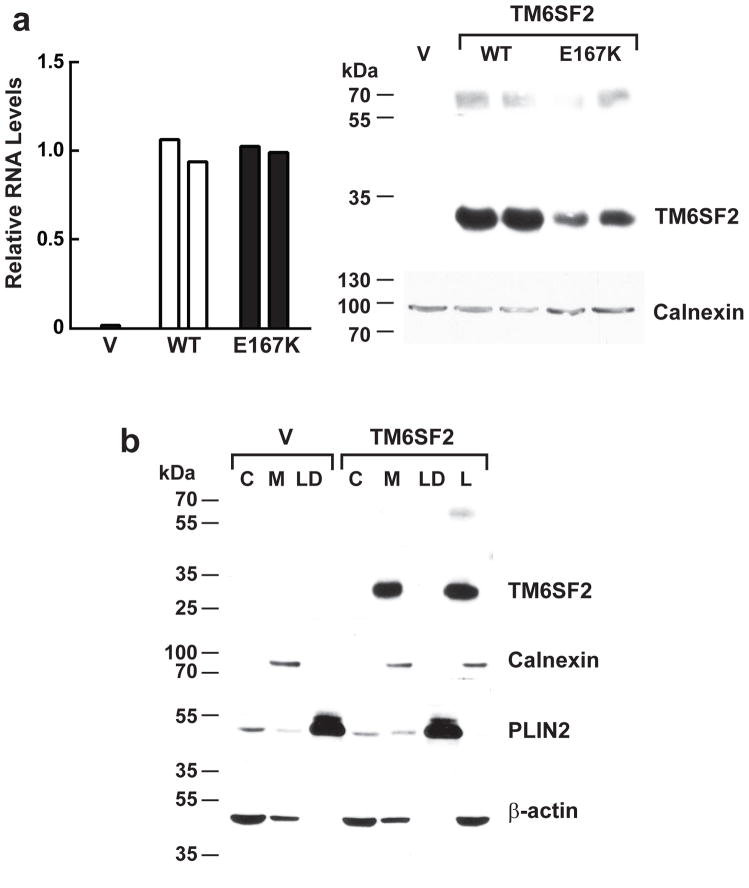
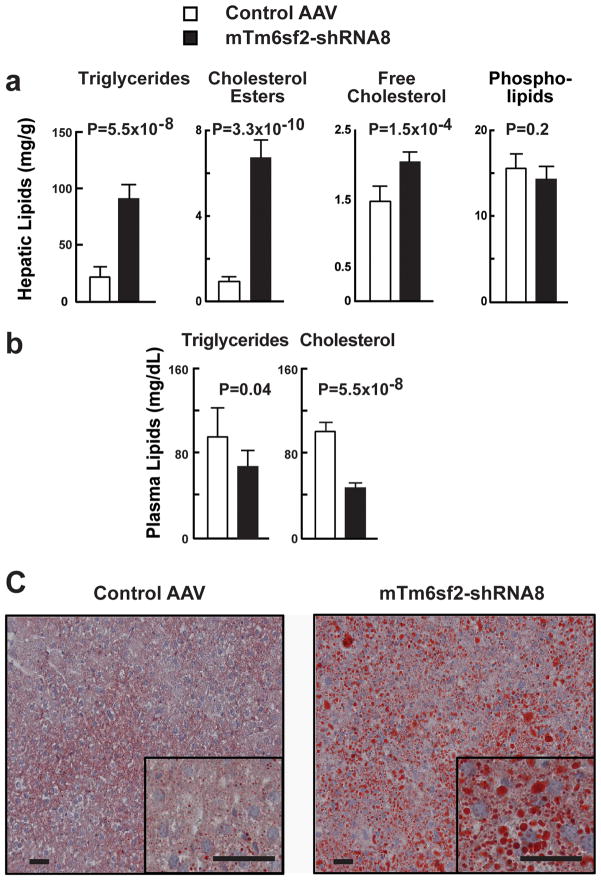
Nonalcoholic fatty liver disease (NAFLD) is the most common form of liver disease. To elucidate the molecular basis of NAFLD, we performed an exome-wide association study of liver fat content. Three variants were associated with higher liver fat levels at the exome-wide significance level of 3.6 × 10(-7): two in PNPLA3, an established locus for NAFLD, and one (encoding p.Glu167Lys) in TM6SF2, a gene of unknown function. The TM6SF2 variant encoding p.Glu167Lys was also associated with higher circulating levels of alanine transaminase, a marker of liver injury, and with lower levels of low-density lipoprotein-cholesterol (LDL-C), triglycerides and alkaline phosphatase in 3 independent populations (n > 80,000). When recombinant protein was expressed in cultured hepatocytes, 50% less Glu167Lys TM6SF2 protein was produced relative to wild-type TM6SF2. Adeno-associated virus-mediated short hairpin RNA knockdown of Tm6sf2 in mice increased liver triglyceride content by threefold and decreased very-low-density lipoprotein (VLDL) secretion by 50%. Taken together, these data indicate that TM6SF2 activity is required for normal VLDL secretion and that impaired TM6SF2 function causally contributes to NAFLD.
Conflict of interest statement
The authors do not have any competing financial interests.
Figures


References
-
- Tiniakos DG, Vos MB, Brunt EM. Nonalcoholic fatty liver disease: pathology and pathogenesis. Annu Rev Pathol. 2010;5:145–71. - PubMed
-
- Browning JD, et al. Prevalence of hepatic steatosis in an urban population in the United States: impact of ethnicity. Hepatology. 2004;40:1387–95. - PubMed
-
- McCullough AJ. The clinical features, diagnosis and natural history of nonalcoholic fatty liver disease. Clin Liver Dis. 2004;8:521–33. viii. - PubMed
Publication types
MeSH terms
Substances
Grants and funding
LinkOut - more resources
Full Text Sources
Other Literature Sources
Medical
Molecular Biology Databases
