


Mechano-signaling in heart failure
- PMID: 24531746
- PMCID: PMC4033803
- DOI: 10.1007/s00424-014-1468-4
Mechano-signaling in heart failure
Erratum in
- Pflugers Arch. 2014 Sep;466(9):1845
Abstract
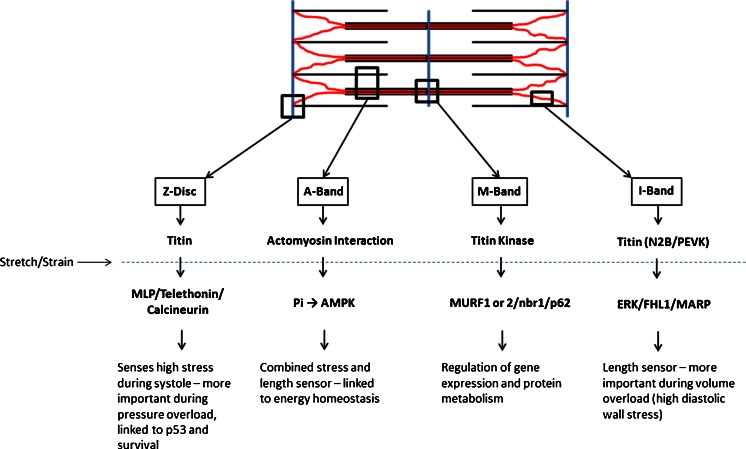
Mechanosensation and mechanotransduction are fundamental aspects of biology, but the link between physical stimuli and biological responses remains not well understood. The perception of mechanical stimuli, their conversion into biochemical signals, and the transmission of these signals are particularly important for dynamic organs such as the heart. Various concepts have been introduced to explain mechanosensation at the molecular level, including effects on signalosomes, tensegrity, or direct activation (or inactivation) of enzymes. Striated muscles, including cardiac myocytes, differ from other cells in that they contain sarcomeres which are essential for the generation of forces and which play additional roles in mechanosensation. The majority of cardiomyopathy causing candidate genes encode structural proteins among which titin probably is the most important one. Due to its elastic elements, titin is a length sensor and also plays a role as a tension sensor (i.e., stress sensation). The recent discovery of titin mutations being a major cause of dilated cardiomyopathy (DCM) also underpins the importance of mechanosensation and mechanotransduction in the pathogenesis of heart failure. Here, we focus on sarcomere-related mechanisms, discuss recent findings, and provide a link to cardiomyopathy and associated heart failure.
Figures
References
-
- Beyder A, Strege PR, Reyes S, Bernard CE, Terzic A, Makielski J, Ackerman MJ, Farrugia G. Ranolazine decreases mechanosensitivity of the voltage-gated sodium ion channel Na(v)1.5: a novel mechanism of drug action. Circulation. 2012;125(22):2698–2706. doi: 10.1161/CIRCULATIONAHA.112.094714. - DOI - PMC - PubMed
-
- Blair E, Redwood C, Ashrafian H, Oliveira M, Broxholme J, Kerr B, Salmon A, Ostman-Smith I, Watkins H. Mutations in the gamma(2) subunit of AMP-activated protein kinase cause familial hypertrophic cardiomyopathy: evidence for the central role of energy compromise in disease pathogenesis. Hum Mol Genet. 2001;10(11):1215–1220. doi: 10.1093/hmg/10.11.1215. - DOI - PubMed
-
- Bos JM, Poley RN, Ny M, Tester DJ, Xu X, Vatta M, Towbin JA, Gersh BJ, Ommen SR, Ackerman MJ. Genotype-phenotype relationships involving hypertrophic cardiomyopathy-associated mutations in titin, muscle LIM protein, and telethonin. Mol Genet Metab. 2006;88(1):78–85. doi: 10.1016/j.ymgme.2005.10.008. - DOI - PMC - PubMed
Publication types
MeSH terms
Substances
LinkOut - more resources
Full Text Sources
Other Literature Sources
Medical
