. 2014 Apr 1;306(7):H1011-7.
doi: 10.1152/ajpheart.00829.2013. Epub 2014 Feb 14.

Albumin modulates S1P delivery from red blood cells in perfused microvessels: mechanism of the protein effect

Affiliations

Albumin modulates S1P delivery from red blood cells in perfused microvessels: mechanism of the protein effect

R H Adamson et al. Am J Physiol Heart Circ Physiol. .

Erratum in

  • Am J Physiol Heart Circ Physiol. 2014 Jul 1;307(1):H120

Abstract

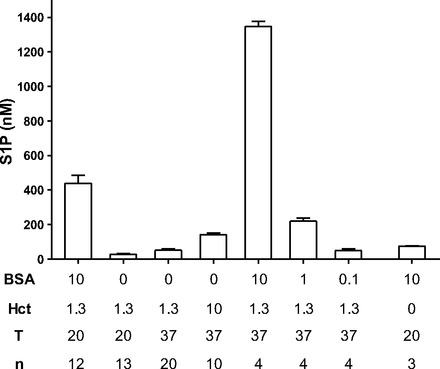
Removal of plasma proteins from perfusates increases vascular permeability. The common interpretation of the action of albumin is that it forms part of the permeability barrier by electrostatic binding to the endothelial glycocalyx. We tested the alternate hypothesis that removal of perfusate albumin in rat venular microvessels decreased the availability of sphingosine-1-phosphate (S1P), which is normally carried in plasma bound to albumin and lipoproteins and is required to maintain stable baseline endothelial barriers (Am J Physiol Heart Circ Physiol 303: H825-H834, 2012). Red blood cells (RBCs) are a primary source of S1P in the normal circulation. We compared apparent albumin permeability coefficients [solute permeability (Ps)] measured using perfusates containing albumin (10 mg/ml, control) and conditioned by 20-min exposure to rat RBCs with Ps when test perfusates were in RBC-conditioned protein-free Ringer solution. The control perfusate S1P concentration (439 ± 46 nM) was near the normal plasma value at 37 °C and established a stable baseline Ps (0.9 ± 0.4 × 10(-6) cm/s). Ringer solution perfusate contained 52 ± 8 nM S1P and increased Ps more than 10-fold (16.1 ± 3.9 × 10(-6) cm/s). Consistent with albumin-dependent transport of S1P from RBCs, S1P concentrations in RBC-conditioned solutions decreased as albumin concentration, hematocrit, and temperature decreased. Protein-free Ringer solution perfusates that used liposomes instead of RBCs as flow markers failed to maintain normal permeability, reproducing the "albumin effect" in these mammalian microvessels. We conclude that the albumin effect depends on the action of albumin to facilitate the release and transport of S1P from RBCs that normally provide a significant amount of S1P to the endothelium.

Keywords: albumin; endothelium; permeability; sphingosine-1-phosphate; vascular.


Figures
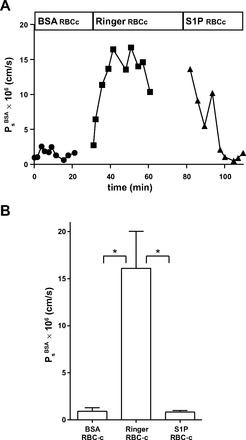
Fig. 1.
Fig. 1.
A: representative data showing that Ringer solution conditioned with red blood cells (RBCs) does not maintain normal permeability to albumin relative to BSA (10 mg/ml) containing solution conditioned by RBCs (RBCc; n = 9). In a subset of the experiments, we additionally perfused the vessel with sphingosine-1-phosphate (S1P; 1,000 nM) in Ringer solution, which returned solute permeability (Ps) values toward normal values (n = 6). Solutions were conditioned (20–22°C) with RBCs at a concentration typical of that used as flow markers in microperfusion experiments [hematocrit (Hct): 1.3% Hct]. Tracer BSA (Alexa fluor 555 labeled, concentration: 0.5–1 mg/ml) alone did not maintain low permeability. B: summary data from vessels as in A. *P < 0.05 (by Kruskal-Wallis test with Dunn's posttest).
Fig. 2.
Fig. 2.
S1P measured in RBC-conditioned solutions. BSA is shown in mg/ml, and Hct is %RBC by volume, T is temperature (in °C), and n is the number of independent measurements.
Fig. 3.
Fig. 3.
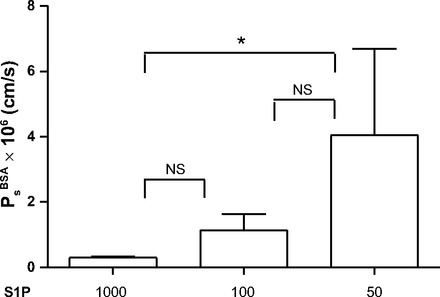
S1P added to Ringer solution perfusates maintains low permeability. Ps was measured with Ringer solution perfusates (no RBCs and not conditioned) with exogenous S1P added at the indicated concentrations to each vessel. Ps increased as S1P concentration decreased (n = 8). NS, not significant. *P < 0.05 (by Friedman test with Dunn's posttests).
Fig. 4.
Fig. 4.
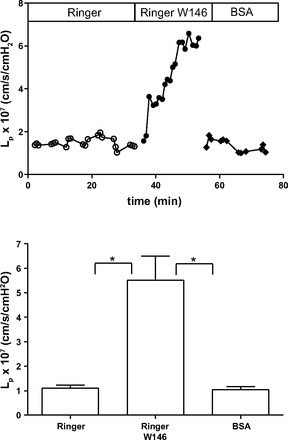
A: we measured hydraulic conductivity (Lp) to test for the “protein effect” by comparing Lp measured with BSA and that measured with protein-free Ringer solution. This representative experiment shows that Lp with Ringer solution was not different from that measured with BSA. The addition of W-146 to the Ringer solution/RBC perfusates caused an increase in Lp, demonstrating that RBCs are able to deliver S1P to the endothelium in the absence of BSA. All perfusates include RBCs as flow markers (Hct: 1.3%). B: summary data from experiments as in A (n = 12). *P < 0.05 (by Friedman test with Dunn's posttests).
Fig. 5.
Fig. 5.
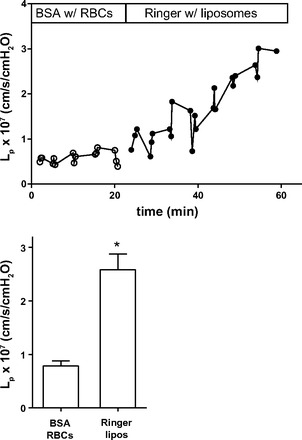
A: representative experiment showing that when liposomes were used as flow markers, the Lp measured with Ringer solution as the perfusate increased relative to Lp with BSA when RBCs were used as flow markers. B: summary of data from experiments conducted as in A (n = 9). *P < 0.05, different from control (by Wilcoxon test).

References

    1. Adamson RH, Clough G. Plasma proteins modify the endothelial cell glycocalyx of frog mesenteric microvessels. J Physiol 445: 473–486, 1992 - PMC - PubMed
    1. Adamson RH, Sarai RK, Clark JF, Altangerel A, Thirkill TL, Curry FE. Attenuation by sphingosine-1-phosphate of rat microvessel acute permeability response to bradykinin is rapidly reversible. Am J Physiol Heart Circ Physiol 302: H1929–H1935, 2012 - PMC - PubMed
    1. Adamson RH, Zeng M, Adamson GN, Lenz JF, Curry FE. PAF- and bradykinin-induced hyperpermeability of rat venules is independent of actin-myosin contraction. Am J Physiol Heart Circ Physiol 285: H406–H417, 2003 - PubMed
    1. Argraves KM, Gazzolo PJ, Groh EM, Wilkerson BA, Matsuura BS, Twal WO, Hammad SM, Argraves WS. High density lipoprotein-associated sphingosine 1-phosphate promotes endothelial barrier function. J Biol Chem 283: 25074–25081, 2008 - PMC - PubMed
    1. Arkill KP, Neal CR, Mantell JM, Michel CC, Qvortrup K, Rostgaard J, Bates DO, Knupp C, Squire JM. 3D reconstruction of the glycocalyx structure in mammalian capillaries using electron tomography. Microcirculation 19: 343–351, 2012 - PMC - PubMed

Publication types