


The effect of out of hours presentation with acute stroke on processes of care and outcomes: analysis of data from the Stroke Improvement National Audit Programme (SINAP)
- PMID: 24533063
- PMCID: PMC3922754
- DOI: 10.1371/journal.pone.0087946
The effect of out of hours presentation with acute stroke on processes of care and outcomes: analysis of data from the Stroke Improvement National Audit Programme (SINAP)
Abstract
Background: There is inconsistent evidence that patients with stroke admitted to hospital out of regular working hours (such as weekends) experience worse outcomes. We aimed to identify if inequalities in the quality of care and mortality exist in contemporary stroke care in England.
Methods: SINAP is a prospective database of acute stroke patients, documenting details of processes of care over the first 72 hours. We compared quality of care indicators and mortality at 72 hours, 7 days and 30 days, for patients who arrived within normal hours (Monday-Friday 8am to 6pm) and for those who arrived out of hours, using multivariable logistic and Cox proportional hazard models. Quality of care was defined according to time from arrival at hospital to interventions (e.g., brain scan), and whether the patient received therapeutic interventions (such as thrombolysis).
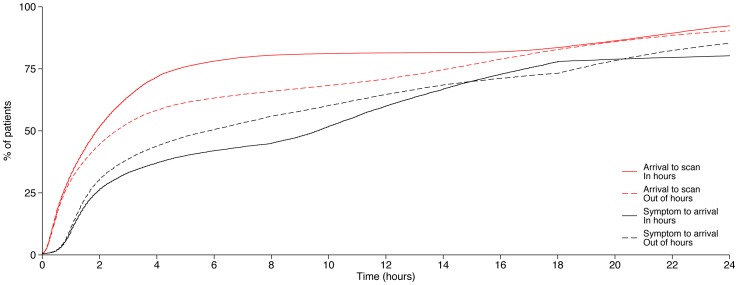
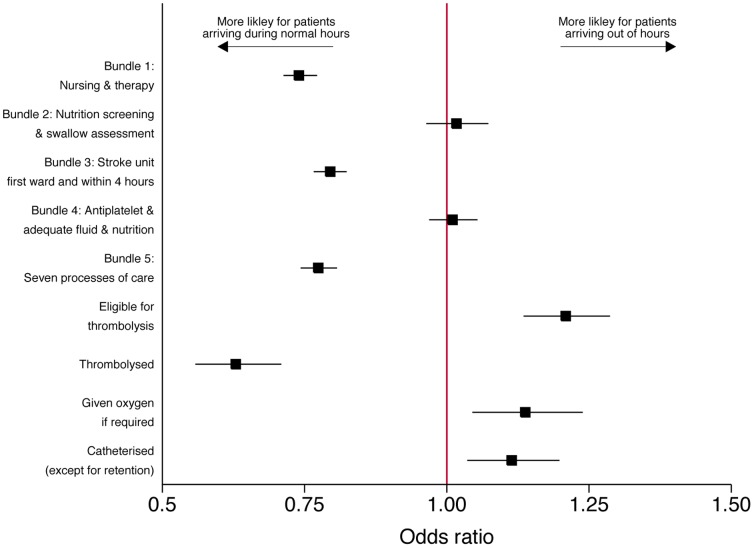
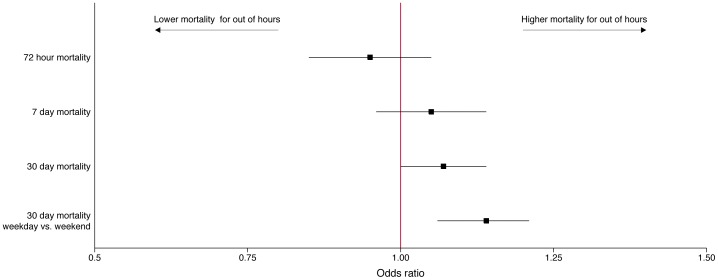
Results: 45,726 stroke patients were admitted to 130 hospitals in England between 1 April 2010 and 31 January 2012. Patients admitted out of hours (n = 23779) had more features indicative of worse prognosis (haemorrhagic stroke, reduced consciousness, pre stroke dependency). Out of hours admission was significantly associated with longer delays in receiving a CT scan or being admitted to a stroke unit, and reduced odds of receiving thrombolysis. After adjusting for casemix, there was no consistent evidence of higher mortality for patients admitted out of hours, but patients admitted at the weekends had a higher risk of 30 day mortality (OR 1.14, 95% CI 1.06-1.21).
Conclusion: Inequalities in the provision of stroke care for people admitted out of regular hours persist in contemporary stroke in England. The association with mortality is small and largely attributable to higher illness severity in patients admitted out of hours.
Conflict of interest statement
Figures
References
-
- Office for National Statistics (2011) Mortality statistics: Deaths registered in England and Wales.
-
- Adamson J, Beswick A, Ebrahim S (2004) Is stroke the most common cause of disability? J Stroke Cerebrovasc Dis 13: 171–7. - PubMed
-
- Stroke Unit Triallists Collaboration (2002) Organized inpatient (stroke unit)care for stroke. Cochrane Database Syst Rev;1:CD000197. - PubMed
-
- Wardlaw JM, Murray V, Berge E, Del Zoppo GJ (2009) Thrombolysis for acute ischemic stroke. Cochrane Database Syst Rev Oct 7;4:CD000213. - PubMed
Publication types
MeSH terms
Grants and funding
LinkOut - more resources
Full Text Sources
Other Literature Sources
Medical
Miscellaneous
