


doi: 10.1016/j.coche.2013.11.004.
Vascular Tissue Engineering: Building Perfusable Vasculature for Implantation
Affiliations
- PMID: 24533306
- PMCID: PMC3923579
- DOI: 10.1016/j.coche.2013.11.004
Item in Clipboard
Vascular Tissue Engineering: Building Perfusable Vasculature for Implantation
Curr Opin Chem Eng.
.
Abstract
Tissue and organ replacement is required when there are no alternative therapies available. Although vascular tissue engineering was originally developed to meet the clinical demands of small-diameter vascular conduits as bypass grafts, it has evolved into a highly advanced field where perfusable vasculatures are generated for implantation. Herein, we review several cutting-edge techniques that have led to implantable human blood vessels in clinical trials, the novel approaches that build complex perfusable microvascular networks in functional tissues, the use of stem cells to generate endothelial cells for vascularization, as well as the challenges in bringing vascular tissue engineering technologies into the clinics.
Figures
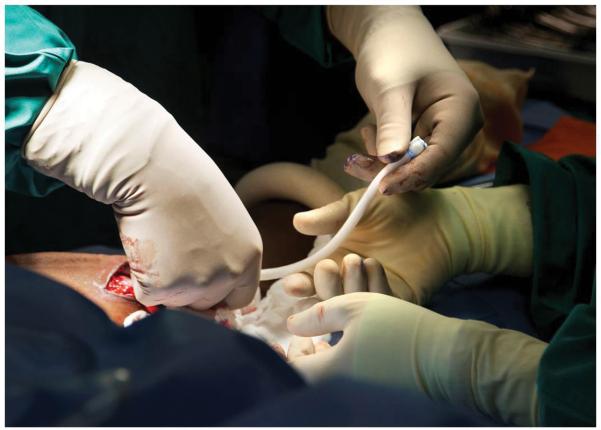
Implantation of an engineered human vascular graft into the arm of a patient as an AV shunt. Reproduced with the permission of Shawn Rocco, Duke Medicine.
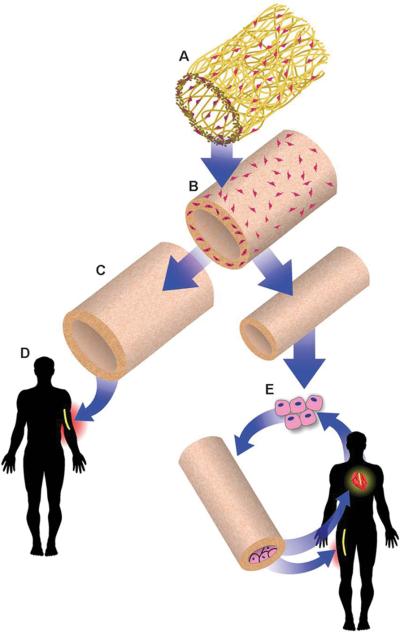
Human SMCs are cultured on the PGA scaffolds (A) to produce the vascular grafts (B), which are then decellularized (C) and stored until the time of patient need. The acellular human-based vascular grafts may be directly implanted without ECs if the diameters are greater than 6 mm (D), or may be seeded with ECs from the patient for small-diameter (3 to 4 mm) applications. From [12]. Reprinted with permission from AAAS.
References
-
- Cleary MA, Geiger E, Grady C, Best C, Naito Y, Breuer C. Vascular tissue engineering: the next generation. Trends Mol Med. 2012;18:394–404. [An overview of the current development in the generation of blood vessels, with focus on those used in the pulmonary system.] - PubMed
-
- Novosel EC, Kleinhans C, Kluger PJ. Vascularization is the key challenge in tissue engineering. Adv Drug Deliv Rev. 2011;63:300–311. - PubMed
-
- Auger FA, Gibot L, Lacroix D. The pivotal role of vascularization in tissue engineering. Annu Rev Biomed Eng. 2013;15:177–200. [A recent comprehensive review on the roles and approaches of vascularization for functional tissues/organs.] - PubMed
Grants and funding
LinkOut - more resources
Full Text Sources
Other Literature Sources