


Spatial, temporal, molecular, and intraspecific differences of haemoparasite infection and relevant selected physiological parameters of wild birds in Georgia, USA
- PMID: 24533333
- PMCID: PMC3862535
- DOI: 10.1016/j.ijppaw.2013.04.005
Spatial, temporal, molecular, and intraspecific differences of haemoparasite infection and relevant selected physiological parameters of wild birds in Georgia, USA
Abstract
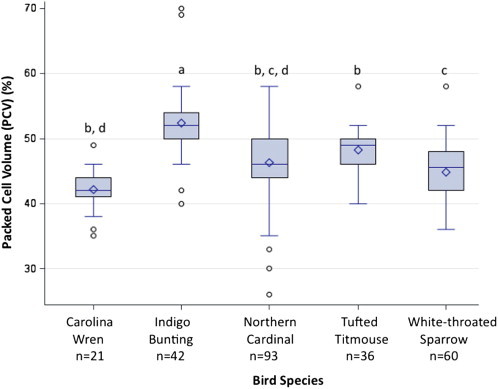
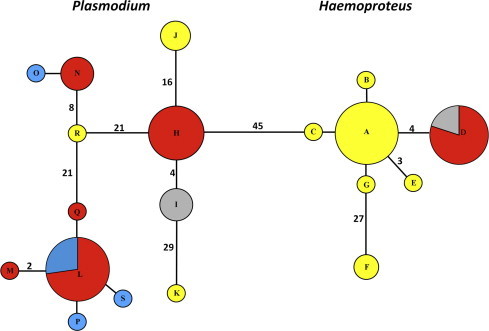
The prevalence of five avian haemoparasite groups was examined for effects on health and associations with extrinsic factors. Overall, 786 samples were examined from six sites in two Georgia (USA) watersheds, during breeding and non-breeding periods in 2010 and 2011. Among the four most commonly infected species, Haemoproteus prevalence was significantly higher in Northern Cardinals (Cardinalis cardinalis) compared to Indigo Buntings (Passerina cyanea) and Tufted Titmice (Baeolophus bicolor) while prevalence in White-throated Sparrows (Zonotrichia albicollis) was significantly higher than in Indigo Buntings. Higher prevalence of Plasmodium was noted in Tufted Titmice and Northern Cardinals. While Leucocytozoon prevalence was highest in White-throated Sparrows, Trypanosoma prevalence was highest in Tufted Titmice. Interesting differences in infection probabilities were noted between foraging guilds with Haemoproteus associated with low-middle level strata and birds in the middle-upper strata were more likely to be infected with Plasmodium and Trypanosoma. In contrast, ground-foraging birds were more likely to be infected with Leucocytozoon. Breeding season was correlated with higher polychromasia counts and higher prevalence of Haemoproteus, Plasmodium and Trypanosoma. In addition, prevalence of infection with certain haemoparasite genera and packed cell volume (PCV) were different among host species. Body mass index was inversely correlated with prevalence of microfilaria infection but positively related to Haemoproteus infection. However, we found no relationship between PCV or polychromasia levels with haemoparasite infection. Molecular characterization of 61 samples revealed 19 unique Haemoproteus (n = 7) and Plasmodium (n = 12) haplotypes with numerous new host records. No differences were noted in haplotype diversity among birds with different migratory behaviors or foraging heights, thus additional studies are needed that incorporate molecular analysis, host biology, and vector biology into comprehensive models on parasite ecology. Detailed morphological examination of these parasites is also necessary to determine if closely related haplotypes represent single species or morphologically distinct, but closely related, haplotypes.
Keywords: Blood parasite; Body mass index; Breeding season; Haemoparasite; Hematology; Prevalence; Wild bird.
Figures
References
-
- Allander K. Reproductive investment and parasite susceptibility in the Great Tit. Funct. Ecol. 1997;11:358–364.
-
- Alonso-Alvarez C., Velando A., Ferrer M., Veira J.A.R. Changes in plasma biochemistry and body mass during incubation in the yellow-legged gull. Waterbirds. 2002;25:253–258.
-
- Applegate J.E., Beaudoin R.L. Mechanism of spring relapse in avian malaria: effect of gonadotropin and corticosterone. J. Wildl. Dis. 1970;6:443–447. - PubMed
-
- Arriero E., Moreno J., Merino S., Martínez J. Habitat effects on physiological stress response in nestling Blue Tits are mediated through parasitism. Physiol. Biochem. Zool. 2008;81:195–203. - PubMed
LinkOut - more resources
Full Text Sources
Other Literature Sources
