


Factors influencing Dipylidium sp. infection in a free-ranging social carnivore, the spotted hyaena (Crocuta crocuta)
- PMID: 24533344
- PMCID: PMC3862517
- DOI: 10.1016/j.ijppaw.2013.09.003
Factors influencing Dipylidium sp. infection in a free-ranging social carnivore, the spotted hyaena (Crocuta crocuta)
Abstract
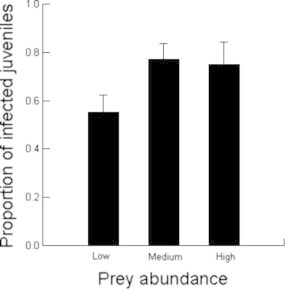
We provide the first genetic sequence data for a Dipylidium species from a wild carnivore plus an analysis of the effects of ecological, demographic, physiological and behavioural factors on Dipylidium sp. infection prevalence in a social carnivore, the spotted hyaena (Crocuta crocuta), in the Serengeti National Park, Tanzania. Our sequence data from a mitochondrial gene fragment (1176 base pair long) had a similarity of between 99% and 89% to Dipylidium caninum. We determined infection prevalence in 146 faecal samples from 124 known animals in three social groups (termed clans) using molecular screening and Dipylidium proglottid presence. Our analysis revealed significantly higher infection prevalence in juveniles (55%) than adults (15.8%), indicating that predominantly juveniles maintained infection in clans. The likelihood of infection in juveniles significantly: (1) increased as the number of adults and older juveniles (>6 months) at communal dens increased, implying a positive relationship between this factor and the size of the intermediate host (probably a flea species) population at communal dens; (2) decreased as the number of younger juveniles (<6 months) increased, suggesting that the chance of susceptible juveniles ingesting infected fleas during self-grooming declined as the number of infected fleas per younger juvenile declined; and (3) decreased during periods of low prey abundance in clan territories when an increased reliance on long-distances foraging excursions reduces the number of clan members visiting communal dens, possibly resulting in a decline in flea populations at dens. Long-distance foraging also increases the intervals (in days) between nursing visits by lactating females to their offspring. Lengthy intervals between milk intake by infected juveniles may reduce adult Dipylidium fecundity and hence decrease infection prevalence in the den flea population. Our study provides useful insights into Dipylidium epidemiology in a social carnivore population subject to large fluctuations in prey abundance.
Keywords: Dipylidium; Grooming; Molecular screening; Parasite infection; Serengeti; Spotted hyaena.
Figures
References
-
- Barutzki D., Schaper R. Endoparasites in dogs and cats in Germany 1999–2002. Parasitol. Res. 2003;90:148–150. - PubMed
-
- Benhaiem S., Dehnhard M., Bonanni R., Hofer H., Goymann W., Eulenberger K., East M.L. Validation of an enzyme immunoassay for the measurement of faecal glucocorticoid metabolites in spotted hyenas (Crocuta crocuta) Gen. Comp. Endocrinol. 2012;178:265–271. - PubMed
-
- Bitam I., Dittmar K., Parola P., Whiting M.F., Raoult D. Fleas and flea-borne diseases. Int. J. Infect. Dis. 2010;14:e667–e676. - PubMed
LinkOut - more resources
Full Text Sources
Other Literature Sources
