. 2014 May:141:160-70.
doi: 10.1016/j.jsbmb.2014.02.002. Epub 2014 Feb 14.

Bisphenol-A and diethylstilbestrol exposure induces the expression of breast cancer associated long noncoding RNA HOTAIR in vitro and in vivo

Affiliations

Bisphenol-A and diethylstilbestrol exposure induces the expression of breast cancer associated long noncoding RNA HOTAIR in vitro and in vivo

Arunoday Bhan et al. J Steroid Biochem Mol Biol. 2014 May.

Abstract

Antisense transcript, long non-coding RNA HOTAIR is a key player in gene silencing and breast cancer and is transcriptionally regulated by estradiol. Here, we have investigated if HOTAIR expression is misregulated by bisphenol-A (BPA) and diethylstilbestrol (DES). Our findings demonstrate BPA and DES induce HOTAIR expression in cultured human breast cancer cells (MCF7) as well as in vivo in the mammary glands of rat. Luciferase assay showed that HOTAIR promoter estrogen-response-elements (EREs) are induced by BPA and DES. Estrogen-receptors (ERs) and ER-coregulators such as MLL-histone methylases (MLL1 and MLL3) bind to the HOTAIR promoter EREs in the presence of BPA and DES, modify chromatin (histone methylation and acetylation) and lead to gene activation. Knockdown of ERs down-regulated the BPA and DES-induced expression of HOTAIR. In summary, our results demonstrate that BPA and DES exposure alters the epigenetic programming of the HOTAIR promoters leading to its endocrine disruption in vitro and in vivo.

Keywords: Bisphenol A; Diethylstilbestrol; Endocrine disruption; Epigenetics; HOTAIR; LncRNA; Transcriptional regulation.


Figures

Figure 1
Figure 1
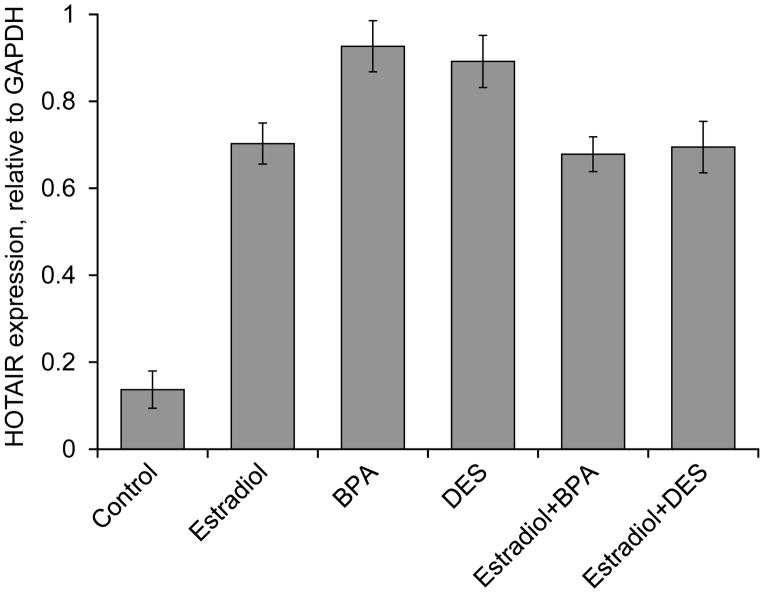
Effect of 17β-estradiol (estradiol), bisphenol-A (BPA) and diethylstilbestrol (DES) on HOTAIR gene expression in MCF7 cells. (A) MCF7 cells were grown in phenol red free DMEM-F-12 media and treated with 0.1 nM estradiol, 100 nM BPA and 10 nM DES separately and in combination of 0.1 nM estradiol + 100 nM BPA and 0.1 nM estradiol + 10 nM DES. RNA from the control and treated cells were analyzed by qPCR using primers specific to HOTAIR. GAPDH was used as the control. Bars indicate standard errors. Each experiment was repeated for thrice with three parallel replicates. P values < 0.05 were considered to be significant.
Figure 2
Figure 2
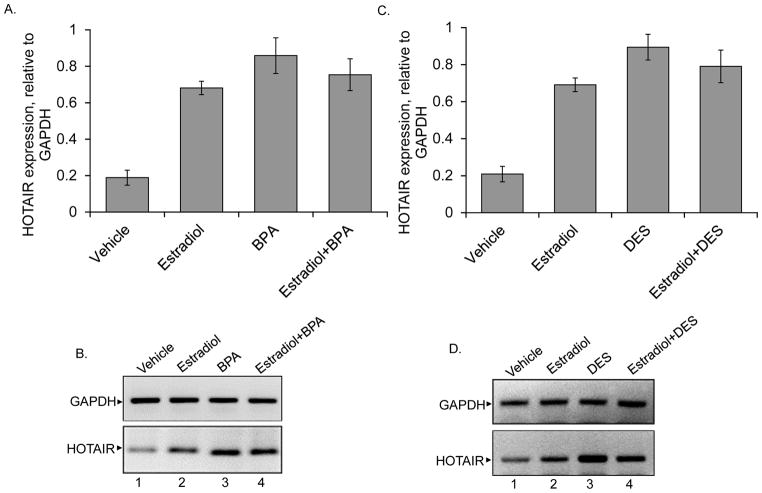
In vivo effect of estradiol, BPA and DES on HOTAIR expression. Ovariectomized adult female rats were administered with acute doses of estradiol (5 μg), BPA (25 μg/kg), and DES (5 μg/kg), for 24 h, either separately or in combination. RNA from the control, estradiol, BPA and estradiol/BPA treated mammary glands were analyzed by qPCR (panel A). The agarose gel analysis of the qPCR products is shown in panel B. GAPDH was used as a loading control. Panel C shows the effects of estradiol, DES and estradiol + DES on HOTAIR expression, analyzed via qPCR and agarose gene analysis of the qPCR products is shown in panel D. Each experiments were performed with three replicate (n = 3). Bars indicate standard errors. P values < 0.05 were considered to be significant.
Figure 3
Figure 3
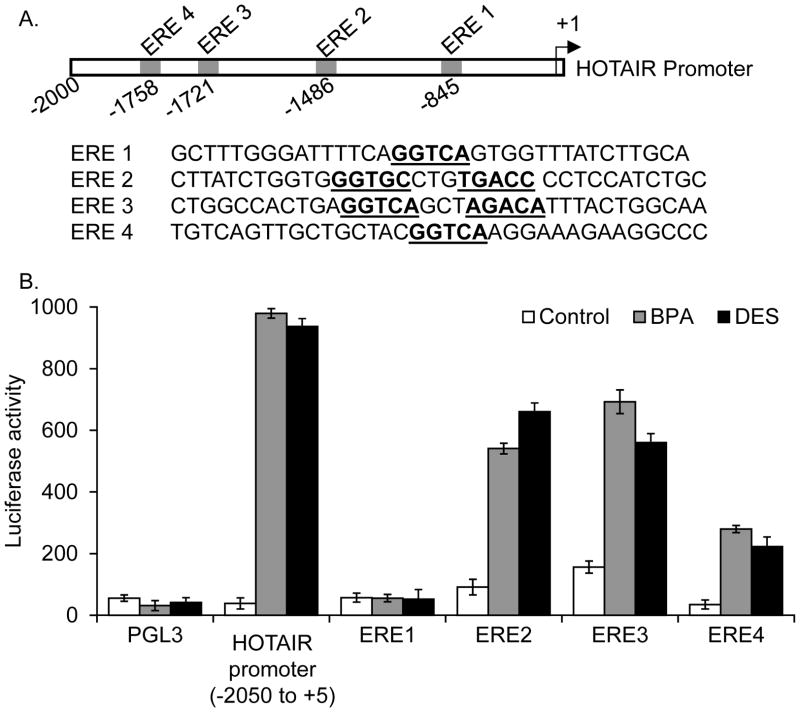
HOTAIR promoter EREs are responsive to BPA and DES treatments. (A) HOTAIR gene promoter EREs (termed as ERE1, ERE2, ERE3 and ERE4 locations and the neighboring sequences are shown). HOTAIR promoter regions spanning ERE1, ERE2 ERE3 and ERE4 as well as the full-length promoter (−2050 to +5 nt region) were cloned individually (clones 1–4) into a luciferase based reporter construct, pGL3, used for transfection and reporter assay. (B) Luciferase based reporter assay. ERE-pGL3, full-length promoter-pGL3 or empty pGL3 (vector control) constructs were transfected into MCF7 cells separately for 24 h. A renilla luciferase construct was also co-transfected along with ERE-pGL3 constructs as an internal transfection control. Cells were then treated with 100 nM BPA and 10 nM DES and subjected to luciferase assay by using dual-Glo Luciferase Assay kit. The luciferase activities (normalized to renilla activity) were plotted. The experiment was repeated thrice with four parallel replicate (n =3). Bars indicate standard errors. P values < 0.05 were considered to be significant.
Figure 4
Figure 4
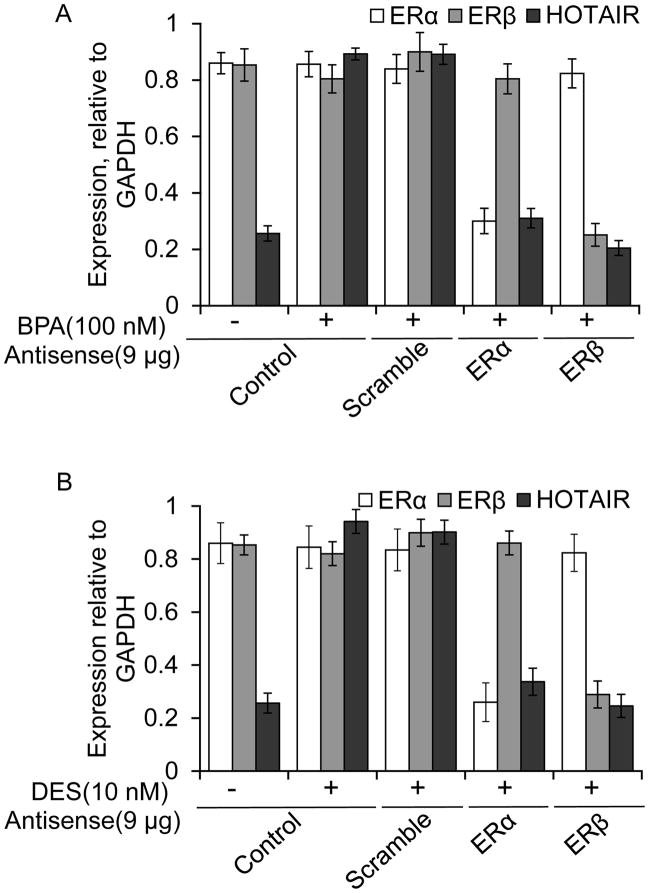
Roles of ERs on BPA and DES-induced expression of HOTAIR. (A–B) MCF7 cells were transfected with ERα, ERβ or scramble antisense (9 μg each) separately for 48 h and treated with BPA (100 nM) (Panel A) and DES (10 nM) (Panel B) for additional 4 h. RNA was isolated and subjected to real-time quantification (qPCR) of HOTAIR expression (relative to GAPDH). In case of ERα-knockdown, ERβ-PCR analysis was performed as a specificity control, in addition to GAPDH and vice versa. Each experiment was repeated at least thrice (n = 3). Bars indicate standard errors. P values < 0.05 were considered to be significant.
Figure 5
Figure 5
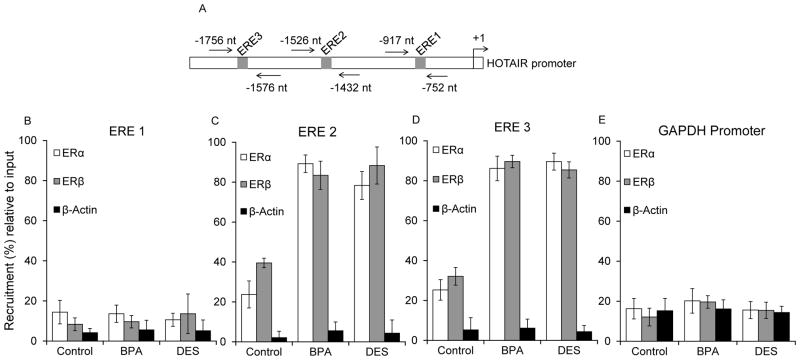
BPA and DES-induced binding of ERs in the HOTAIR promoter EREs. (A–D) MCF7 cells were treated with 100 nM BPA and 10 nM DES, separately for 4 h and subjected to ChIP assay using antibodies specific to ERα and ERβ. ChIP DNA fragments were PCR-amplified (qPCR) using primers specific to different ERE regions in the HOTAIR promoter. Panel A shows the position of the primers in the HOTAIR promoter. Panel B, C and D show the ChIP analysis with ERα and ERβ antibodies, respectively, at different ERE regions (ERE1–3). Panel E demonstrates ChIP analysis of the GAPDH promoter (non-specific DNA control) with ERα and ERβ antibodies. Each experiment was repeated at least thrice. Bars indicate standard errors.
Figure 6
Figure 6
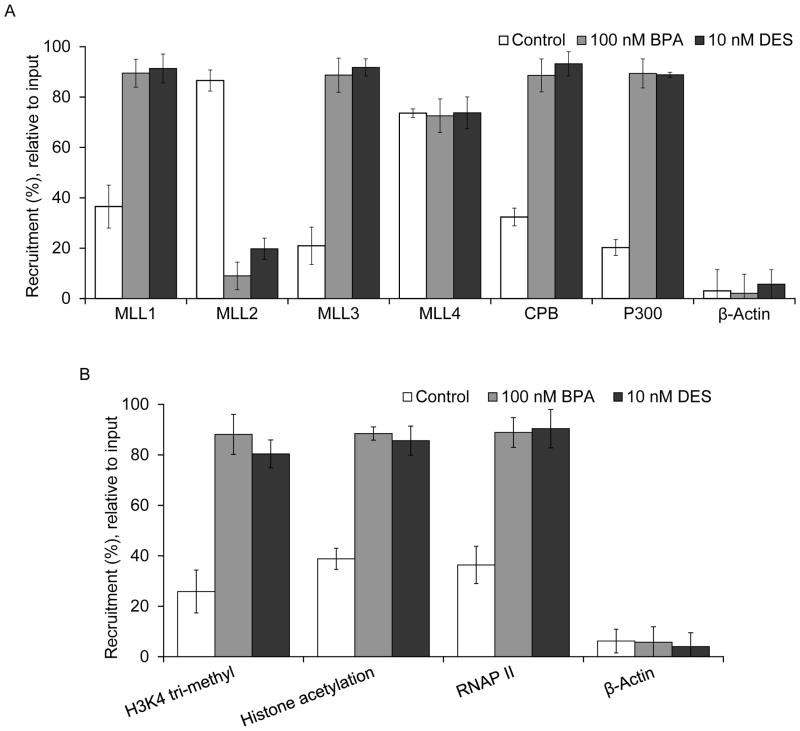
Roles of MLLs, ER-coregulators, and histone modification. (A–B) MCF7 cells were treated with 100 nM BPA and 10 nM DES, separately for 4 h and subjected to ChIP assay using antibodies specific to MLLs (MLL1–4), CBP, p300, H3K4-trimethyl, histone acetyl, RNA polymerase II (RNAP II) and β-actin (control). ChIP DNA fragments were PCR-amplified (qPCR) using primers specific to ERE2 region in the HOTAIR promoter. Panel A shows the ChIP analysis of MLLs (MLL1–4), CBP, p300 and β-actin on the ERE2 of the HOTAIR promoter. Panel B shows the ChIP analysis of H3K4-trimethyl, histone acetyl, RNA polymerase II (RNAP II) and β-actin (control) on the ERE2 region of the HOTAIR promoter. Each experiment was repeated at least thrice. Bars indicate standard errors. P values < 0.05 were considered to be significant
Figure 7
Figure 7
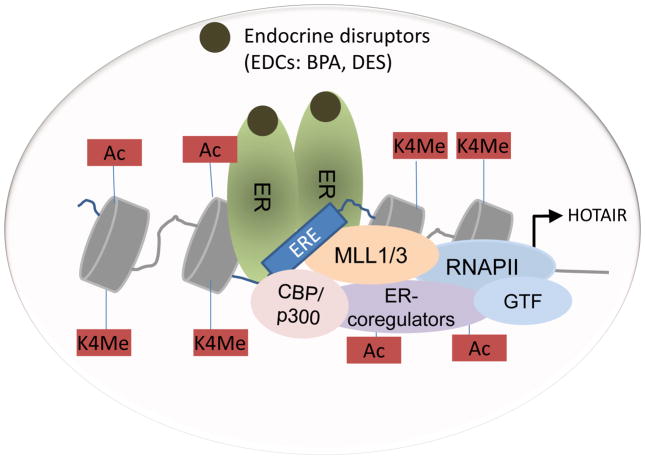
Models showing the roles of ERs, MLLs and other ER-coregulators during BPA and DES mediated endocrine disruption of HOTAIR. Steroidogenic EDCs like BPA and DES binds to ERs (ERα and ERβ), in a similar fashion to estradiol. Activated ERs (dimerized) bind to the functional EREs of the HOTAIR promoter. ER-coregulators such as MLL1 and MLL3, CBP/p300, and other ER-coregulators are recruited to the HOTAIR promoter EREs. Promoter histones are methylated (H3K4-trimethylated) and acetylated followed by recruitment of general transcription factors (GTFs) and RNA polymerase II (RNAP II), transcription initiation and gene activation.

References

    1. Adamsson NA, Brokken LJ, Paranko J, Toppari J. In vivo and in vitro effects of flutamide and diethylstilbestrol on fetal testicular steroidogenesis in the rat. Reprod Toxicol. 2008;25:76–83. - PubMed
    1. Akbas GE, Song J, Taylor HS. A HOXA10 estrogen response element (ERE) is differentially regulated by 17 beta-estradiol and diethylstilbestrol (DES) Journal of molecular biology. 2004;340:1013–1023. - PubMed
    1. Ansari KI, Hussain I, Kasiri S, Mandal SS. HOXC10 is overexpressed in breast cancer and transcriptionally regulated by estrogen via involvement of histone methylases MLL3 and MLL4. J Mol Endocrinol. 2012a;48:61–75. - PubMed
    1. Ansari KI, Hussain I, Shrestha B, Kasiri S, Mandal SS. HOXC6 Is transcriptionally regulated via coordination of MLL histone methylase and estrogen receptor in an estrogen environment. J Mol Biol. 2011a;411:334–349. - PMC - PubMed
    1. Ansari KI, Kasiri S, Hussain I, Bobzean SA, Perrotti LI, Mandal SS. MLL histone methylases regulate expression of HDLR-SR-B1 in presence of estrogen and control plasma cholesterol in vivo. Mol Endocrinol. 2013a;27:92–105. - PMC - PubMed

Publication types

MeSH terms