


Correlates of self-reported quality of life in adults and children with morphea
- PMID: 24534655
- PMCID: PMC3992170
- DOI: 10.1016/j.jaad.2013.11.037
Correlates of self-reported quality of life in adults and children with morphea
Abstract
Background: Determining a disease's impact on life quality is important in clinical decision making, research, and resource allocation. Determinants of quality of life (QOL) in morphea are poorly understood.
Objective: We sought to ascertain demographic and clinical variables correlated with negative impact on self-reported QOL in morphea.
Methods: We conducted a cross-sectional survey of the Morphea in Adults and Children cohort.
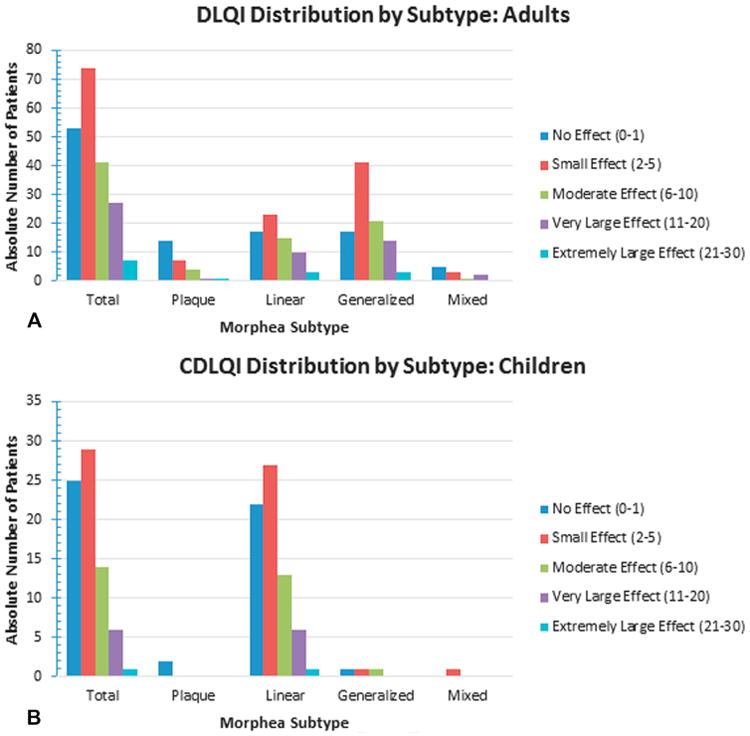
Results: Symptoms (pruritus and pain) and functional impairment were correlated with decreased QOL in children and adults. This was true in both sexes and was independent of subtype and age. Patient-reported QOL correlated with physician-based measures of disease severity in adults, but not in children. Patients with linear and generalized morphea had the greatest impact on QOL.
Limitations: Small sample size is a limitation.
Conclusion: Symptoms and functional impairment were determinants of impaired life quality in both children and adults independent of morphea subtype. These results suggest that clinicians should consider suppressing the accumulation of new lesions (when rapidly accumulating) and symptoms (pain and pruritus) in the treatment of patients with morphea.
Keywords: Morphea in Adults and Children cohort; life quality or quality of life; localized scleroderma; morphea; outcomes or disease outcomes.
Copyright © 2013 American Academy of Dermatology, Inc. Published by Mosby, Inc. All rights reserved.
Conflict of interest statement
Conflicts of interest: None declared.
Figures
References
-
- Zulian F, Vallongo C, Woo P, Russo R, Ruperto N, Harper J, et al. Localized scleroderma in childhood is not just a skin disease. Arthritis Rheum. 2005;52:2873–81. - PubMed
-
- Uziel Y, Krafchik BR, Silverman ED, Thorner PS, Laxer RM. Localized scleroderma in childhood: a report of 30 cases. Semin Arthritis Rheum. 1994;23:328–40. - PubMed
-
- Christen-Zaech S, Hakim MD, Afsar FS, Paller AS. Pediatric morphea (localized scleroderma): review of 136 patients. J Am Acad Dermatol. 2008;59:385–96. - PubMed
-
- Bendeck SE, Jacobe HT. Ultrasound as an outcome measure to assess disease activity in disorders of skin thickening: an example of the use of radiologic techniques to assess skin disease. Dermatol Ther. 2007;20:86–92. - PubMed
Publication types
MeSH terms
Grants and funding
LinkOut - more resources
Full Text Sources
Other Literature Sources
Medical
