


MOR103, a human monoclonal antibody to granulocyte-macrophage colony-stimulating factor, in the treatment of patients with moderate rheumatoid arthritis: results of a phase Ib/IIa randomised, double-blind, placebo-controlled, dose-escalation trial
- PMID: 24534756
- PMCID: PMC4431325
- DOI: 10.1136/annrheumdis-2013-204816
MOR103, a human monoclonal antibody to granulocyte-macrophage colony-stimulating factor, in the treatment of patients with moderate rheumatoid arthritis: results of a phase Ib/IIa randomised, double-blind, placebo-controlled, dose-escalation trial
Abstract
Objectives: To determine the safety, tolerability and signs of efficacy of MOR103, a human monoclonal antibody to granulocyte-macrophage colony-stimulating factor (GM-CSF), in patients with rheumatoid arthritis (RA).
Methods: Patients with active, moderate RA were enrolled in a randomised, multicentre, double-blind, placebo-controlled, dose-escalation trial of intravenous MOR103 (0.3, 1.0 or 1.5 mg/kg) once a week for 4 weeks, with follow-up to 16 weeks. The primary outcome was safety.
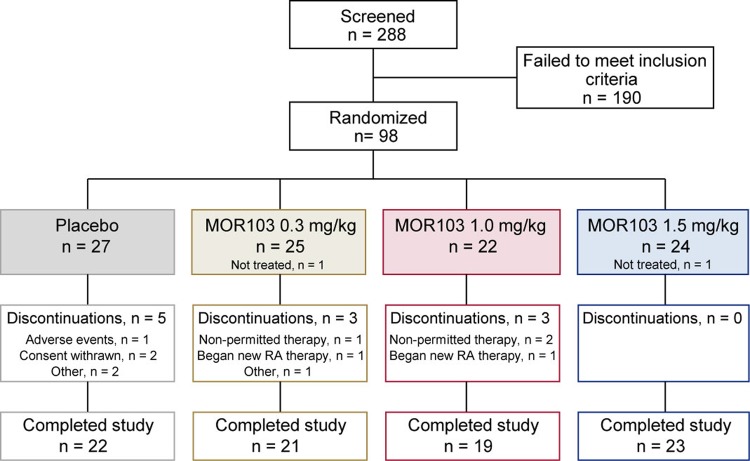
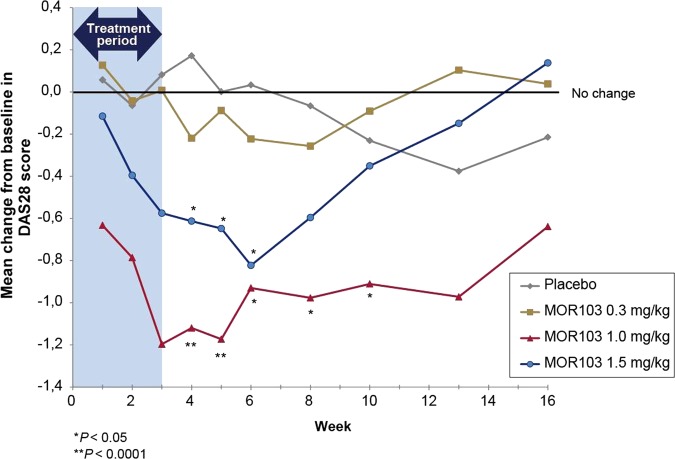
Results: Of the 96 randomised and treated subjects, 85 completed the trial (n=27, 24, 22 and 23 for pooled placebo and MOR103 0.3, 1.0 and 1.5 mg/kg, respectively). Treatment emergent adverse events (AEs) in the MOR103 groups were mild or moderate in intensity and generally reported at frequencies similar to those in the placebo group. The most common AE was nasopharyngitis. In two cases, AEs were classified as serious because of hospitalisation: paronychia in a placebo subject and pleurisy in a MOR103 0.3 mg/kg subject. Both patients recovered fully. In exploratory efficacy analyses, subjects in the MOR103 1.0 and 1.5 mg/kg groups showed significant improvements in Disease Activity Score-28 scores and joint counts and significantly higher European League Against Rheumatism response rates than subjects receiving placebo. MOR103 1.0 mg/kg was associated with the largest reductions in disease activity parameters.
Conclusions: MOR103 was well tolerated and showed preliminary evidence of efficacy in patients with active RA. The data support further investigation of this monoclonal antibody to GM-CSF in RA patients and potentially in those with other immune-mediated inflammatory diseases.
Trial registration number: NCT01023256.
Keywords: DAS28; DMARDs (biologic); Rheumatoid Arthritis; Treatment.
Published by the BMJ Publishing Group Limited. For permission to use (where not already granted under a licence) please go to http://group.bmj.com/group/rights-licensing/permissions.
Figures
References
-
- Hetland ML, Christensen IJ, Tarp U, et al. Direct comparison of treatment responses, remission rates, and drug adherence in patients with rheumatoid arthritis treated with adalimumab, etanercept, or infliximab. Arthritis Rheum 2010;62:22–32. - PubMed
-
- Hamilton JA. Colony-stimulating factors in inflammation and autoimmunity. Nat Rev Immunol 2008;8:533–44. - PubMed
-
- Cornish AL, Campbell IK, McKenzie BS, et al. G-CSF and GM-CSF as therapeutic targets in rheumatoid arthritis. Nat Rev Rheumatol 2009;5:554–9. - PubMed
Publication types
MeSH terms
Substances
Associated data
LinkOut - more resources
Full Text Sources
Other Literature Sources
Medical
