


Enhanced excitability of primary sensory neurons and altered gene expression of neuronal ion channels in dorsal root ganglion in paclitaxel-induced peripheral neuropathy
- PMID: 24534904
- PMCID: PMC4031279
- DOI: 10.1097/ALN.0000000000000176
Enhanced excitability of primary sensory neurons and altered gene expression of neuronal ion channels in dorsal root ganglion in paclitaxel-induced peripheral neuropathy
Abstract
Background: The mechanism of chemotherapy-induced peripheral neuropathy after paclitaxel treatment is not well understood. Given the poor penetration of paclitaxel into central nervous system, peripheral nervous system is most at risk.
Methods: Intrinsic membrane properties of dorsal root ganglion neurons were studied by intracellular recordings. Multiple-gene real-time polymerase chain reaction array was used to investigate gene expression of dorsal root ganglion neuronal ion channels.
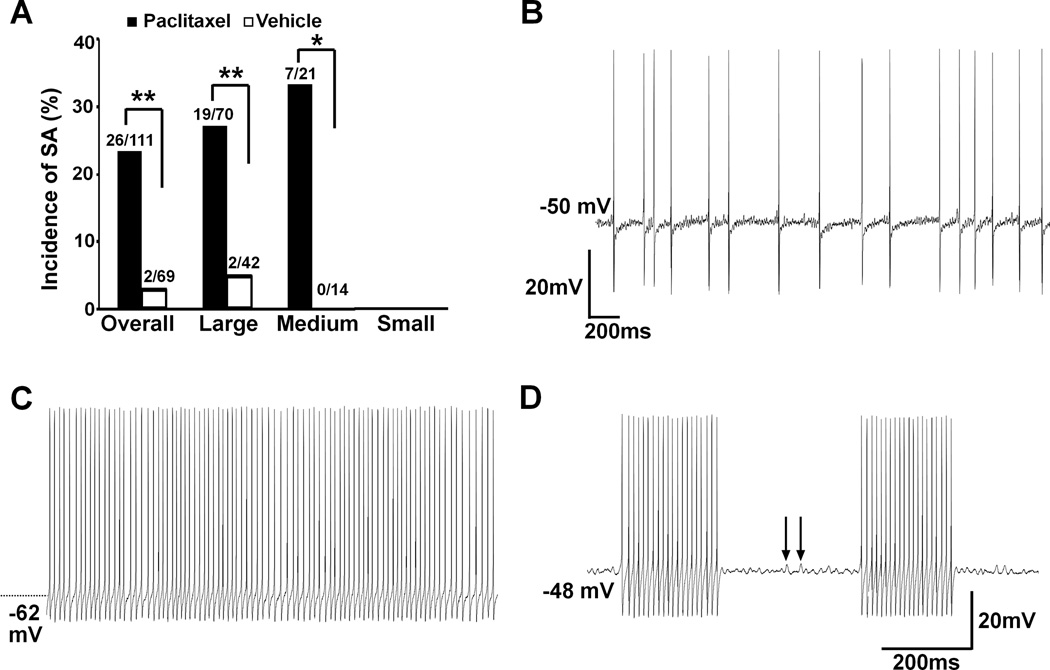
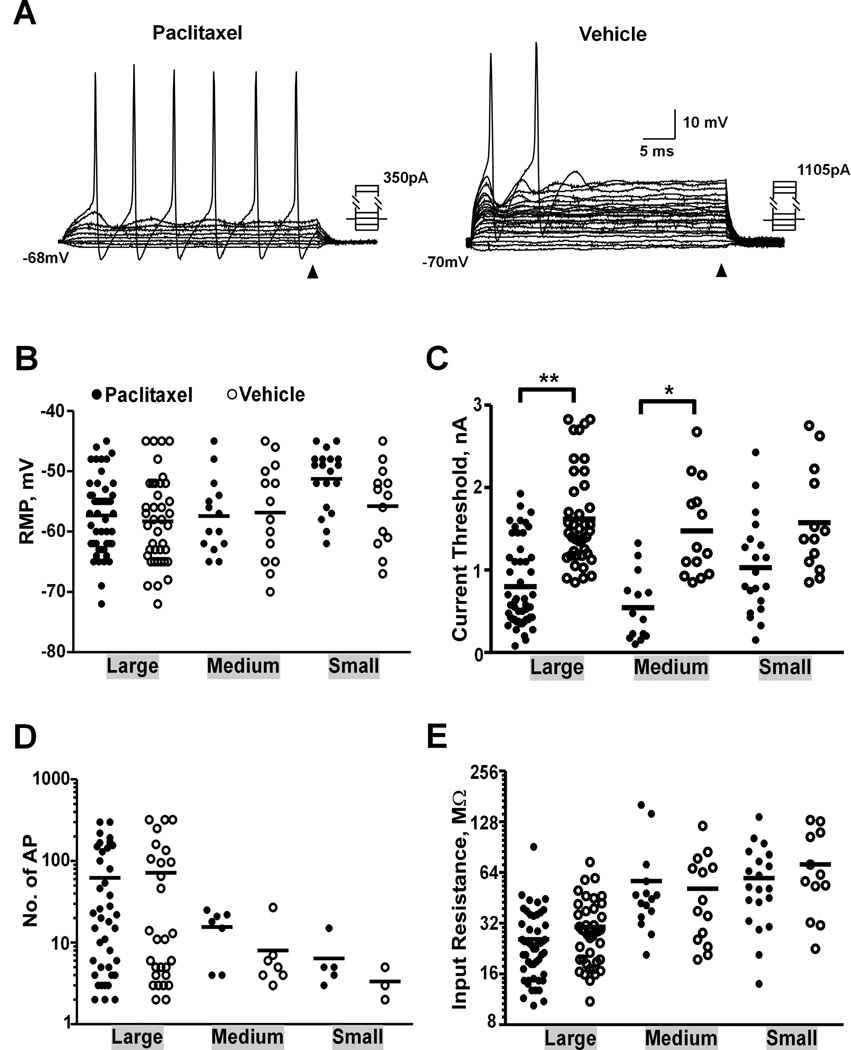
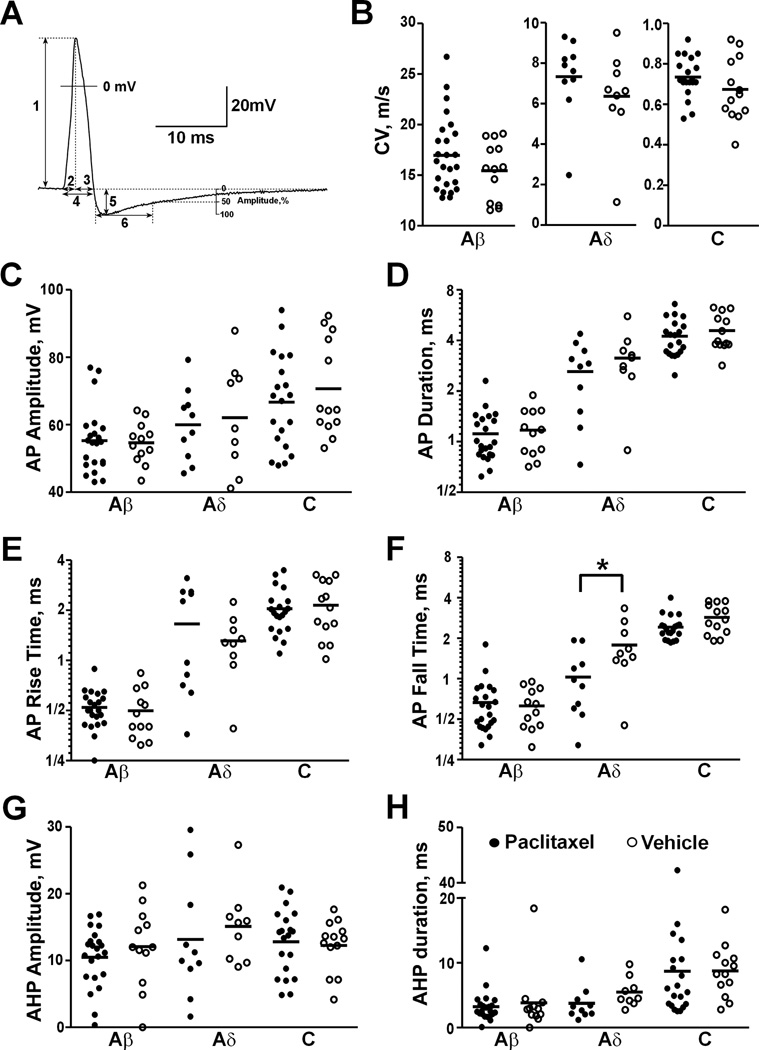
Results: Paclitaxel increased the incidence of spontaneous activity from 4.8 to 27.1% in large-sized and from 0 to 33.3% in medium-sized neurons. Paclitaxel decreased the rheobase (nA) from 1.6 ± 0.1 to 0.8 ± 0.1 in large-sized, from 1.5 ± 0.2 to 0.6 ± 0.1 in medium-sized, and from 1.6 ± 0.2 to 1.0 ± 0.1 in small-sized neurons. After paclitaxel treatment, other characteristics of membrane properties in each group remained the same except that Aδ neurons showed shorter action potential fall time (ms) (1.0 ± 0.2, n = 10 vs. 1.8 ± 0.3, n = 9, paclitaxel vs. vehicle). Meanwhile, real-time polymerase chain reaction array revealed an alteration in expression of some neuronal ion channel genes including up-regulation of hyperpolarization-activated cyclic nucleotide-gated channel 1 (fold change 1.76 ± 0.06) and Nav1.7 (1.26 ± 0.02) and down-regulation of Kir channels (Kir1.1, 0.73 ± 0.05, Kir3.4, 0.66 ± 0.06) in paclitaxel-treated animals.
Conclusion: The increased neuronal excitability and the changes in gene expression of some neuronal ion channels in dorsal root ganglion may provide insight into the molecular and cellular basis of paclitaxel-induced neuropathy, which may lead to novel therapeutic strategies.
Figures
References
-
- Cavaletti G, Marmiroli P. Chemotherapy-induced peripheral neurotoxicity. Nat Rev Neurol. 2010;6:657–666. - PubMed
-
- Dougherty PM, Cata JP, Cordella JV, Burton A, Weng H-R. Taxol-induced sensory disturbance is characterized by preferential impairment of myelinated fiber function in cancer patients. Pain. 2004;109:132–142. - PubMed
-
- Reeves BN, Dakhil SR, Sloan JA, Wolf SL, Burger KN, Kamal A, Le-Lindqwister NA, Soori GS, Jaslowski AJ, Kelaghan J, Novotny PJ, Lachance DH, Loprinzi CL. Further data supporting that paclitaxel-associated acute pain syndrome is associated with development of peripheral neuropathy: North Central Cancer Treatment Group trial N08C1. Cancer. 2012;118:5171–5178. - PMC - PubMed
-
- Cavaletti G, Cavaletti E, Oggioni N, Sottani C, Minoia C, D'Incalci M, Zucchetti M, Marmiroli P, Tredici G. Distribution of paclitaxel within the nervous system of the rat after repeated intravenous administration. Neurotoxicol. 2000;21:389–394. - PubMed
Publication types
MeSH terms
Substances
Grants and funding
LinkOut - more resources
Full Text Sources
Other Literature Sources
Medical
