


Food security and sustainable intensification
- PMID: 24535385
- PMCID: PMC3928882
- DOI: 10.1098/rstb.2012.0273
Food security and sustainable intensification
Abstract
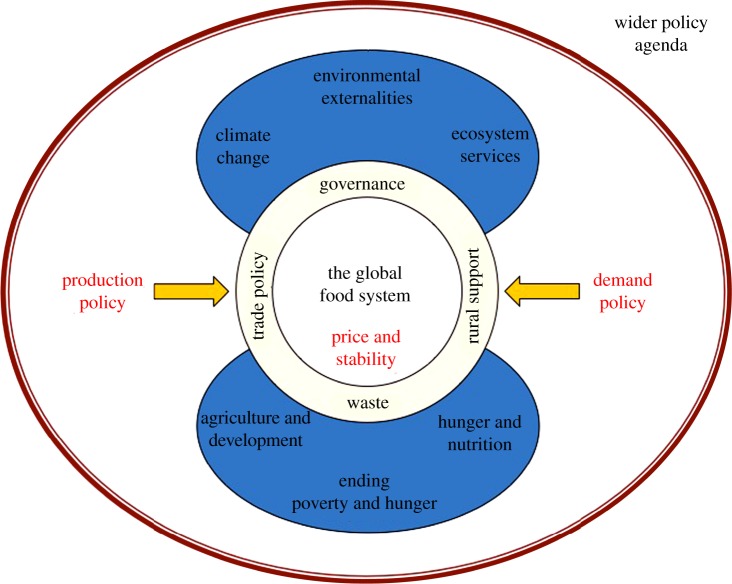
The coming decades are likely to see increasing pressures on the global food system, both on the demand side from increasing population and per capita consumption, and on the supply side from greater competition for inputs and from climate change. This paper argues that the magnitude of the challenge is such that action is needed throughout the food system, on moderating demand, reducing waste, improving governance and producing more food. It discusses in detail the last component, arguing that more food should be produced using sustainable intensification (SI) strategies, and explores the rationale behind, and meaning of, this term. It also investigates how SI may interact with other food policy agendas, in particular, land use and biodiversity, animal welfare and human nutrition.
Keywords: animal welfare; biodiversity; food security; nutrition; sustainable intensification.
Figures
References
-
- Fraser EDG, Rimas A. 2010. Empires of food. New York, NY: Simon & Schuster.
-
- Foresight. 2011. The future of food and farming. London, UK: Government Office of Science.
-
- Oxfam. 2011. Growing a better future: food justice in a resource-constrained world. Oxford, UK: Oxfam.
-
- FAO. 2008. An introduction to the basic concepts of food security. Rome, Italy: FAO.
Publication types
MeSH terms
LinkOut - more resources
Full Text Sources
Other Literature Sources
Medical
