


Thalamic glutamate decreases with cigarette smoking
- PMID: 24535652
- PMCID: PMC4182312
- DOI: 10.1007/s00213-014-3441-5
Thalamic glutamate decreases with cigarette smoking
Abstract
Rationale: Findings from animal studies and human PET imaging indicate that nicotine and cigarette smoking affect glutamate (Glu) and related neurochemical markers in the brain and imply that smoking reduces extracellular Glu. As Glu release is mediated by nicotinic acetylcholine receptors (nAChRs), which are present at high concentrations in the thalamus, we examined the effects of smoking on thalamic Glu.
Objective: To determine the effects of tobacco smoking on thalamic glutamate levels.
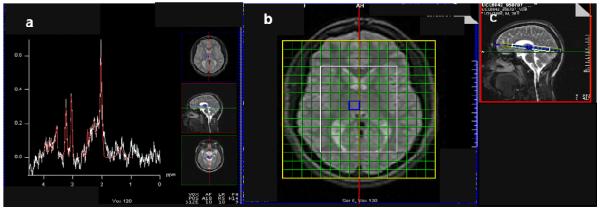
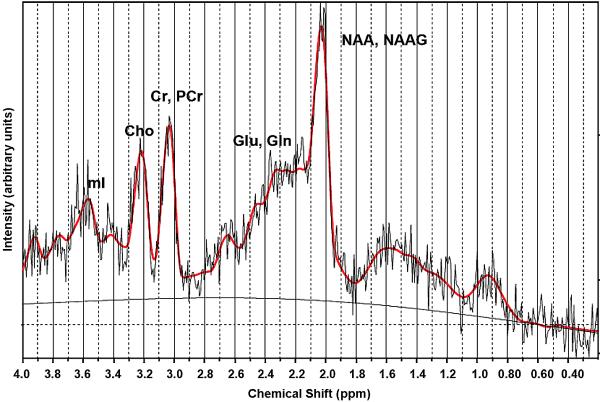
Methods: Thalamic Glu levels were measured in vivo in 18 smokers and 16 nonsmokers using proton magnetic resonance spectroscopic imaging ((1)H MRSI) at 1.5 T.
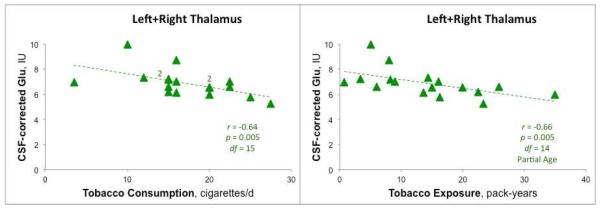
Results: Mean Glu levels did not differ significantly between the subject groups. However, within smokers, Glu levels were negatively correlated with self-reports of both cigarettes/day over the last 30 days (r = -0.64, p = 0.006) and pack-years of smoking (r = -0.66, p = 0.005).
Conclusions: Consistent with expectations based on preclinical studies, within smokers, cigarettes/day and pack-years are associated with reduced Glu in thalamus, a brain region rich in nAchRs. These results encourage work on candidate glutamatergic therapies for smoking cessation and suggest a noninvasive metric for their action in the brain.
Figures
References
-
- Akkus F, Ametamey SM, Treyer V, Burger C, Johayem A, Umbricht D, Gomez Mancilla B, Sovage J, Buck A, Hasler G. Marked global reduction in mGluR5 receptor binding in smokers and ex-smokers determined by [11C]ABP688 positron emission tomography. Proc Natl Acad Sci U S A. 2013;110(2):737–742. doi:10.1073/pnas.1210984110. - PMC - PubMed
-
- Baker DA, McFarland K, Lake RW, Shen H, Tang XC, Toda S, et al. Neuroadaptations in cystine glutamate exchange underlie cocaine relapse. Nat Neurosci. 2003;6:743–749. doi:10.1038/nn1069. - PubMed
-
- Ballmaier M, Toga AW, Siddarth P, Blanton RE, Levitt JG, Lee M, Caplan R. Thought disorder and nucleus accumbens in childhood: a structural MRI study. Psychiatry Res. 2004;130:43–55. doi:10.1016/j.pscychresns.2003.10.001. - PubMed
-
- Beck AT, Steer RA, Brown GK. 2nd Psychological Corporation, Harcourt, Brace; San Antonio, TX: 1996. Manual for the Beck Depression Inventory.
-
- Conti F, Weinberg RJ. Shaping excitation at glutamatergic synapses. Trend Neurosci. 1999;22(10):451–458. doi: 10.1016/s0166-2236(99)01445-9. - PubMed
Publication types
MeSH terms
Substances
Grants and funding
- R21DA023192/DA/NIDA NIH HHS/United States
- M01RR00865/RR/NCRR NIH HHS/United States
- P20 DA022539/DA/NIDA NIH HHS/United States
- K23MH094613/MH/NIMH NIH HHS/United States
- R03DA20512/DA/NIDA NIH HHS/United States
- R01DA020726/DA/NIDA NIH HHS/United States
- T32 MH073517/MH/NIMH NIH HHS/United States
- P20DA022539/DA/NIDA NIH HHS/United States
- K23 MH094613/MH/NIMH NIH HHS/United States
- R03 DA020512/DA/NIDA NIH HHS/United States
- T32MH073517/MH/NIMH NIH HHS/United States
- R01 DA020726/DA/NIDA NIH HHS/United States
- R21 DA023192/DA/NIDA NIH HHS/United States
- M01 RR000865/RR/NCRR NIH HHS/United States
LinkOut - more resources
Full Text Sources
Other Literature Sources
Research Materials
