


Exercise for depressive symptoms in stroke patients: a systematic review and meta-analysis
- PMID: 24535729
- PMCID: PMC4591069
- DOI: 10.1177/0269215514523631
Exercise for depressive symptoms in stroke patients: a systematic review and meta-analysis
Abstract
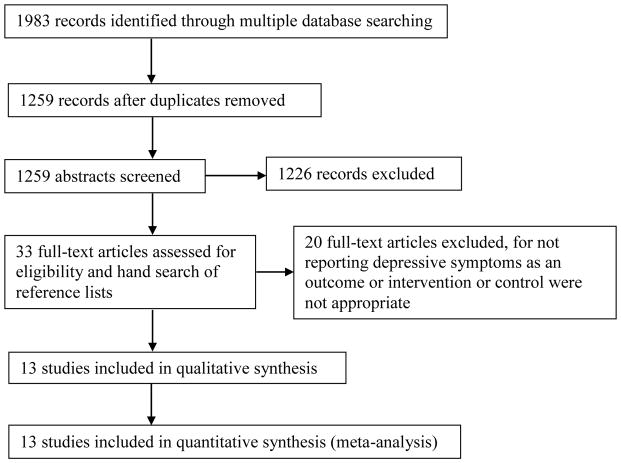
Objective: The objective was to conduct a systematic review and meta-analysis of studies that examined the effects of structured exercise on depressive symptoms in stroke patients.
Methods: We searched for published randomized controlled trials that evaluated the effect of structured exercise programs (e.g. functional, resistance, or aerobic training) on depressive symptoms. The mean effect size, a 95% confidence interval (CI) and I-squared (I2) for heterogeneity were estimated. Sensitivity analyses were conducted.
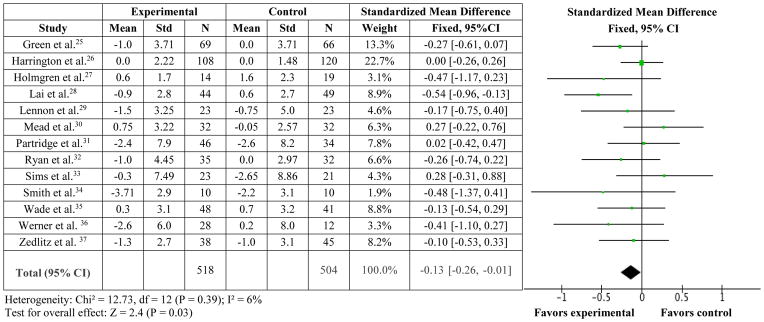
Results: Thirteen studies (n = 1022) were included in the meta-analysis. Exercise resulted in less depressive symptoms immediately after the exercise program ended, standardized mean difference = -0.13 [95% CI = -0.26, -0.01], I2 = 6%, p = 0.03, but these effects were not retained with longer term follow-up. Exercise appeared to have a positive effect on depressive symptoms across both the subacute (≤6 months post stroke) and chronic stage of recovery (>6 months). There was a significant effect of exercise on depressive symptoms when higher intensity studies were pooled, but not for lower intensity exercise protocols. Antidepressant medication use was not documented in the majority of studies and thus, its potential confounding interaction with exercise could not be assessed.
Conclusions: Exercise may be a potential treatment to prevent or reduce depressive symptoms in individuals with subacute and chronic stroke.
Keywords: Depression; exercise; meta-analysis; stroke; systematic review.
© The Author(s) 2014.
Conflict of interest statement
Declaration of conflicting interests The Author(s) declare(s) that there is no conflict of interest
Figures
References
-
- Hackett ML, Yapa C, Parag V, et al. Frequency of depression after stroke: a systematic review of observational studies. Stroke. 2005;36:1330–1340. - PubMed
-
- Kotila M, Numminen H, Waltimo O, et al. Post-stroke depression and functional recovery in a population-based stroke register. The Finnstroke study. Eur J Neurol. 1999;6:309–312. - PubMed
-
- Pohjasvaara T, Leskela M, Vataja R, et al. Post-stroke depression, executive dysfunction and functional outcome. Eur J Neurol. 2002;9:269–275. - PubMed
-
- Pohjasvaara T, Vataja R, Leppävuori A, et al. Suicidal ideas in stroke patients 3 and 15 months after stroke. Cerebrovasc Dis. 2001;12:21–26. - PubMed
-
- Kauhanen M, Korpelainen JT, Hiltunen P, et al. Poststroke depression correlates with cognitive impairment and neurological deficits. Stroke. 1999;30:1875–1880. - PubMed
Grants and funding
LinkOut - more resources
Full Text Sources
Other Literature Sources
