. 2014 Apr 1;20(7):1741-6.
doi: 10.1158/1078-0432.CCR-13-1547. Epub 2014 Feb 17.

Molecular pathways: emerging roles of mammalian Sirtuin SIRT7 in cancer

Affiliations

Molecular pathways: emerging roles of mammalian Sirtuin SIRT7 in cancer

Silvana Paredes et al. Clin Cancer Res. .

Abstract

SIRT7 belongs to the Sirtuin family of NAD-dependent enzymes, the members of which play diverse roles in aging, metabolism, and disease biology. Increased SIRT7 expression is observed in human cancers and growing evidence suggests important SIRT7 functions in fundamental cellular programs with an impact on oncogenic transformation and tumor biology. SIRT7 associates with chromatin, where it catalyzes selective deacetylation of lysine 18 on histone H3 (H3K18), an emerging epigenetic biomarker of aggressive tumors and poor clinical outcome in patients with cancer. Through H3K18 deacetylation at specific promoters, SIRT7 controls a tumor-suppressive gene expression program that stabilizes the transformed state of cancer cells. SIRT7 also orchestrates several molecular processes, including rRNA and tRNA synthesis, which ultimately promote the increased ribosome biogenesis necessary for tumor cell growth and proliferation. Remarkably, inactivation of SIRT7 can reverse the transformed phenotype of cancer cells and reduce their tumorigenicity in vivo. These findings place SIRT7 at the crossroads of chromatin signaling, metabolic, and tumor-regulatory pathways. Thus, SIRT7 is a promising pharmacologic target for epigenetic cancer therapy. The development of SIRT7 modulators may allow new therapeutic strategies that control tumor progression by reprogramming the chromatin landscape and biosynthetic machinery of cancer cells.


Figures

Figure 1
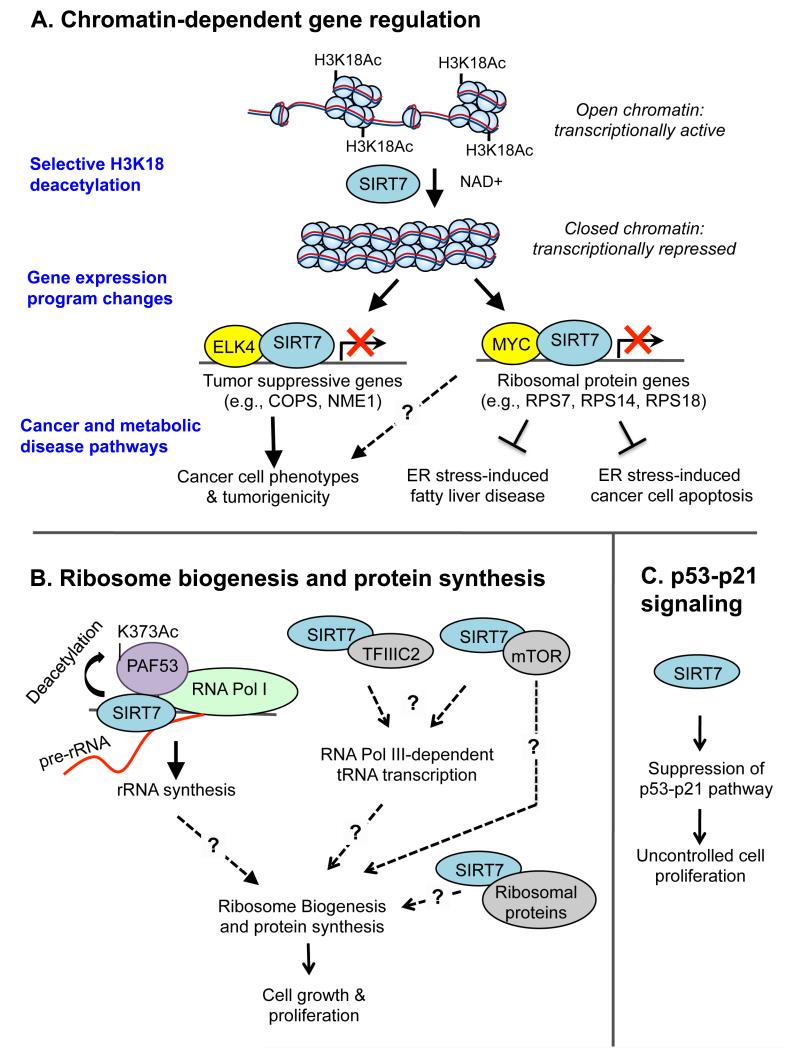
Figure 1. Molecular pathways of SIRT7 and their known or predicted effects on cancer cell biology
(A) Chromatin-dependent gene regulation: SIRT7 deacetylates H3K18 to promote formation of transcriptionally repressive chromatin at specific gene promoters. SIRT7 represses expression of an ELK4-dependent tumor suppressive gene network, leading to stabilization of the transformed phenotype of cancer cells. SIRT7 also represses Myc-dependent ribosomal protein genes, which alleviates ER stress and prevents fatty liver disease. In cancer cells, SIRT7 opposes Myc function in ER stress-induced apoptosis, allowing cancer cell survival and proliferation. SIRT7 might also impact on cancer cell phenotypes and tumorigenicity by regulating other functions of Myc in cancer cells. (B) Ribosome biogenesis and protein synthesis: SIRT7 is implicated in multiple pathways that ultimately promote ribosome biogenesis and increased protein translation. At rDNA, SIRT7 deacetylates the PAF53 subunit of RNA Polymerase I to activate rRNA transcription, the rate-limiting step in ribosome biogenesis. SIRT7 also interacts with TFIIIC2 and mTOR, factors that promote tRNA transcription and protein synthesis. SIRT7 also interacts with ribosomal protein subunits, and might directly regulate ribosome function through such interactions. High levels of ribosome biogenesis fuels cancer cell proliferation and survival. (C) p53-p21 signaling: SIRT7 is implicated in repressing the tumor suppressive p53-p21 pathway, with potential effects on cancer cell proliferation and survival. The molecular mechanisms are still unclear, but might involve effects on p53 acetylation or nucleolar dysfunction. Question marks indicate connections that are predicted but not yet demonstrated experimentally.

References

    1. Imai S, Armstrong CM, Kaeberlein M, Guarente L. Transcriptional silencing and longevity protein Sir2 is an NAD-dependent histone deacetylase. Nature. 2000;403:795–800. - PubMed
    1. Kaeberlein M, Andalis AA, Fink GR, Guarente L. High osmolarity extends life span in Saccharomyces cerevisiae by a mechanism related to calorie restriction. Molecular and cellular biology. 2002;22:8056–66. - PMC - PubMed
    1. Du J, Zhou Y, Su X, Yu JJ, Khan S, Jiang H, et al. Sirt5 is a NAD-dependent protein lysine demalonylase and desuccinylase. Science. 2011;334:806–9. - PMC - PubMed
    1. Mao Z, Hine C, Tian X, Van Meter M, Au M, Vaidya A, et al. SIRT6 promotes DNA repair under stress by activating PARP1. Science. 2011;332:1443–6. - PMC - PubMed
    1. Martinez-Redondo P, Vaquero A. The diversity of histone versus nonhistone sirtuin substrates. Genes Cancer. 2013;4:148–63. - PMC - PubMed

Publication types