


Eye tracking and pupillometry are indicators of dissociable latent decision processes
- PMID: 24548281
- PMCID: PMC4114997
- DOI: 10.1037/a0035813
Eye tracking and pupillometry are indicators of dissociable latent decision processes
Abstract
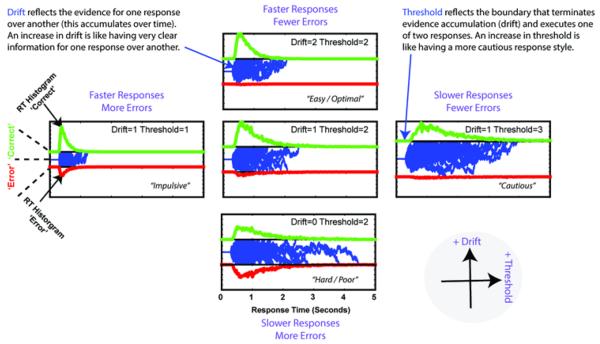
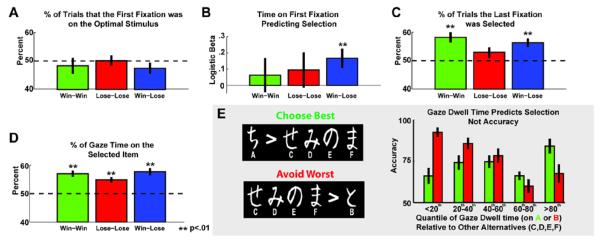
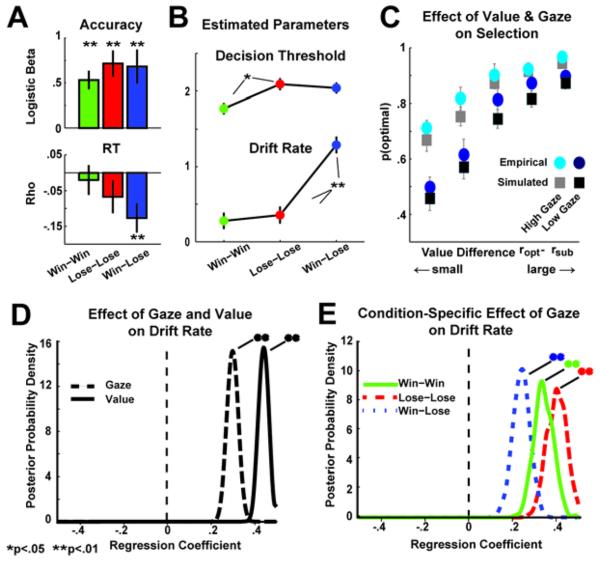
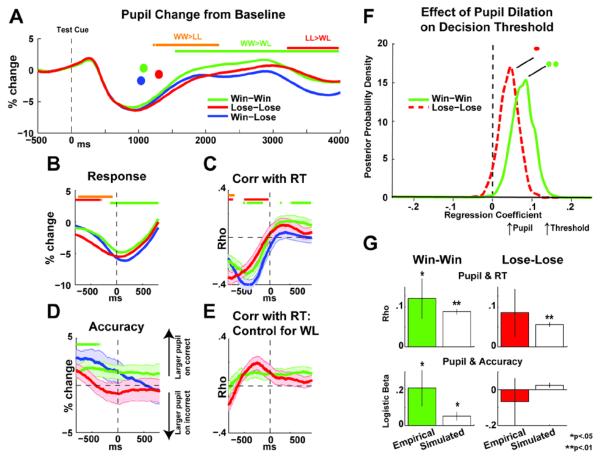
Can you predict what people are going to do just by watching them? This is certainly difficult: it would require a clear mapping between observable indicators and unobservable cognitive states. In this report, we demonstrate how this is possible by monitoring eye gaze and pupil dilation, which predict dissociable biases during decision making. We quantified decision making using the drift diffusion model (DDM), which provides an algorithmic account of how evidence accumulation and response caution contribute to decisions through separate latent parameters of drift rate and decision threshold, respectively. We used a hierarchical Bayesian estimation approach to assess the single trial influence of observable physiological signals on these latent DDM parameters. Increased eye gaze dwell time specifically predicted an increased drift rate toward the fixated option, irrespective of the value of the option. In contrast, greater pupil dilation specifically predicted an increase in decision threshold during difficult decisions. These findings suggest that eye tracking and pupillometry reflect the operations of dissociated latent decision processes.
PsycINFO Database Record (c) 2014 APA, all rights reserved.
Figures

References
-
- Armel KC, Beaumel A, Rangel A. Biasing simple choices by manipulating relative visual attention. Judgment and Decision Making. 2008;3(5):396–403.
-
- Beatty J, Lucero-Wagoner B. The Pupillary System. In: Cacioppo JT, Tassinary LG, Berntson GG, editors. Handbook of Psychophysiology. 2nd ed. Cambridge University Press; 2000. pp. 142–162.
-
- Bogacz R, Brown E, Moehlis J, Holmes P, Cohen JD. The physics of optimal decision making: a formal analysis of models of performance in two-alternative forced-choice tasks. Psychological review. 2006;113(4):700–65. doi:10.1037/0033-295X.113.4.700. - PubMed
-
- Brisson J, Mainville M, Mailloux D, Beaulieu C, Serres J, Sirois S. Pupil diameter measurement errors as a function of gaze direction in corneal reflection eyetrackers. Behavior research methods. 2013 doi:10.3758/s13428-013-0327-0. - PubMed
Publication types
MeSH terms
Grants and funding
LinkOut - more resources
Full Text Sources
Other Literature Sources
