


Invasive bacterial co-infection in African children with Plasmodium falciparum malaria: a systematic review
- PMID: 24548672
- PMCID: PMC3928319
- DOI: 10.1186/1741-7015-12-31
Invasive bacterial co-infection in African children with Plasmodium falciparum malaria: a systematic review
Abstract
Background: Severe malaria remains a major cause of pediatric hospital admission across Africa. Invasive bacterial infection (IBI) is a recognized complication of Plasmodium falciparum malaria, resulting in a substantially worse outcome. Whether a biological relationship exists between malaria infection and IBI susceptibility remains unclear. We, therefore, examined the extent, nature and evidence of this association.
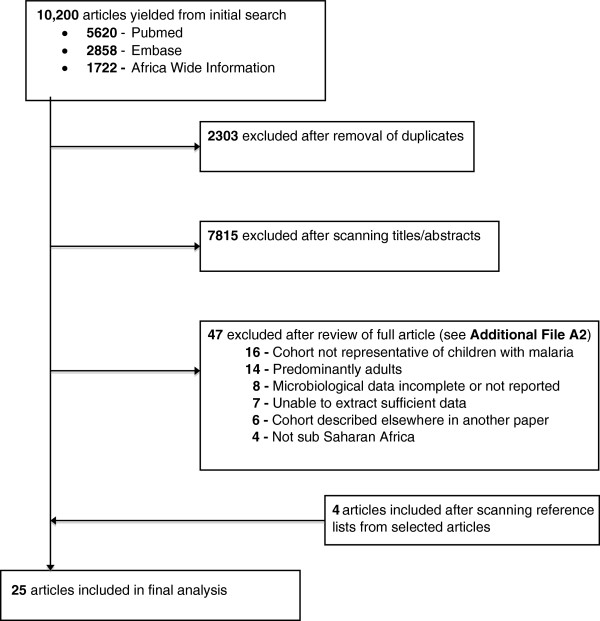
Methods: We conducted a systematic search in August 2012 of three major scientific databases, PubMed, Embase and Africa Wide Information, for articles describing bacterial infection among children with P. falciparum malaria using the search string '(malaria OR plasmodium) AND (bacteria OR bacterial OR bacteremia OR bacteraemia OR sepsis OR septicaemia OR septicemia).' Eligiblity criteria also included studies of children hospitalized with malaria or outpatient attendances in sub-Saharan Africa.
Results: A total of 25 studies across 11 African countries fulfilled our criteria. They comprised twenty cohort analyses, two randomized controlled trials and three prospective epidemiological studies. In the meta-analysis of 7,208 children with severe malaria the mean prevalence of IBI was 6.4% (95% confidence interval (CI) 5.81 to 6.98%). In a further meta-analysis of 20,889 children hospitalised with all-severity malaria and 27,641 children with non-malarial febrile illness the mean prevalence of IBI was 5.58 (95% CI 5.5 to 5.66%) in children with malaria and 7.77% (95% CI 7.72 to 7.83%) in non-malaria illness. Ten studies reported mortality stratified by IBI. Case fatality was higher at 81 of 336, 24.1% (95% CI 18.9 to 29.4) in children with malaria/IBI co-infection compared to 585 of 5,760, 10.2% (95% CI 9.3 to 10.98) with malaria alone. Enteric gram-negative organisms were over-represented in malaria cases, non-typhoidal Salmonellae being the most commonest isolate. There was weak evidence indicating IBI was more common in the severe anemia manifestation of severe malaria.
Conclusions: The accumulated evidence suggests that children with recent or acute malaria are at risk of bacterial infection, which results in an increased risk of mortality. Characterising the exact nature of this association is challenging due to the paucity of appropriate severity-matched controls and the heterogeneous data. Further research to define those at greatest risk is necessary to target antimicrobial treatment.
Figures
References
-
- World Health Organization. Global Health Observatory Data Repository. Geneva; 2011. Cause-specific mortality and morbidity; causes of deaths among children.
-
- Dondorp AM, Fanello CI, Hendriksen IC, Gomes E, Seni A, Chhaganlal KD, Bojang K, Olaosebikan R, Anunobi N, Maitland K, Kivaya E, Agbenyega T, Nguah SB, Evans J, Gesase S, Kahabuka C, Mtove G, Nadjm B, Deen J, Mwanga-Amumpaire J, Nansumba M, Karema C, Umulisa N, Uwimana A, Mokuolu OA, Adedoyin OT, Johnson WB, Tshefu AK, Onyamboko MA, Sakulthaew T. et al. Artesunate versus quinine in the treatment of severe falciparum malaria in African children (AQUAMAT): an open-label, randomised trial. Lancet. 2010;376:1647–1657. doi: 10.1016/S0140-6736(10)61924-1. - DOI - PMC - PubMed
-
- Maitland K, Kiguli S, Opoka RO, Engoru C, Olupot-Olupot P, Akech SO, Nyeko R, Mtove G, Reyburn H, Lang T, Brent B, Evans JA, Tibenderana JK, Crawley J, Russell EC, Levin M, Babiker AG, Gibb DM. Mortality after fluid bolus in African children with severe infection. N Engl J Med. 2011;364:2483–2495. doi: 10.1056/NEJMoa1101549. - DOI - PubMed
-
- Nadjm B, Amos B, Mtove G, Ostermann J, Chonya S, Wangai H, Kimera J, Msuya W, Mtei F, Dekker D, Malahiyo R, Olomi R, Crump JA, Whitty CJ, Reyburn H. WHO guidelines for antimicrobial treatment in children admitted to hospital in an area of intense Plasmodium falciparum transmission: prospective study. BMJ. 2010;340:c1350. doi: 10.1136/bmj.c1350. - DOI - PMC - PubMed
Publication types
MeSH terms
Grants and funding
LinkOut - more resources
Full Text Sources
Other Literature Sources
Medical
