Review
. 2014 Jun;15(3):741-52.
doi: 10.1208/s12249-014-0097-8. Epub 2014 Feb 19.

Light-activatable gold nanoshells for drug delivery applications

Affiliations
Review

Light-activatable gold nanoshells for drug delivery applications

Burapol Singhana et al. AAPS PharmSciTech. 2014 Jun.

Abstract

Gold nanoshells (AuNSs) are currently being investigated as nanocarriers for drug delivery systems and have both diagnostic and therapeutic applications, including photothermal ablation, hyperthermia, drug delivery, and diagnostic imaging, particularly in oncology. AuNSs are valuable for their localized surface plasmon resonance, biocompatibility, low immunogenicity, and facile functionalization. AuNSs used for drug delivery can be spatially and temporally triggered to release controlled quantities of drugs inside the target cells when illuminated with a near-infrared (NIR) laser. Recently, many research groups have demonstrated that these AuNS complexes are able to deliver antitumor drugs (e.g., doxorubicin, paclitaxel, small interfering RNA, and single-stranded DNA) into cancer cells, which enhances the efficacy of treatment. AuNSs can also be functionalized with active targeting ligands such as antibodies, aptamers, and peptides to increase the particles' specific binding to the desired targets. This article reviews the current research on NIR light-activatable AuNSs used as nanocarriers for drug delivery systems and cancer theranostics.


Figures
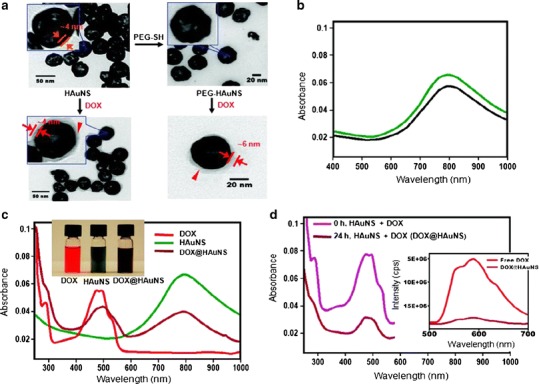
Fig. 1
Fig. 1
Physico-chemical characteristics of DOX-loaded HAuNSs. a Transmission electron microscope images depicted DOX covering the surface of both DOX@HAuNS and DOX@PEG-HAuNS, which did not exist in HAuNS and PEG-HAuNS before DOX coating. b Ultraviolet-visible absorption spectra exhibited that the plasmon resonance peak of PEG-HAuNSs (black line) did not change as compared with bare AuNSs (green line). c The color of the HAuNS changed from greenish to henna upon absorption of DOX. DOX@HAuNS displayed an ultraviolet–visible absorption peak at 490 nm, which is characteristic of DOX, and a broad NIR plasmon absorption peak at ∼800 nm, which is characteristic of HAuNS. d At 24 h after mixing, the absorbance peak intensity of DOX in the ultraviolet–visible region was significantly reduced compared with the absorbance peak intensity immediately after mixing DOX and HAuNS (0 h) owing to the quenching effect. In addition, compared with free DOX, which exhibited strong fluorescence emission, the fluorescence signal from DOX in DOX@HAuNS was almost completely quenched (d, inset). These results indicate that DOX was tightly bound to HAuNS and PEG-HAuNS after 24 h of incubation. Reproduced with permission from ref. (18). Copyright 2010, American Chemical Society (ACS)
Fig. 2
Fig. 2
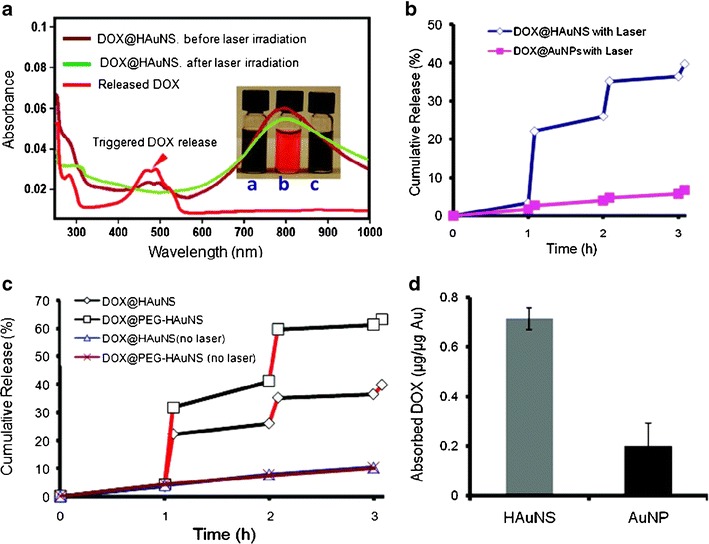
Release profile of DOX from HAuNS complexes when irradiated with an 808-nm NIR laser. a Ultraviolet-visible spectra of DOX@HAuNS before and after NIR laser irradiation. Inset photograph of aqueous solutions of a DOX@HAuNS before laser irradiation, b released DOX collected in the supernatant, and c DOX@HAuNS after complete release of DOX. b Release of DOX from DOX@HAuNS (blue line) and DOX@AuNP (pink line) under repeated NIR laser exposure. c NIR light-triggered release of DOX from DOX@HAuNS and DOX@PEG-HAuNS with and without NIR laser irradiation. Rapid DOX release was observed during NIR exposure (5 min, red lines), and the release was turned off when the laser was switched off. d DOX payload was higher in HAuNS than in solid AuNS. Reproduced with permission from ref. (18). Copyright 2010, ACS
Fig. 3
Fig. 3
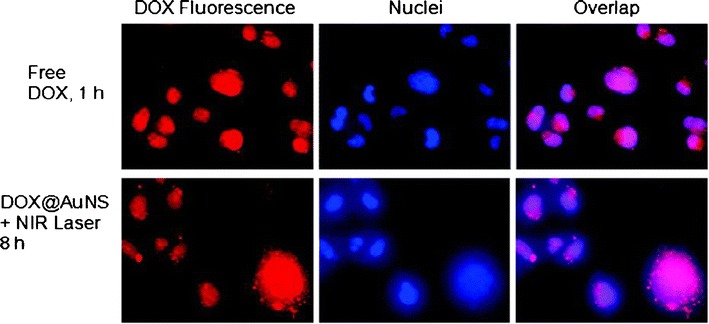
In vitro imaging of DOX@HAuNS and free DOX in MDA-MB-231 breast cancer cells. Cell uptake of free DOX and DOX@HAuNS treated with an 808-nm NIR laser (1.0 W/cm2 for 3 min per treatment, four treatments over 2 h, incubated for 8 h). Cell nuclei were counterstained with 4′,6-diamidino-2-phenylindole (DAPI; blue). The red fluorescence signal from DOX in DOX@HAuNS was localized to the cell nuclei after NIR laser irradiation, indicating intracellular release of DOX from DOX@HAuNS upon NIR exposure. Reproduced with permission from ref. (18). Copyright 2010, ACS
Fig. 4
Fig. 4
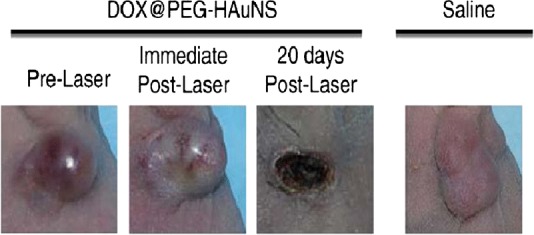
Antitumor activity in vivo of DOX@PEG-HAuNSs plus laser treatment against an MDA-MB-231 tumor. The tumor growth was slowed by treatment with the HAuNS complex and laser irradiation. Reproduced with permission from ref. (19). Copyright 2012, Elsevier
Fig. 5
Fig. 5
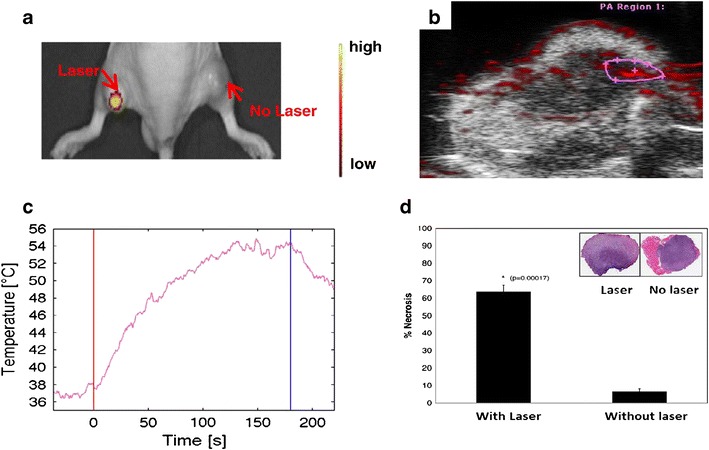
In vivo fluorescence intensity studies. a Representative in vivo fluorescence optical imaging of DOX release following the intratumoral injection of DOX@PEG-HAuNS at t = 24 h. b Overlaid photoacoustic and B-mode images of DOX release in vivo following intratumoral injection of DOX@PEG-HAuNS (1.32 × 1012 particles/mL) and treatment with a 6-W surface laser. c Conversion of photoacoustic signal to temperature. The first vertical line indicates the start of laser treatment, and the second vertical line indicates the end of laser treatment. d Histological analysis. The percentage of tumor necrosis in laser-treated mice (64%) was significantly higher than that in untreated mice (7%). Inset representative hematoxylin and eosin-stained slides of 4T1 tumors injected intratumorally with DOX@PEG-HAuNS with and without NIR surface laser treatment (0.15 W/mm2 for 1 min). Reproduced with permission from ref. (41). Copyright 2013, Elsevier
Fig. 6
Fig. 6
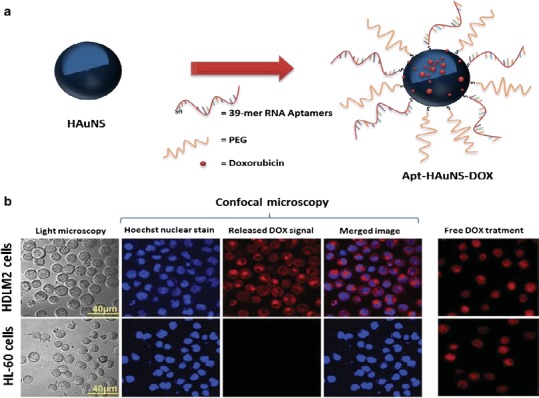
a Apt-HAuNS-DOX synthesis. b Top row Apt-HAuNS-DOX bound specifically to HDLM2 lymphoma cells and released the DOX (red) intracellularly. Hoechst 33342 was used for nuclear staining (blue). Bottom row Apt-HAuNS-DOX did not bind to HL-60 cells, which do not express CD30 biomarkers. Free DOX treatment was the control. Adapted from ref. (10), and used with permission. Copyright 2013, Wiley
Fig. 7
Fig. 7
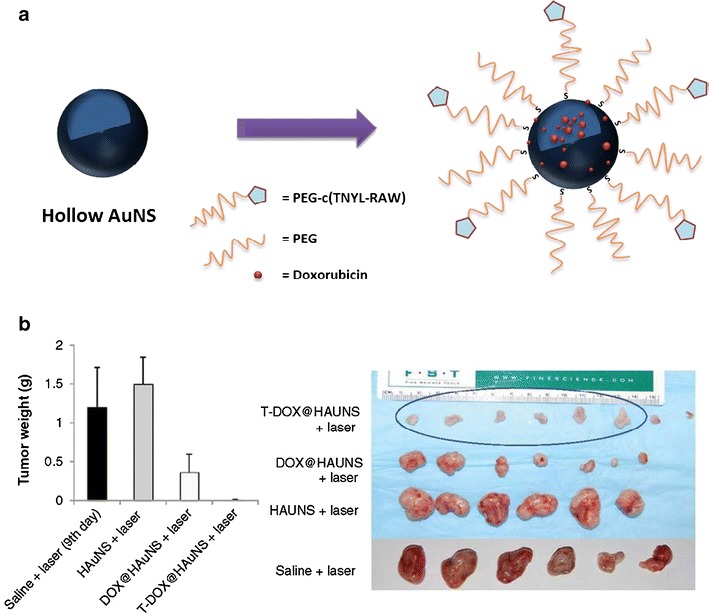
a SH-PEG-c(TNYL-RAW)-conjugated, DOX-loaded HAuNSs for targeted photothermal chemotherapy. b The average weights of tumors from different treatment groups. Reproduced with permission from ref. (46). Copyright 2012, American Association for Cancer Research (AACR)
Fig. 8
Fig. 8
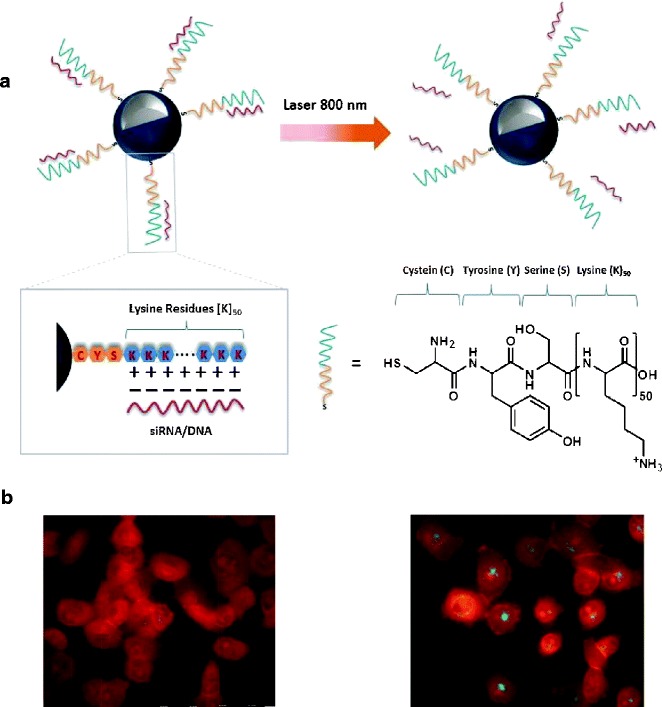
a Si@AuNS poly-l-lysine-based therapeutic RNA interference oligonucleotide delivery system. The negatively charged phosphate backbone of the siRNA/ssDNA (red) is electrostatically attached to the cationic peptide (blue), which consists of one cysteine, one tyrosine, one serine, and 50 lysine amino acids. Upon NIR irradiation, the siRNA/ssDNA is released. b Fluorescence images of H1299 cells incubated with ssDNA-Si@AuNSs. Alexa Fluor 488 (green) was used to fluorescently label the ssDNA. Without illumination with an NIR laser (without laser treatment), Alexa Fluor 488 was quenched by the AuNS surface, indicating that there is no dehybridization/release of ssDNA. The release of ssDNA after illumination with an NIR laser (with laser treatment). Adapted and reproduced with permission from ref. (49). Copyright 2012, ACS
Fig. 9
Fig. 9
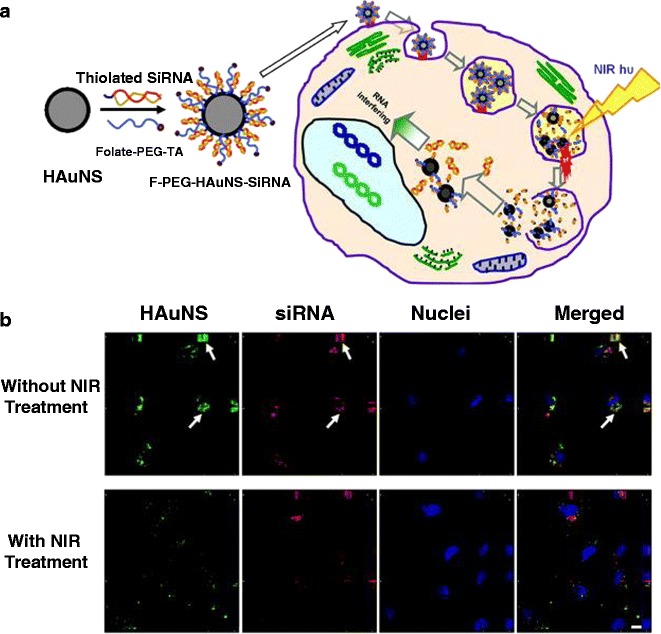
a The synthetic scheme of F-PEG-HAuNS-siRNA and their proposed intracellular itinerary following NIR light irradiation. b In vitro fluorescence imaging showed the dissociation of siRNA from HAuNS after laser irradiation. Red Dy547-labeled siRNA, green scattering signal of HAuNS, blue cell nuclei counterstained with DAPI. Arrows siRNA colocalized with HAuNS. Reproduced with permission from ref. (11). Copyright 2010, AACR

References

    1. Link S, El-Sayed MA. Optical properties and ultrafast dynamics of metallic nanocrystals. Annu Rev Phys Chem. 2003;54:331–6. doi: 10.1146/annurev.physchem.54.011002.103759. - DOI - PubMed
    1. Halas NJ, Lal S, Link L, Chang W-S, Natelson D, Hafner JH, et al. A plethora of plasmonics from the laboratory for nanophotonics at Rice University. Adv Mater. 2012;24:4842–77. doi: 10.1002/adma.201202331. - DOI - PubMed
    1. Bardhan R, Lal S, Joshi A, Halas NJ. Theranostic nanoshells: from probe design to imaging and treatment of cancer. Acc Chem Res. 2011;44:936–46. doi: 10.1021/ar200023x. - DOI - PMC - PubMed
    1. Weissleder R. A clearer vision for in vivo imaging. Nat Biotechnol. 2001;19:316–7. doi: 10.1038/86684. - DOI - PubMed
    1. Hirsch LR, Stafford RJ, Bankson JA, Sershen SR, Rivera B, Price RE, et al. Nanoshell-mediated near-infrared thermal therapy of tumors under magnetic resonance guidance. P Natl Acad Sci. 2003;100:13549–54. doi: 10.1073/pnas.2232479100. - DOI - PMC - PubMed

Publication types