. 2014 Feb 18;111(7):2632-7.
doi: 10.1073/pnas.1313787111. Epub 2014 Feb 3.

Ancient west Eurasian ancestry in southern and eastern Africa

Affiliations

Ancient west Eurasian ancestry in southern and eastern Africa

Joseph K Pickrell et al. Proc Natl Acad Sci U S A. .

Abstract

The history of southern Africa involved interactions between indigenous hunter-gatherers and a range of populations that moved into the region. Here we use genome-wide genetic data to show that there are at least two admixture events in the history of Khoisan populations (southern African hunter-gatherers and pastoralists who speak non-Bantu languages with click consonants). One involved populations related to Niger-Congo-speaking African populations, and the other introduced ancestry most closely related to west Eurasian (European or Middle Eastern) populations. We date this latter admixture event to ∼900-1,800 y ago and show that it had the largest demographic impact in Khoisan populations that speak Khoe-Kwadi languages. A similar signal of west Eurasian ancestry is present throughout eastern Africa. In particular, we also find evidence for two admixture events in the history of Kenyan, Tanzanian, and Ethiopian populations, the earlier of which involved populations related to west Eurasians and which we date to ∼2,700-3,300 y ago. We reconstruct the allele frequencies of the putative west Eurasian population in eastern Africa and show that this population is a good proxy for the west Eurasian ancestry in southern Africa. The most parsimonious explanation for these findings is that west Eurasian ancestry entered southern Africa indirectly through eastern Africa.

Keywords: migration; population genetics; prehistory.


Conflict of interest statement

The authors declare no conflict of interest.

Figures
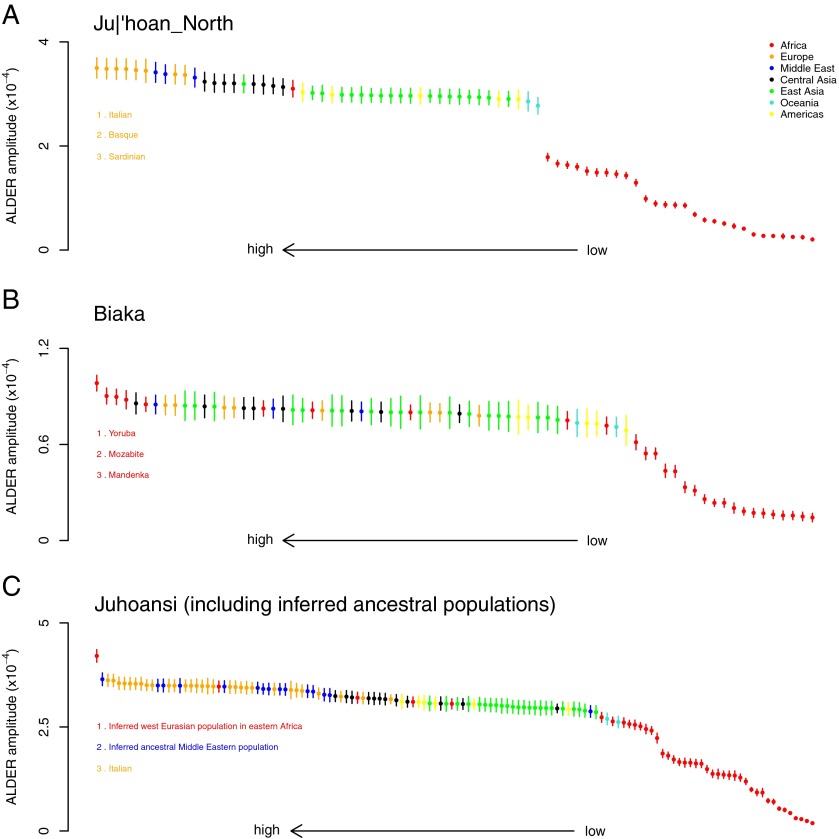
Fig. 1.
Fig. 1.
Identifying sources of admixture using LD. In each panel, we computed weighted LD curves with ALDER v1.0 using a test population as one reference and a panel of other populations as the second reference. We performed this analysis with different test populations: (A) the Ju|’hoan_North, (B) the Biaka, and (C) the Juhoansi [equivalent to the Ju|’hoan_North, but different samples genotyped on a different genotyping array (2)]. We fit an exponential decay curve to each LD curve, starting from 0.5 centiMorgans. Plotted are the fitted amplitudes for each curve; error bars indicate one SE. A larger amplitude indicates a closer relationship to one of the true admixing populations. Populations are ordered according to the amplitude and colored according to their continent of origin. The three populations with the largest amplitude (and thus the closest inferred relationship to the true mixing population) are listed. Note that the only populations from western Africa in these data are the Yoruba and Mandenka. In C, we include as references two inferred populations: the inferred west Eurasian population that entered Ethiopia (see main text for details) and an inferred Middle Eastern population before admixture with African populations (24).
Fig. 2.
Fig. 2.
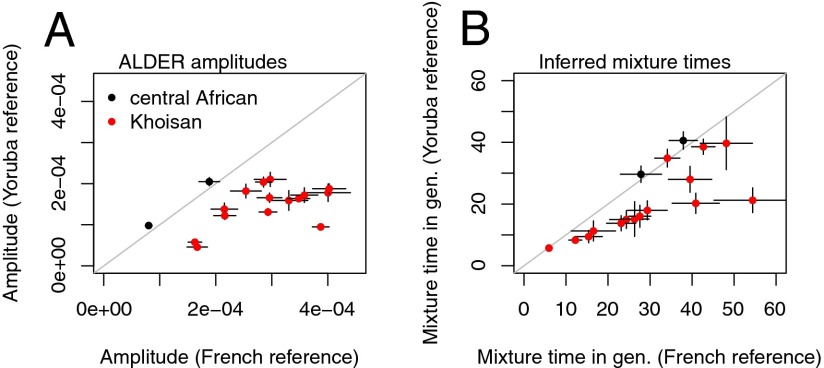
Relationship with west Eurasia is shared by all Khoisan populations. We generated weighted LD decay curves in each Khoisan (or central African hunter–gatherer) population, using weights computed using the test population as one reference and either the French or the Yoruba as the other reference. We then fit an exponential decay model to each LD curve. Plotted are the inferred (A) amplitudes and (B) admixture times in each population. Larger amplitudes indicate a closer relationship to the true admixing population, and under a model of a single admixture event the admixture times do not depend on the reference populations used.
Fig. 3.
Fig. 3.
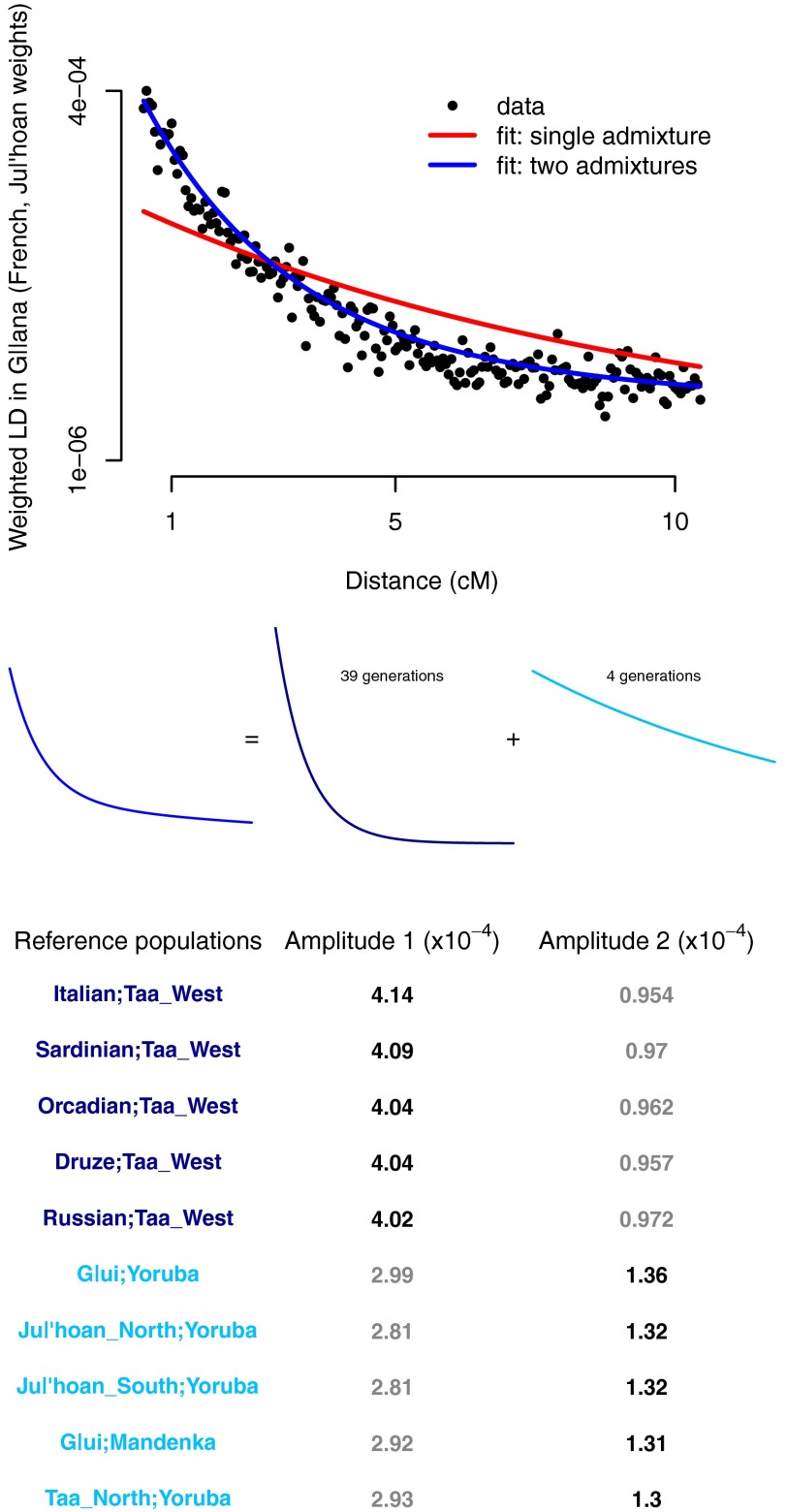
LD evidence for multiple waves of mixture in the G‖ana. We computed 990 (45 choose 2) weighted LD curves in the G‖ana and fit two models: one with a single admixture event, and one with two admixture events. Shown is the LD curve computed using the French and Ju|’hoan_North populations as references, along with the fitted curves from the two models (note that the decay rates in the fitted curves are shared across the data for all 990 pairs of populations, not only to the shown data). Below the plot, we show a schematic representation of the fitted model with two admixture events. In the table, we show the population pairs with the five largest estimated amplitudes on each admixture event (that is, the population pairs in dark blue are those with the largest weights on the dark blue curve, and those labeled in light blue are those with the largest weights on the light blue curve).
Fig. 4.
Fig. 4.
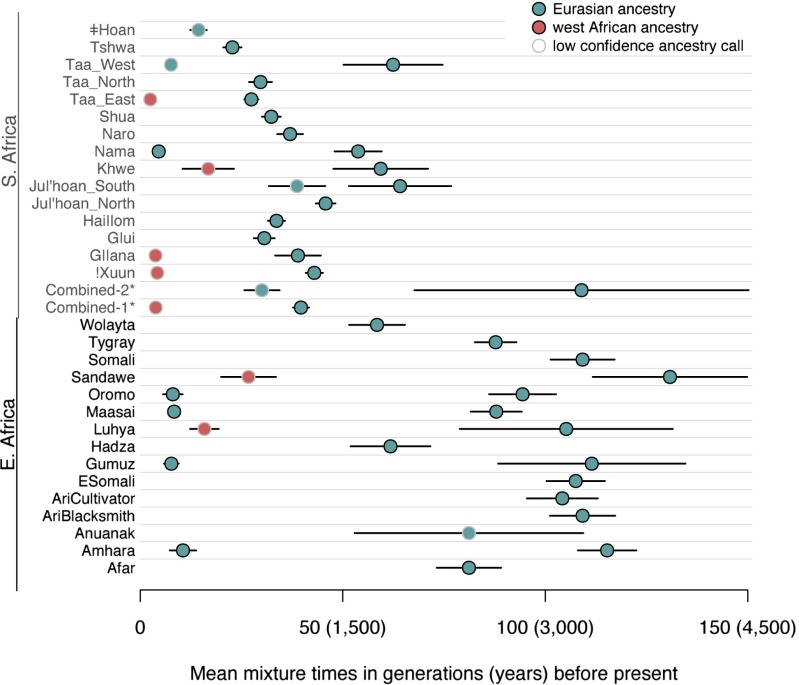
Mean times of admixture in southern and eastern Africa. For each southern or eastern African population, we estimated the number of mixture events and their dates. Plotted are the estimated dates. Black lines show one SE on the estimates. Points are colored according to the populations inferred as proxies for the mixing populations (SI Appendix). *The combined-1 population is the Tshwa, Shua, Hai‖om, ǂHoan, Naro, and Taa_North. The combined-2 population is the Ju|’hoan_North and G|ui (see main text for details).

References

    1. Phillipson D. African Archaeology. Cambridge, UK: Cambridge Univ Press; 2005.
    1. Schlebusch CM, et al. Genomic variation in seven Khoe-San groups reveals adaptation and complex African history. Science. 2012;338(6105):374–379. - PMC - PubMed
    1. Pickrell JK, et al. The genetic prehistory of southern Africa. Nat Commun. 2012;3:1143. - PMC - PubMed
    1. Petersen DC, et al. Complex patterns of genomic admixture within southern Africa. PLoS Genet. 2013;9(3):e1003309. - PMC - PubMed
    1. Patterson N, et al. Ancient admixture in human history. Genetics. 2012;192(3):1065–1093. - PMC - PubMed

Publication types

LinkOut - more resources