. 2014 Feb 18;111(7):2710-5.
doi: 10.1073/pnas.1317834111. Epub 2014 Feb 3.

Trimethylamine N-oxide metabolism by abundant marine heterotrophic bacteria

Affiliations

Trimethylamine N-oxide metabolism by abundant marine heterotrophic bacteria

Ian Lidbury et al. Proc Natl Acad Sci U S A. .

Abstract

Trimethylamine N-oxide (TMAO) is a common osmolyte found in a variety of marine biota and has been detected at nanomolar concentrations in oceanic surface waters. TMAO can serve as an important nutrient for ecologically important marine heterotrophic bacteria, particularly the SAR11 clade and marine Roseobacter clade (MRC). However, the enzymes responsible for TMAO catabolism and the membrane transporter required for TMAO uptake into microbial cells have yet to be identified. We show here that the enzyme TMAO demethylase (Tdm) catalyzes the first step in TMAO degradation. This enzyme represents a large group of proteins with an uncharacterized domain (DUF1989). The function of TMAO demethylase in a representative from the SAR11 clade (strain HIMB59) and in a representative of the MRC (Ruegeria pomeroyi DSS-3) was confirmed by heterologous expression of tdm (the gene encoding Tdm) in Escherichia coli. In R. pomeroyi, mutagenesis experiments confirmed that tdm is essential for growth on TMAO. We also identified a unique ATP-binding cassette transporter (TmoXWV) found in a variety of marine bacteria and experimentally confirmed its specificity for TMAO through marker exchange mutagenesis and lacZ reporter assays of the promoter for genes encoding this transporter. Both Tdm and TmoXWV are particularly abundant in natural seawater assemblages and actively expressed, as indicated by a number of recent metatranscriptomic and metaproteomic studies. These data suggest that TMAO represents a significant, yet overlooked, nutrient for marine bacteria.

Keywords: TMAO transporter; marine nitrogen cycle; methylated amine metabolism; nitrogenous osmolyte.


Conflict of interest statement

The authors declare no conflict of interest.

Figures
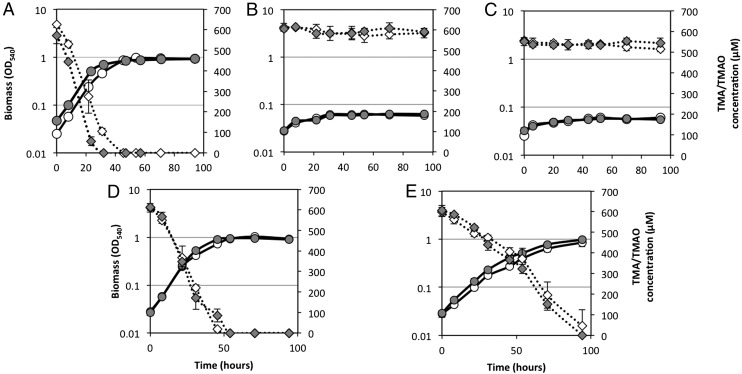
Fig. 1.
Fig. 1.
Growth of R. pomeroyi DSS-3 on TMA and TMAO as a sole N source. R. pomeroyi DSS-3 was grown on either TMA (white circles) or TMAO (gray circles) and concentrations of TMA (white diamonds) and TMAO (gray diamonds) were quantified throughout the growth. The function of tdm was determined by comparing growth of the wild type (A) against the Δtdm::Gm mutant (B). When the mutant was corrected with a native tdm from either R. pomeroyi DSS-3 (D) or Pelagibacteraceae strain HIMB59 (E) growth was restored, whereas the vector control (pBBR1MCS-km) did not restore the growth of the mutant on TMA or TMAO (C). All cultures were grown in triplicate and error bars denote SDs.
Fig. 2.
Fig. 2.
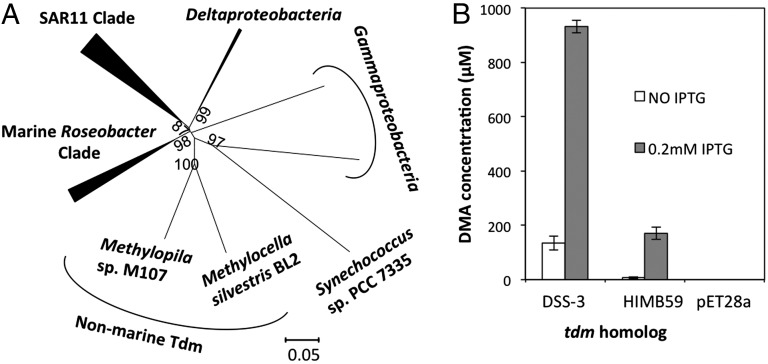
(A) Neighbor-joining phylogenetic analysis of Tdm retrieved from the genomes of sequenced marine bacteria. Bootstrap values (500 replicates) greater than 60% are shown. The scale bar denotes the number of amino acid differences per site. The analysis involved 49 Tdm sequences. There were a total of 468 amino acid residues in the alignment. Evolutionary analyses were conducted in MEGA5.1 (52). (B) Production of DMA from TMAO demethylation by recombinant Tdm of R. pomeroyi DSS-3 and Pelagibacteraceae strain HIMB59. pET28a represents the control empty vector with no insert. Error bars denote SDs of triplicate measurements. IPTG, isopropyl β-d-1-thiogalactopyranoside.
Fig. 3.
Fig. 3.
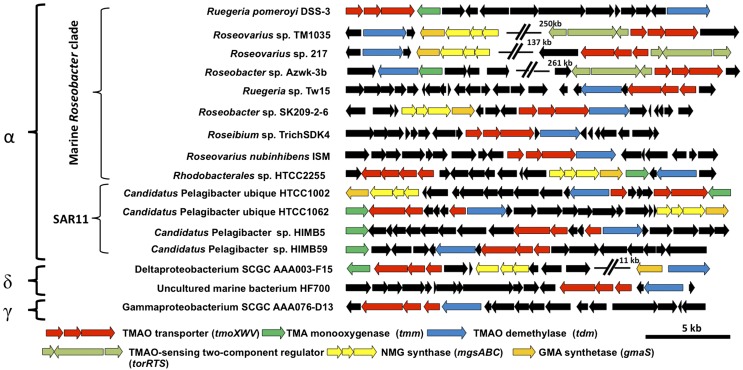
Genetic neighborhoods of the genes (tmoXWV) that encode the TMAO transporter (red) among representative genome-sequenced marine bacteria. All genes colored black have no confirmed functional relationship with TMAO metabolism. α, Alphaproteobacteria; δ, Deltaproteobacteria; γ, Gammaproteobacteria; GMA, γ-glutamylmethylamide; NMG, N-methylglutamate.
Fig. 4.
Fig. 4.
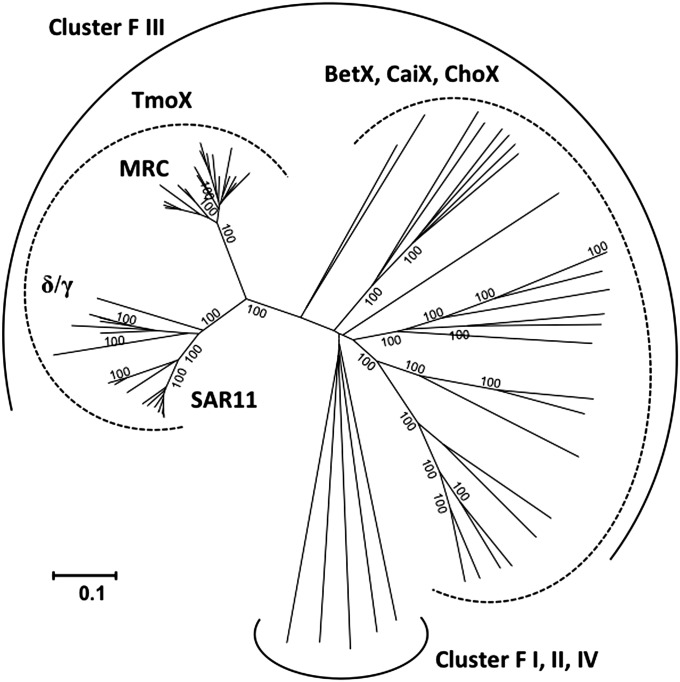
Phylogenetic analysis of the SBP, TmoX, of the TMAO-specific transporter in relation to other characterized SBPs. Current known SBPs specific for osmolytes, such as choline, glycine betaine, and carnitine, fall into the cluster F of the ABC superfamily (22). The evolutionary history was inferred using the neighbor-joining method (53). Bootstrap values (500 replicates) greater than 99% are shown. The scale bar represents the number of amino acid differences per site. The analysis involved 69 SBP sequences. There were a total of 296 amino acids positions in the alignment. Evolutionary analyses were conducted in MEGA5.1 (52). δ, Deltaproteobacteria; γ, Gammaproteobacteria; BetX, glycine betaine/proline betaine SBP; CaiX, carnitine SBP; ChoX, choline SBP.
Fig. 5.
Fig. 5.
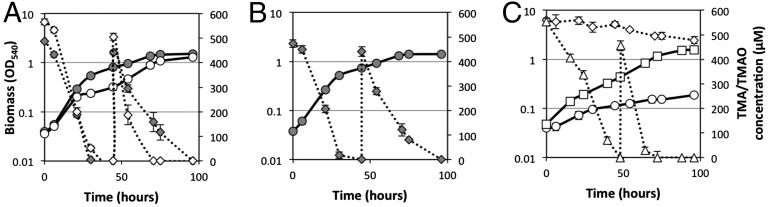
Growth of R. pomeroyi DSS-3 and the TMAO transporter mutants on TMA and TMAO as a sole N source. (A) R. pomeroyi wild type was grown on either TMA (gray circles) or TMAO (white circles) and concentrations of TMA (gray diamonds) and TMAO (white diamonds) were quantified during growth. (B) R. pomeroyi mutant ΔtmoX::Gm was grown on TMA (gray circles) and the concentration of TMA (gray diamonds) was quantified throughout growth. (C) R. pomeroyi mutant ΔtmoX::Gm was grown on TMAO (white circles) and the concentration of TMAO (white diamonds) was quantified throughout growth. The mutant was complemented with the native tmoX from R. pomeroyi, which was grown on TMAO as a sole N source (white squares), and the concentration of TMAO was quantified (white triangles). Once TMA/TMAO was depleted in the medium, a second dose (final concentration 0.5 mM) was added at 48 h. All cultures were grown in triplicate and error bars denote SDs.
Fig. 6.
Fig. 6.
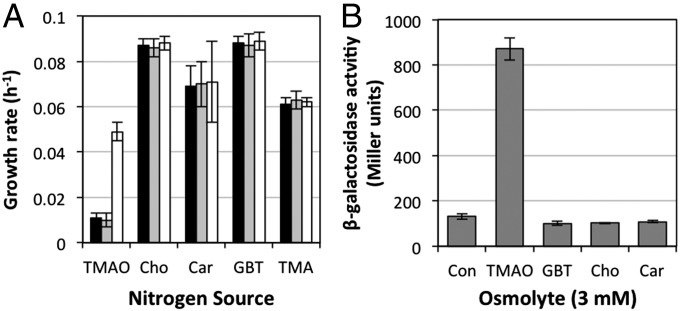
Effects of different compatible osmolytes on the growth of R. pomeroyi DSS-3 and regulation of the TMAO transporter tmoXWV. The growth rates of R. pomeroyi wild type (white bars) and the two transporter mutants, ΔtmoX::Gm (gray bars) and ΔtmoXW::Gm (black bars), were determined for each osmolyte and TMA as a sole N source. (A) Cultures of R. pomeroyi DSS-3 containing the tmoX–lacZ fusion plasmid pBIL101 were grown in the presence of each compatible osmolyte (3 mM). (B) Cultures were grown and assayed in triplicate for β-galactosidase activity and error bars denote SDs. Car, carnitine; Cho, choline; Con, control.

References

    1. Yancey PH, Clark ME, Hand SC, Bowlus RD, Somero GN. Living with water stress: Evolution of osmolyte systems. Science. 1982;217(4566):1214–1222. - PubMed
    1. Seibel BA, Walsh PJ. Trimethylamine oxide accumulation in marine animals: Relationship to acylglycerol storage. J Exp Biol. 2002;205(Pt 3):297–306. - PubMed
    1. Ballantyne JS. Jaws: The inside story. the metabolism of elasmobranch fishes. Comp Biochem Physiol B Biochem Mol Biol. 1997;118(4):703–742.
    1. Treberg JR, et al. The accumulation of methylamine counteracting solutes in elasmobranchs with differing levels of urea: A comparison of marine and freshwater species. J Exp Biol. 2006;209(Pt 5):860–870. - PubMed
    1. Quinn PK, Charlson RJ, Bates TS. Simultaneous observations of ammonia in the atmosphere and ocean. Nature. 1988;335(6188):336–338.

Publication types

MeSH terms