Review
. 2014 Feb 5:8:11.
doi: 10.3389/fnins.2014.00011. eCollection 2014.

Perinatal programming of emotional brain circuits: an integrative view from systems to molecules

Affiliations
Review

Perinatal programming of emotional brain circuits: an integrative view from systems to molecules

Jörg Bock et al. Front Neurosci. .

Abstract

Environmental influences such as perinatal stress have been shown to program the developing organism to adapt brain and behavioral functions to cope with daily life challenges. Evidence is now accumulating that the specific and individual effects of early life adversity on the functional development of brain and behavior emerge as a function of the type, intensity, timing and the duration of the adverse environment, and that early life stress (ELS) is a major risk factor for developing behavioral dysfunctions and mental disorders. Results from clinical as well as experimental studies in animal models support the hypothesis that ELS can induce functional "scars" in prefrontal and limbic brain areas, regions that are essential for emotional control, learning and memory functions. On the other hand, the concept of "stress inoculation" is emerging from more recent research, which revealed positive functional adaptations in response to ELS resulting in resilience against stress and other adversities later in life. Moreover, recent studies indicate that early life experiences and the resulting behavioral consequences can be transmitted to the next generation, leading to a transgenerational cycle of adverse or positive adaptations of brain function and behavior. In this review we propose a unifying view of stress vulnerability and resilience by connecting genetic predisposition and programming sensitivity to the context of experience-expectancy and transgenerational epigenetic traits. The adaptive maturation of stress responsive neural and endocrine systems requires environmental challenges to optimize their functions. Repeated environmental challenges can be viewed within the framework of the match/mismatch hypothesis, the outcome, psychopathology or resilience, depends on the respective predisposition and on the context later in life.

Keywords: early life stress; epigenetics; psychopathology; resilience; sex differences.


Figures
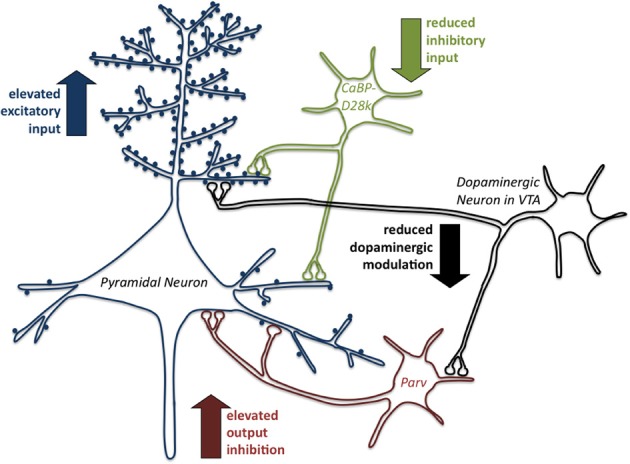
Figure 1
Figure 1
Early life stress induces inhibitory/excitatory dysbalance in the prefrontal anterior cingulate cortex. The scheme summarizes the changes of excitatory and inhibitory systems in the anterior cingulate cortex (ACC) induced by early life stress (repeated parental separation) in degus (Octodon degus). At first the excitatory input on pyramidal neurons is enhanced in response to early life stress since enhanced density of dendritic spines is observed, an effect indicating a disturbance in selective synaptic pruning. This effect is amplified by a reduction of inhibitory input reflected by reduction in CaBP-positive GABAergic interneurons. The resulting dysbalance in the system also becomes apparent in an elevated output inhibition by an increase in Parv-positive GABAergic interneurons. In addition the modulatory function of dopamine on the system is reduced. Overall, the observed alterations indicate a dysbalance of the excitatory and inhibitory modulation of pyramidal neuron activity in the prefrontal anterior cingulate cortex as a result of early life stress experience, which presumably underlies the described behavioral dysfunctions (for details see text).
Figure 2
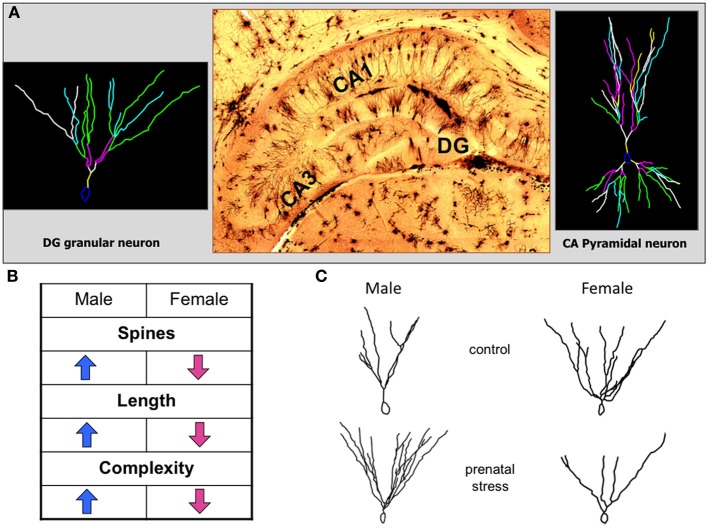
Figure 2
Opposing effects of prenatal stress exposure on dentate gyrus granular neurons in male and female offspring. (A) The histological picture in the middle shows a representative image of the hippocampal formation stained with the classical Golgi-Cox technique. On the left a representative reconstruction of a dentate gyrus granular neuron is shown, on the right a representative reconstruction of a CA pyramidal neuron. (B) The table indicates the significant changes of neuromorphologic parameters of dentate gyrus granular neuron dendrites after prenatal stress. Male and female offspring are affected in opposite directions. (C) Representative reconstructions of dentate gyrus granular neurons in male and female offspring of control and prenatally stressed dams showing the opposing sex-specific alterations of dendritic length and complexity.
Figure 3
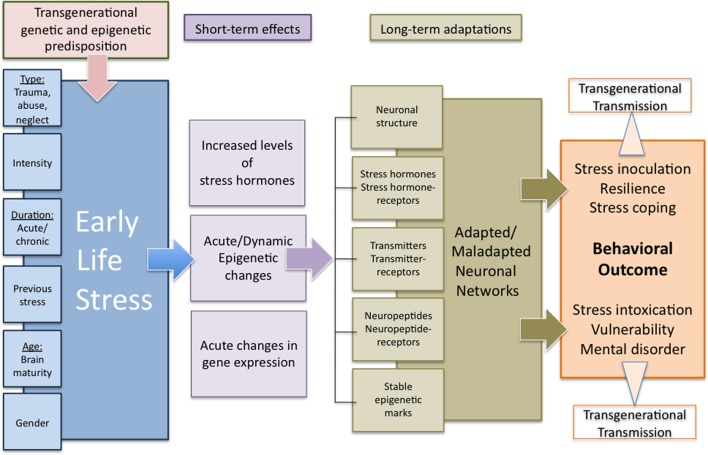
Figure 3
Transgenerational programming of neuronal networks by early life stress. The extent to which early life stress results in either an adaptive or a maladaptive behavioral outcome depends on a variety of environmental and internal influences and includes transgenerational components in terms of both genetic predisposition as well as acquired and transgenerationally transmitted epigenetic marks. Lasting behavioral changes are supposed to derive from acute and dynamic stress-induced alterations in gene expression as well as endocrine and epigenetic changes in interaction with the particular environmental and internal conditions resulting in stable long-term changes in neuronal networks. The adaptive or maladaptive changes determine the particular behavioral outcome under normal or stressful conditions in a positive or negative way. Additionally, these multi-level long-term adaptations might be transferred to following generations by epigenetic or behavioral mechanisms, representing a transgenerational predisposition for the adaptation to early life experiences.

References

    1. Abraham A., Gruss M. (2010). Stress inoculation facilitates active avoidance learning of the semi-precocial rodent Octodon degus. Behav. Brain Res. 213, 293–303 10.1016/j.bbr.2010.05.018 - DOI - PubMed
    1. Agid O., Kohn Y., Lerer B. (2000). Environmental stress and psychiatric illness. Biomed. Pharmacother. 54, 135–141 10.1016/S0753-3322(00)89046-0 - DOI - PubMed
    1. Ainsworth M. D. (1962). The effects of maternal deprivation: a review of findings and controversy in the context of research strategy. Public Health Pap. 14, 97–165 - PubMed
    1. Andersen S. L. (2003). Trajectories of brain development: point of vulnerability or window of opportunity? Neurosci. Biobehav. Rev. 27, 3–18 10.1016/S0149-7634(03)00005-8 - DOI - PubMed
    1. Andersen S. L., Teicher M. H. (2004). Delayed effects of early stress on hippocampal development. Neuropsychopharmacology 29, 1988–1993 10.1038/sj.npp.1300528 - DOI - PubMed

LinkOut - more resources