. 2014 Jan 31:8:8.
doi: 10.3389/fnsys.2014.00008. eCollection 2014.

Effects of age-related hearing loss and background noise on neuromagnetic activity from auditory cortex

Affiliations

Effects of age-related hearing loss and background noise on neuromagnetic activity from auditory cortex

Claude Alain et al. Front Syst Neurosci. .

Abstract

Aging is often accompanied by hearing loss, which impacts how sounds are processed and represented along the ascending auditory pathways and within the auditory cortices. Here, we assess the impact of mild binaural hearing loss on the older adults' ability to both process complex sounds embedded in noise and to segregate a mistuned harmonic in an otherwise periodic stimulus. We measured auditory evoked fields (AEFs) using magnetoencephalography while participants were presented with complex tones that had either all harmonics in tune or had the third harmonic mistuned by 4 or 16% of its original value. The tones (75 dB sound pressure level, SPL) were presented without, with low (45 dBA SPL), or with moderate (65 dBA SPL) Gaussian noise. For each participant, we modeled the AEFs with a pair of dipoles in the superior temporal plane. We then examined the effects of hearing loss and noise on the amplitude and latency of the resulting source waveforms. In the present study, results revealed that similar noise-induced increases in N1m were present in older adults with and without hearing loss. Our results also showed that the P1m amplitude was larger in the hearing impaired than in the normal-hearing adults. In addition, the object-related negativity (ORN) elicited by the mistuned harmonic was larger in hearing impaired listeners. The enhanced P1m and ORN amplitude in the hearing impaired older adults suggests that hearing loss increased neural excitability in auditory cortices, which could be related to deficits in inhibitory control.

Keywords: MEG; aging; auditory cortex; hearing loss; inhibition (psychology).


Figures
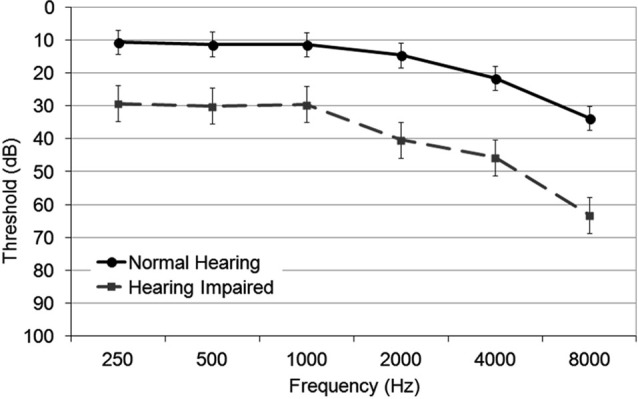
Figure 1
Figure 1
Group mean audiometric thresholds in normal hearing and hearing impaired older adults for octave frequencies between 250 and 8000 Hz. The error bars indicate standard error of the mean.
Figure 2
Figure 2
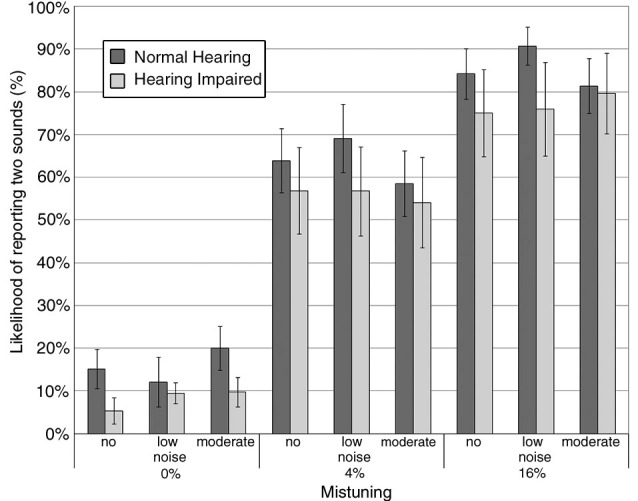
Group mean likelyhood of reporting hearing two concurrent sounds as a function of mistuning and background noise. The error bars indicate ±1 standard error of the mean. Normal hearing: darker gray bar; Hearing impaired: lighter gray bar.
Figure 3
Figure 3
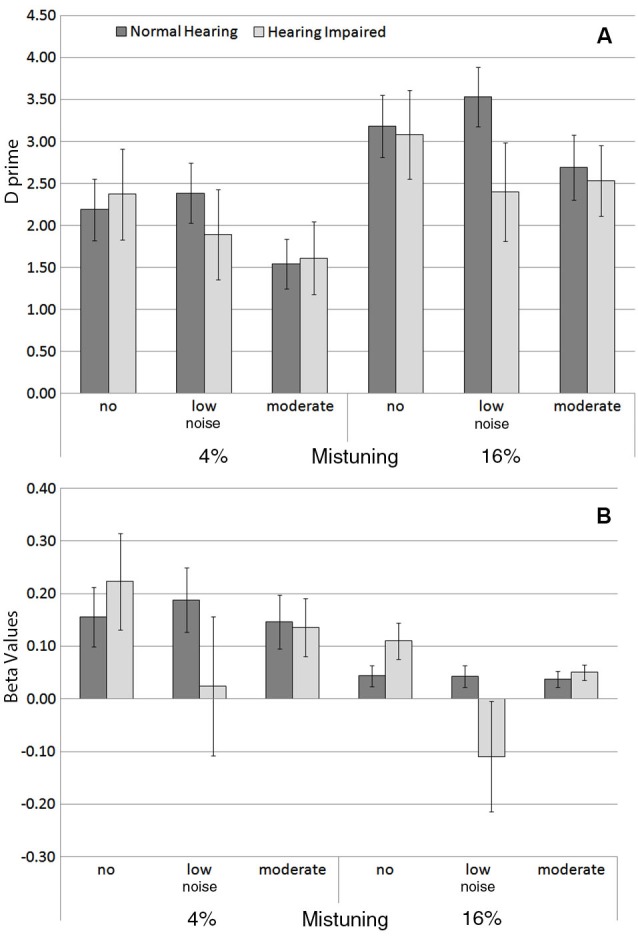
(A) Group mean sensitivity (d′) and (B) response bias (β) for each background noise condition for the 4% and for the 16% mistuned harmonics in normal hearing and in hearing impaired older adults. The error bars indicate ±1 standard error of the mean.
Figure 4
Figure 4
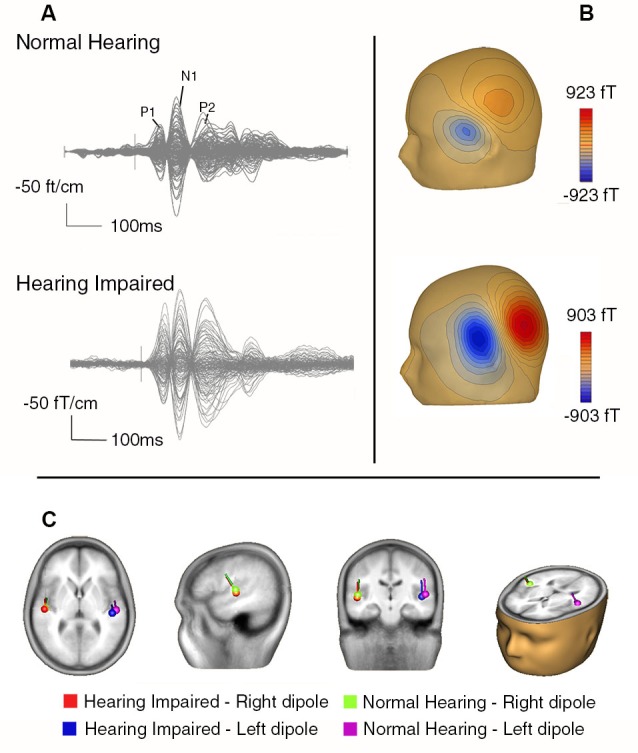
(A) Butterfly plot showing AEFs from a representative normal hearing older adult (top) and a hearing impaired older adult (bottom) averaged over all stimulus types from all sensors. (B) The contour maps for the N1m for these two participants indicate the direction of the magnetic flux (i.e., blue = negative, red = positive). (C) The group mean dipole location for the N1m from the normal and hearing impaired older adults overlaid on a magnetic resonance imaging template from BESA (5.3).
Figure 5
Figure 5
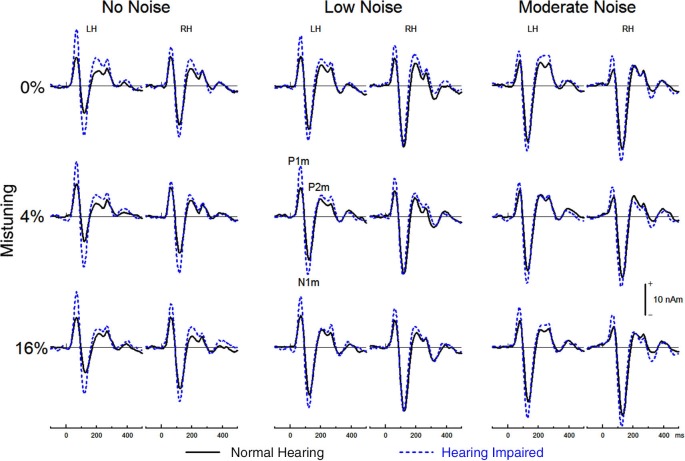
Group mean source waveform from the left hemisphere (LH) and the right hemisphere (RH) for tuned (top) and mistuned stimuli.
Figure 6
Figure 6
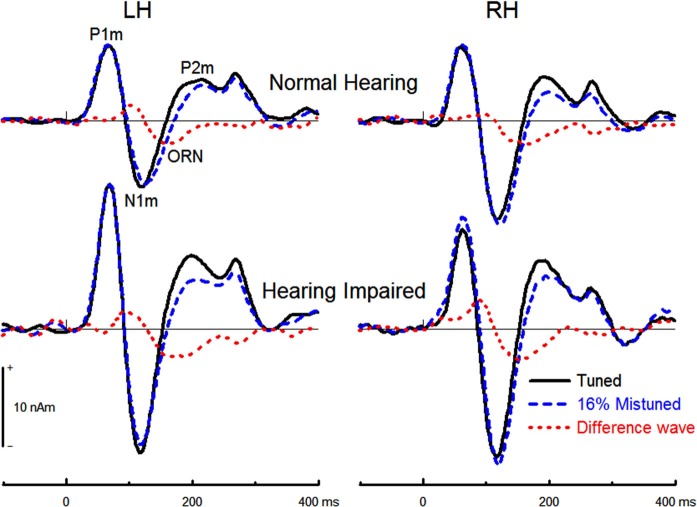
Group mean source waveform for the tuned and the 16% mistuned stimuli and the corresponding difference in source waveforms. The ORN peaked earlier when the harmonic was mistuned by 16% (M = 165, s.e. = 1.7 ms) than when it was mistuned by 4% (M = 175, s.e. = 1.7 ms), F(1,32) = 18.71, P < 0.001, η2 = 0.37. The effect of hearing status was not significant (F(1,32)= 2.10, P = 0.16) nor was the effect of noise (F < 1) or hemisphere (F(1,32) = 2.70, P = 0.11). The interaction between hearing status and mistuning was not significant (F(1,32) = 2.01, P = 0.17) nor was the interaction between hearing status and noise (F < 1).

References

    1. Alain C., Arnott S. R., Picton T. W. (2001). Bottom-up and top-down influences on auditory scene analysis: evidence from event-related brain potentials. J. Exp. Psychol. Hum. Percept. Perform. 27, 1072–1089 10.1037/0096-1523.27.5.1072 - DOI - PubMed
    1. Alain C., McDonald K. L. (2007). Age-related differences in neuromagnetic brain activity underlying concurrent sound perception. J. Neurosci. 27, 1308–1314 10.1523/jneurosci.5433-06.2007 - DOI - PMC - PubMed
    1. Alain C., McDonald K., Van Roon P. (2012). Effects of age and background noise on processing a mistuned harmonic in an otherwise periodic complex sound. Hear. Res. 283, 126–135 10.1016/j.heares.2011.10.007 - DOI - PubMed
    1. Alain C., Quan J., McDonald K., Van Roon P. (2009). Noise-induced increase in human auditory evoked neuromagnetic fields. Eur. J. Neurosci. 30, 132–142 10.1111/j.1460-9568.2009.06792.x - DOI - PubMed
    1. Alain C., Schuler B. M., McDonald K. L. (2002). Neural activity associated with distinguishing concurrent auditory objects. J. Acoust. Soc. Am. 111, 990–995 10.1121/1.1434942 - DOI - PubMed

LinkOut - more resources