


Implementing guidelines for depression on antidepressant prescribing in general practice: a quasi-experimental evaluation
- PMID: 24552140
- PMCID: PMC3996100
- DOI: 10.1186/1471-2296-15-35
Implementing guidelines for depression on antidepressant prescribing in general practice: a quasi-experimental evaluation
Abstract
Background: Internationally, guidelines for depression recommend a stepped care approach, implying that antidepressant medication should not be offered as a first step treatment to patients with sub-threshold or mild depression. In the Netherlands, antidepressant prescribing rates in general practice as a first treatment step are considered to be high. The aim of this study was to evaluate the implementation of guideline recommendations on antidepressant prescribing.
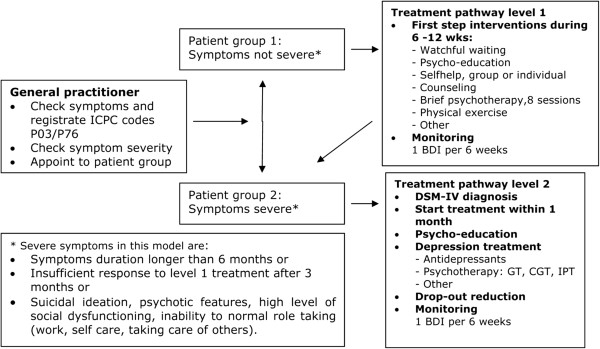
Methods: A quasi-experimental study with a non-equivalent naturalistic control group and three years follow-up was performed in the general practice setting in the Netherlands. General Practitioners (GPs) participated in a national Quality Improvement Collaborative (QIC), focusing on the implementation of a guideline based model for a stepped care approach to depression. The model consisted of self-help and psychological treatment options for patients with milder symptoms as an alternative to antidepressants in general practice. Changes in antidepressant prescription rates of GPs were documented for a three-year period and compared to those in a control group of GPs, selected from an ongoing national registration network.
Results: A decrease of 23.3% (49.4%-26.1%) in antidepressant prescription rates for newly diagnosed patients with depressive symptoms was found within the intervention group, whereas no difference occurred in the reference group (50.3%-52.6%). The decrease over time was significant, compared to the usual care group (OR 0.44, 95% CI: 0.21-0.92).
Conclusions: An implementation program using stepped care principles for the allocation of depression interventions resulted in reduced antidepressant prescription rates in general practice. GPs can change prescribing behaviour within the context of a QIC.
References
-
- Landelijke Stuurgroep Multidisciplinaire Richtlijnontwikkeling in de GGZ. Multidisciplinary guideline depression: guideline for diagnostics and treatment of adult clients with a major depressive disorder. Utrecht: Trimbos-instituut; 2005. [in Dutch]
-
- Landelijke Stuurgroep Multidisciplinaire Richtlijnontwikkeling in de GGZ. Revision of the Multidisciplinary guideline for Depression. Guideline for the diagnosis, treatment and care of adult patients with a depressive disorder. Utrecht: Trimbos-instituut; 2010. [in Dutch]
-
- National Collaborating Centre for Mental Health. Depression: the treatment and management of depression in adults: NICE clinical guideline 90. London: National Institute for Health and Clinical Excellence; 2009.
-
- New Zealand Guidelines Group. Identification of common mental disorders and management of depression in primary care. Wellington: New Zealand Guidelines Group; 2008.
Publication types
MeSH terms
Substances
LinkOut - more resources
Full Text Sources
Other Literature Sources
Medical
