


Brood parasitism: a good strategy in our changing world?
- PMID: 24552836
- PMCID: PMC4027383
- DOI: 10.1098/rspb.2013.2404
Brood parasitism: a good strategy in our changing world?
Abstract
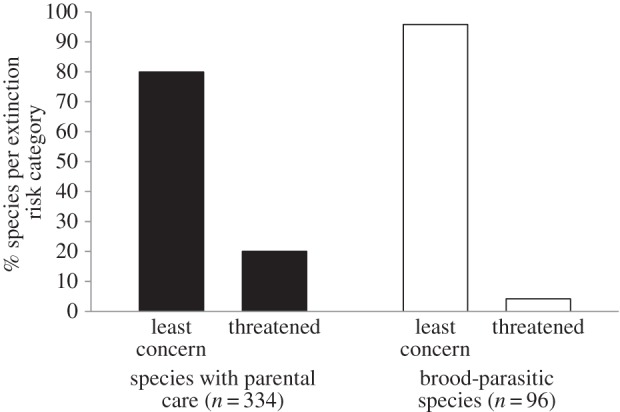
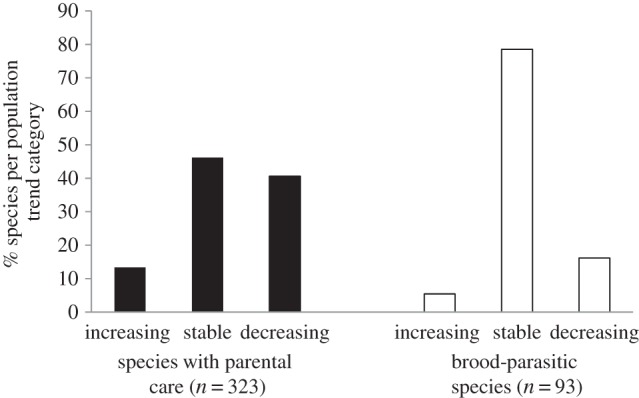
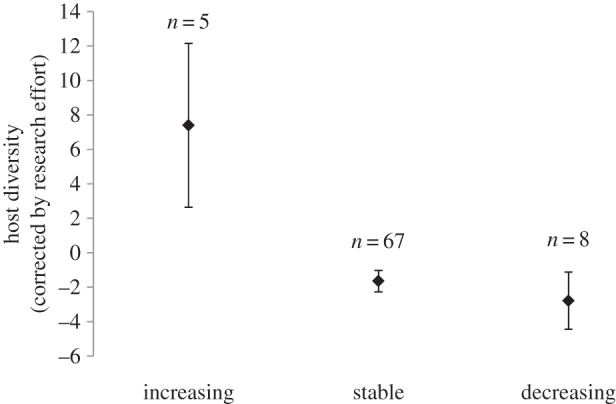
The original life-history strategy of brood-parasitic birds has been the focus of a large number of studies in ecology and evolution. Whether species adopting such a strategy differ in their response to global changes remains, however, unknown. Both the absence of investment in parental care and the capacity to spread nesting failure by laying eggs in several nests might help brood parasites in dealing with environmental changes. Alternatively, brood parasites might cumulate the negative effects of environmental changes on their own environment and on their hosts' environment. Here, I tested whether brood parasites' extinction risk and population trend differed from those of species with parental care. Focusing on the five bird families containing brood parasite species, I show that brood parasites are less at risk of extinction, and have a more stable population trend than species with parental care. In addition, I found that brood parasites with a higher host diversity were more likely to be increasing than those with fewer hosts. The bet-hedging strategy of brood parasites, by allowing them to spread nesting failure risks associated with environmental changes, is likely to help them resist current global changes.
Keywords: International Union for Conservation of Nature Red List; bet-hedging; global changes; host generalism.
Figures
References
-
- Payne R. 2005. The cuckoos. Oxford, NY: Oxford University Press.
-
- Slatkin M. 1974. Hedging one's evolutionary bets. Nature 250, 704–705. ( 10.1038/250704b0) - DOI
-
- Brown CR, Brown MB. 1996. Coloniality in the cliff swallow, the effect of group size on social behavior. Chicago, IL: University of Chicago Press.
Publication types
MeSH terms
LinkOut - more resources
Full Text Sources
Other Literature Sources
