. 2014 Mar;76(3):601-8; discussion 608-9.
doi: 10.1097/TA.0000000000000129.

Complement mediates a primed inflammatory response after traumatic lung injury

Affiliations

Complement mediates a primed inflammatory response after traumatic lung injury

J Jason Hoth et al. J Trauma Acute Care Surg. 2014 Mar.

Abstract

Background: Pulmonary contusion (PC) is a common, potentially lethal injury that results in the priming for exaggerated responses to subsequent immune challenge such as an infection (second hit). We hypothesize a PC-induced complement (C) activation participates in the priming effect for a second hit.

Methods: Male, 8 weeks to 9 weeks, C57BL/6 mice (wild-type, C5) underwent blunt chest trauma resulting in PC. At 3 hours/24 hours after injury, the inflammatory response was measured in tissue, serum, and bronchoalveolar lavage (BAL). The thrombin inhibitor, hirudin, was used to determine if injury-induced thrombin participated in the activation of C. Injury-primed responses were tested by challenging injured mice with bacterial endotoxin (lipopolysaccharide, LPS) as a second hit. Inflammatory responses were assessed at 4 hours after LPS challenge. Data were analyzed using one-way analysis of variance with Bonferroni multiple comparison posttest (significance, p ≤ 0.05). Protocols were approved by the Institutional Animal Care and Use Committee.

Results: We found significantly increased levels of C5a in the BAL of injured animals as early as 24 hours, persisting for up to 72 hours after injury. Hirudin-treated injured mice had significantly decreased levels of thrombin in the BAL that correlated with reduced C5a levels. Injured mice challenged with intratracheal (IT) LPS had increased C5a and inflammatory response. Conversely, inhibition of C5a or its receptor, C5aR, before LPS challenge correlated with decreased inflammatory responses; C5a-deficient mice showed a similar loss of primed response to LPS challenge.

Conclusion: Complement C5a levels in the BAL are increased over several days after PC. Premorbid inhibition of thrombin markedly decreases C5a levels after PC, suggesting that thrombin-induced C activation is the major pathway of activation after PC. Similarly, inhibition of C5a after PC will decrease injury-primed responses to LPS stimulation. Our findings suggest cross-talk between the coagulation and complement systems that induce immune priming after PC.


Figures

Figure 1
Figure 1
Patients with PC show sustained BAL levels of C5a after injury. C5a levels in the BAL from uninjured and injured patients with PC were measured as described in the Materials and Methods section. A, BALs from PC patients show increased C5a levels compared with BAL levels from healthy, uninjured controls (n = 4 per group). B, At 24 hours after injury, patients with PC greater than 24% (n = 4) showed significantly decreased C5a BAL levels compared with patients with PC greater than 24% (n = 6), while patients with PC greater than 24% and pneumonia (pc >24%pn, n = 4) showed significantly increased C5a BAL levels (significance, *p ≤ 0.05).
Figure 2
Figure 2
A mouse model of PC shows sustained BAL levels of C5a after injury and C5a-dependent injury and inflammatory responses. C5a and PMN (24 hours, BAL), CXCL1, and IL-6 levels (3 hours, serum) from uninjured and injured mice measured as described in the Materials and Methods section. A, BALs from WT injured mice show increased C5a levels compared with BAL levels from uninjured controls (n = 6 per group). B, C5-deficient (C5−/−, open bars) injured mice show significantly decreased PMN levels compared with WT injured mice (solid bars) (n = 6 per group). WT injured mice were treated IP or intravenously (n = 4) with α-C5a as described in the Materials and Methods section and show significantly decreased PMN levels compared with untreated injured WT mice. C, Serum levels of inflammatory mediators in uninjured (n = 3 per group) and injured (n = 5 per group) WT or C5−/− mice were compared. CXCL1 and IL-6 (10-fold difference in injured scale, left panel) were increased in injured mice compared with uninjured mice and was significantly decreased in C5−/− injured mice. (significance *p ≤ 0.05; **p < 0.001; n.s., no significant difference). D, Uninjured and injured lungs from WT and C5-deficient mice were formalin fixed, stained, and analyzed by an experienced pathologist. Lung sections of the contusion are shown (original magnification, 20×) at 24 hours after injury. Hemorrhage is evident in all injuries (right panels). Neutrophil infiltration is reduced in C5−/− mice compared with WT. Specimens shown are representative of lung injuries in at least three animals per genotype.
Figure 3
Figure 3
C5a release into the alveolar space after PC seems to be C3 independent. C5a levels in the BAL from uninjured and injured WT (black) and C3-deficient (C3−/−, gray) mice (24 hours, n = 5 per group) were measured as described in the Materials and Methods section. Levels of C5a in the BAL from injured C3−/− mice were similar to C5a levels in injured WT mice. For comparison, C5a levels in C5−/− mice are shown (open bars, left panel, note different scale, n = 4 per group) and show low C5a BAL levels with or without injury. (n.s., no significant difference).
Figure 4
Figure 4
Thrombin activity is inhibited by hirudin treatment and decreases C5a levels in the BAL of injured mice. Injured WT mice (black) were treated with hirudin, and thrombin activity and C5a were measured in the BAL as described in the Materials and Methods section. A, At 3 hours after injury, thrombin activity is significantly increased in the BAL from injured mice and is decreased to uninjured levels with inhibition by hirudin treatment of injured mice. B, Hirudin treatment also decreased C5a levels in the BAL of injured WT or C3-deficient (C3−/−) mice at 24 hours after injury (n = 5 per group, significance *p < 0.001).
Figure 5
Figure 5
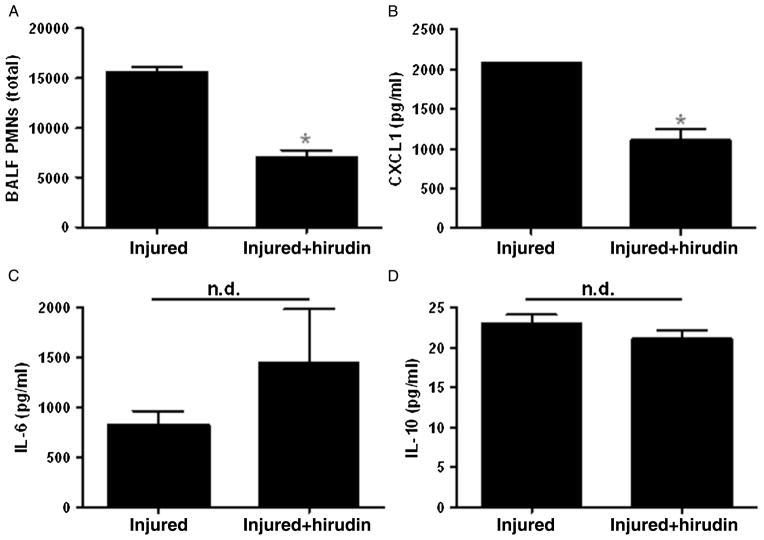
Inhibition of thrombin activity decreases PMN and CXCL1 levels in injured mice. Injured WT mice were treated with hirudin and PMN, and inflammatory mediator levels were measured as described in the Materials and Methods section. A, Hirudin treatment significantly decreases PMN in the BAL at 24 hours after injury. B, Hirudin treatment also significantly decreases CXCL1 levels in the serum at 3 hours after injury. Serum levels of IL-6 (C) and IL-10 (D) are not affected by hirudin treatment (n = 6 per group; significance *p < 0.0001; n.d., no difference).
Figure 6
Figure 6
C5a mediates a primed inflammatory response after PC. As described in the Materials and Methods section, injured WT mice were treated without or with α-C5a or C5aRa before LPS as a second hit; BAL as well as serum and tissue samples were obtained at 4 hours after the second hit. PMN in the BAL and inflammatory mediator levels in the serum were measured; tissue was fixed and stained as described in the Materials and Methods section. A, PMN levels in the BAL are significantly increased in injured + LPS mice compared with LPS only. Treatment with α-C5a or C5aRa (striped bars) decreased PMN levels. Injury-primed PMN response to a second hit in C5−/− mice is shown for comparison. B, CXCL1 and IL-6 show a significant injury-primed response that is inhibited in injured mice treated with α-C5a or C5aRa before the second hit. IL-10 levels do not show an injury-primed response to LPS, consistent with IL-10 levels remaining unaffected by PC (n = 5 per group; significance *p < 0.05). C, Injured WT mice treated without or with α-C5a or C5aRa before LPS as a second hit were formalin fixed, stained, and analyzed by an experienced pathologist. Lung sections (original magnification, 20×) at 4 hours after injury are shown. Histopathology is reduced in treated mice compared with untreated mice. Specimens shown are representative of at least three animals in the treated or untreated groups.

References

    1. Lasanianos NG, Kanakaris NK, Giannoudis PV. Intramedullary nailing as a ‘second hit’ phenomenon in experimental research: lessons learned and future directions. Clin Orthop Relat Res. 2010;468:2514–2529. - PMC - PubMed
    1. Murphy TJ, Paterson HM, Kriynovich S, et al. Linking the “two-hit” response following injury to enhanced TLR4 reactivity. J Leukoc Biol. 2005;77:16–23. - PubMed
    1. Paterson HM, Murphy TJ, Purcell EJ, et al. Injury primes the innate immune system for enhanced Toll-like receptor reactivity. J Immunol. 2003;171:1473–1483. - PubMed
    1. Hoth JJ, Martin RS, Yoza BK, Wells JD, Meredith JW, McCall CE. Pulmonary contusion primes systemic innate immunity responses. J Trauma. 2009;67:14–21. - PMC - PubMed
    1. Sarma JV, Ward PA. The complement system. Cell Tissue Res. 2011;343:227–235. - PMC - PubMed

Publication types

MeSH terms