. 2014 Feb 20;15(2):R36.
doi: 10.1186/gb-2014-15-2-r36.

Whole genome sequencing of Ethiopian highlanders reveals conserved hypoxia tolerance genes

Whole genome sequencing of Ethiopian highlanders reveals conserved hypoxia tolerance genes

Nitin Udpa et al. Genome Biol. .

Abstract

Background: Although it has long been proposed that genetic factors contribute to adaptation to high altitude, such factors remain largely unverified. Recent advances in high-throughput sequencing have made it feasible to analyze genome-wide patterns of genetic variation in human populations. Since traditionally such studies surveyed only a small fraction of the genome, interpretation of the results was limited.

Results: We report here the results of the first whole genome resequencing-based analysis identifying genes that likely modulate high altitude adaptation in native Ethiopians residing at 3,500 m above sea level on Bale Plateau or Chennek field in Ethiopia. Using cross-population tests of selection, we identify regions with a significant loss of diversity, indicative of a selective sweep. We focus on a 208 kbp gene-rich region on chromosome 19, which is significant in both of the Ethiopian subpopulations sampled. This region contains eight protein-coding genes and spans 135 SNPs. To elucidate its potential role in hypoxia tolerance, we experimentally tested whether individual genes from the region affect hypoxia tolerance in Drosophila. Three genes significantly impact survival rates in low oxygen: cic, an ortholog of human CIC, Hsl, an ortholog of human LIPE, and Paf-AHα, an ortholog of human PAFAH1B3.

Conclusions: Our study reveals evolutionarily conserved genes that modulate hypoxia tolerance. In addition, we show that many of our results would likely be unattainable using data from exome sequencing or microarray studies. This highlights the importance of whole genome sequencing for investigating adaptation by natural selection.


Figures
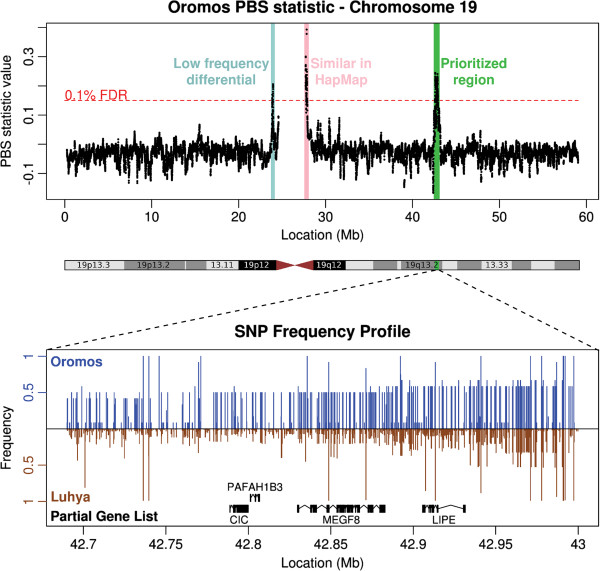
Figure 1
Figure 1
Population branch statistic (PBS) across chromosome 19 in the Oromos population compared to both the Luhya (LWK) and European (CEU) populations. The red line represents a genome-wide 0.1% FDR. Three distinct regions exceed this cutoff, two of which are near the centromere and were thus not prioritized. The bottom panel shows the SNP frequency profile in the prioritized region for Oromos (blue) and LWK (brown, inverted). Genes with Drosophila orthologs (on which RNAi experiments were conducted) are shown in black below the frequency profiles. As can be seen, variant frequencies in this region are considerably higher in the highlanders than in a nearby lowlander population.
Figure 2
Figure 2
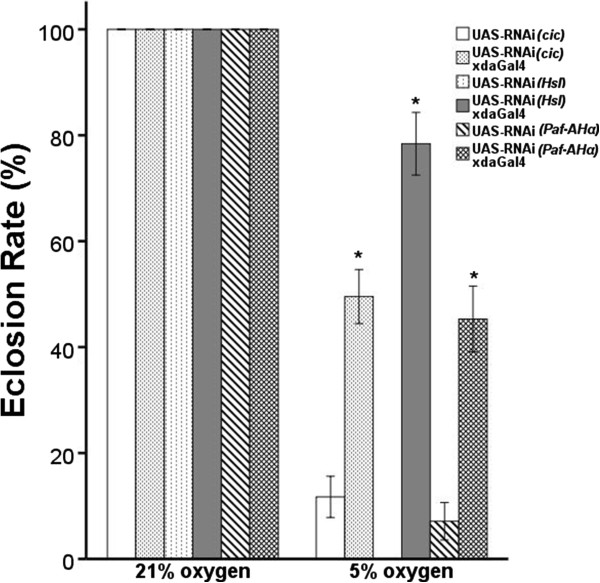
RNAi-mediated knockdown of candidate human gene orthologs enhanced hypoxia tolerance in D. melanogaster. The available UAS-RNAi lines for cic (ortholog of human CIC), Hsl (ortholog of human LIPE) and Paf-AHα (ortholog of human PAFAH1B3) were crossed with the daughterless (da)-GAL4, a driver strain that expresses GAL4 ubiquitously. The level of hypoxia tolerance was determined by measuring eclosion rate in an atmosphere chamber containing 5% O2. The UAS-RNAi stocks without cross were used as a negative control (open bars). Two different UAS-RNAi lines targeting each candidate gene were used in each experiment to minimize off-target effects. Each bar represents the mean ± standard error of the mean value of three separate tests; *P < 0.05.

References

    1. Rupert JL, Hochachka PW. The evidence for hereditary factors contributing to high altitude adaptation in Andean natives: a review. High Alt Med Biol. 2001;2:235–256. doi: 10.1089/152702901750265332. - DOI - PubMed
    1. Moore LG, Niermeyer S, Zamudio S. Human adaptation to high altitude: regional and life-cycle perspectives. Am J Phys Anthropol. 1998;27:25–64. - PubMed
    1. Beall CM. Two routes to functional adaptation: Tibetan and Andean high-altitude natives. Proc Natl Acad Sci USA. 2007;104:8655–8660. doi: 10.1073/pnas.0701985104. - DOI - PMC - PubMed
    1. Beall CM, Decker MJ, Brittenham GM, Kushner I, Gebremedhin A, Strohl KP. An Ethiopian pattern of human adaptation to high-altitude hypoxia. Proc Natl Acad Sci U S A. 2002;99:17215–17218. doi: 10.1073/pnas.252649199. - DOI - PMC - PubMed
    1. Appenzeller O, Claydon VE, Gulli G, Qualls C, Slessarev M, Zenebe G, Gebremedhin A, Hainsworth R. Cerebral vasodilatation to exogenous NO is a measure of fitness for life at altitude. Stroke. 2006;37:1754–1758. doi: 10.1161/01.STR.0000226973.97858.0b. - DOI - PubMed

Publication types

Associated data