Dovitinib versus sorafenib for third-line targeted treatment of patients with metastatic renal cell carcinoma: an open-label, randomised phase 3 trial
- PMID: 24556040
- PMCID: PMC5719485
- DOI: 10.1016/S1470-2045(14)70030-0
Dovitinib versus sorafenib for third-line targeted treatment of patients with metastatic renal cell carcinoma: an open-label, randomised phase 3 trial
Abstract
Background: An unmet medical need exists for patients with metastatic renal cell carcinoma who have progressed on VEGF-targeted and mTOR-inhibitor therapies. Fibroblast growth factor (FGF) pathway activation has been proposed as a mechanism of escape from VEGF-targeted therapies. Dovitinib is an oral tyrosine-kinase inhibitor that inhibits VEGF and FGF receptors. We therefore compared dovitinib with sorafenib as third-line targeted therapies in patients with metastatic renal cell carcinoma.
Methods: In this multicentre phase 3 study, patients with clear cell metastatic renal cell carcinoma who received one previous VEGF-targeted therapy and one previous mTOR inhibitor were randomly assigned through an interactive voice and web response system to receive open-label dovitinib (500 mg orally according to a 5-days-on and 2-days-off schedule) or sorafenib (400 mg orally twice daily) in a 1:1 ratio. Randomisation was stratified by risk group and region. The primary endpoint was progression-free survival (PFS) assessed by masked central review. Efficacy was assessed in all patients who were randomly assigned and safety was assessed in patients who received at least one dose of study drug. This study is registered with ClinicalTrials.gov, number NCT01223027.
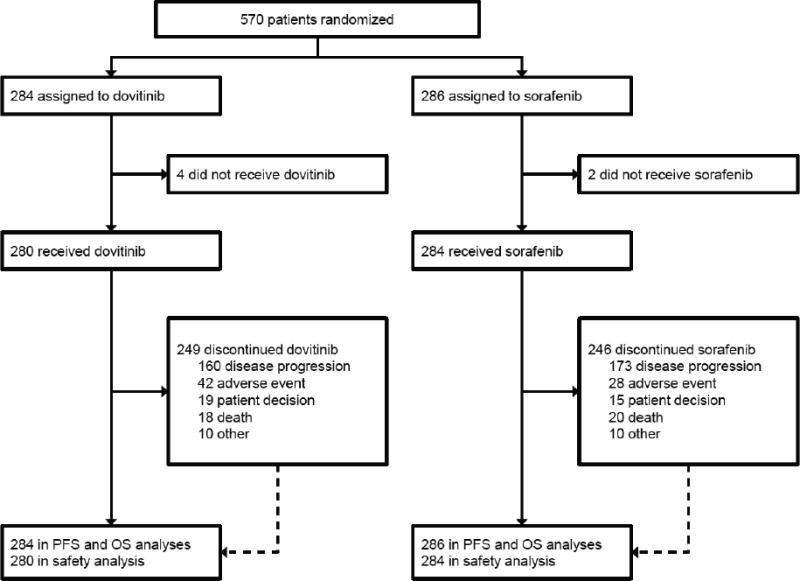
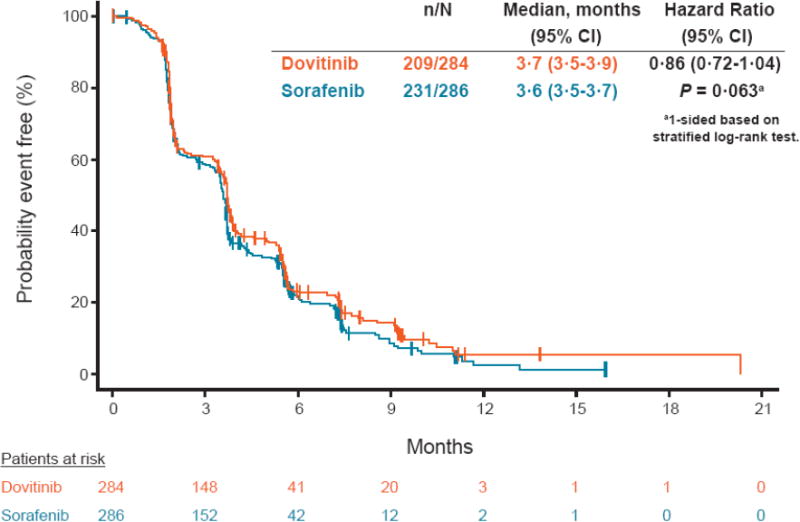
Findings: 284 patients were randomly assigned to the dovitinib group and 286 to the sorafenib group. Median follow-up was 11·3 months (IQR 7·9-14·6). Median PFS was 3·7 months (95% CI 3·5-3·9) in the dovitinib group and 3·6 months (3·5-3·7) in the sorafenib group (hazard ratio 0·86, 95% CI 0·72-1·04; one-sided p=0·063). 280 patients in the dovitinib group and 284 in the sorafenib group received at least one dose of study drug. Common grade 3 or 4 adverse events included hypertriglyceridaemia (38 [14%]), fatigue (28 [10%]), hypertension (22 [8%]), and diarrhoea (20 [7%]) in the dovitinib group, and hypertension (47 [17%]), fatigue (24 [8%]), dyspnoea (21 [7%]), and palmar-plantar erythrodysaesthesia (18 [6%]) in the sorafenib group. The most common serious adverse event was dyspnoea (16 [6%] and 15 [5%] in the dovitinib and sorafenib groups, respectively).
Interpretation: Dovitinib showed activity, but this was no better than that of sorafenib in patients with renal cell carcinoma who had progressed on previous VEGF-targeted therapies and mTOR inhibitors. This trial provides reference outcome data for future studies of targeted inhibitors in the third-line setting.
Funding: Novartis Pharmaceuticals Corporation.
Copyright © 2014 Elsevier Ltd. All rights reserved.
Conflict of interest statement
Figures
Comment in
-
Third-line dovitinib in metastatic renal cell carcinoma.Lancet Oncol. 2014 Mar;15(3):245-6. doi: 10.1016/S1470-2045(14)70082-8. Epub 2014 Feb 17. Lancet Oncol. 2014. PMID: 24556039 No abstract available.
-
Kidney cancer: targeting FGF for third-line treatment of mRCC.Nat Rev Urol. 2014 Apr;11(4):186. doi: 10.1038/nrurol.2014.55. Epub 2014 Mar 4. Nat Rev Urol. 2014. PMID: 24595120 No abstract available.
References
-
- Escudier B, Szczylik C, Porta C, Gore M. Treatment selection in metastatic renal cell carcinoma: expert consensus. Nat Rev Clin Oncol. 2012;9:327–37. - PubMed
-
- Bukowski RM. Temsirolimus: a safety and efficacy review. Expert Opin Drug Saf. 2012;11:861–79. - PubMed
-
- National Comprehensive Cancer Network. Clinical practice guidelines in oncology. [accessed December 10, 2013];Kidney cancer version 2.2014. 2013 http://www.nccn.org/professionals/physician_gls/pdf/kidney.pdf.
-
- European Association of Urology. Ljungberg B, Bensalah K, Bex A, et al. [accessed May 7, 2013];Guidelines on renal cell carcinoma. 2013 http://www.uroweb.org/gls/pdf/10_Renal_Cell_Carcinoma_LRV2.pdf.
-
- Presta M, Dell'Era P, Mitola S, Moroni E, Ronca R, Rusnati M. Fibroblast growth factor/fibroblast growth factor receptor system in angiogenesis. Cytokine Growth Factor Rev. 2005;16:159–78. - PubMed
Publication types
MeSH terms
Substances
Associated data
Grants and funding
LinkOut - more resources
Full Text Sources
Other Literature Sources
Medical
Miscellaneous