. 2014 Jul;25(7):1564-73.
doi: 10.1681/ASN.2013090921. Epub 2014 Feb 20.

Patient-reported and actionable safety events in CKD

Affiliations

Patient-reported and actionable safety events in CKD

Jennifer S Ginsberg et al. J Am Soc Nephrol. 2014 Jul.

Abstract

Patients with CKD are at high risk for adverse safety events because of the complexity of their care and impaired renal function. Using data from our observational study of predialysis patients with CKD enrolled in the Safe Kidney Care study, we estimated the baseline frequency of adverse safety events and determined to what extent these events co-occur. We examined patient-reported adverse safety incidents (class I) and actionable safety findings (class II), conditioned on participant use of drugs that might cause such an event, and we used association analysis as a data-mining technique to identify co-occurrences of these events. Of 267 participants, 185 (69.3%) had at least one class I or II event, 102 (38.2%) had more than one event, and 48 (18.0%) had at least one event from both classes. The adjusted conditional rates of class I and class II events ranged from 2.9 to 57.6 per 100 patients and from 2.2 to 8.3 per 100 patients, respectively. The most common conditional class I and II events were patient-reported hypoglycemia and hyperkalemia (serum potassium>5.5 mEq/L), respectively. Reporting of hypoglycemia (in patients with diabetes) and falling or severe dizziness (in patients without diabetes) were most frequently paired with other adverse safety events. We conclude that adverse safety events are common and varied in CKD, with frequent association between disparate events. Further work is needed to define the CKD "safety phenotype" and identify patients at highest risk for adverse safety events.

Keywords: chronic kidney disease; data mining; patient safety.


Figures

Figure 1.
Figure 1.
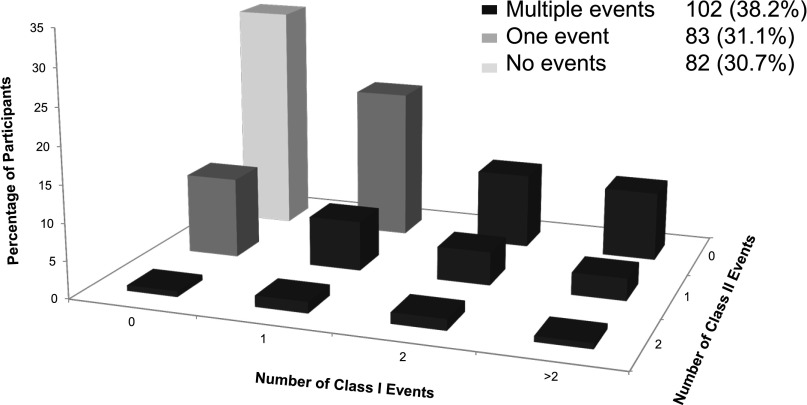
Study population distributed by the occurrence and frequency of class I and II adverse safety events showing that multiple events are common.
Figure 2.
Figure 2.
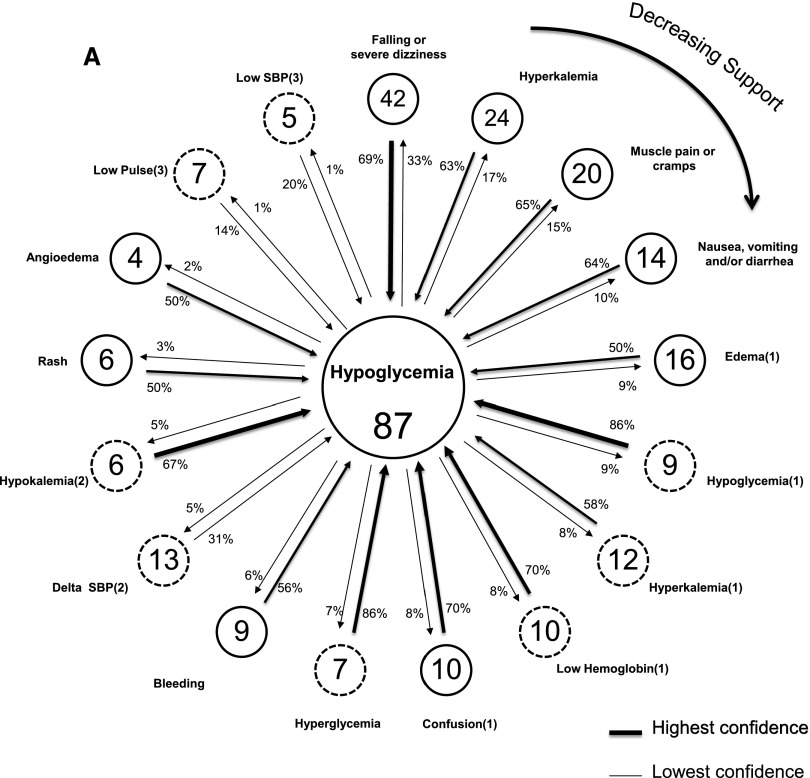
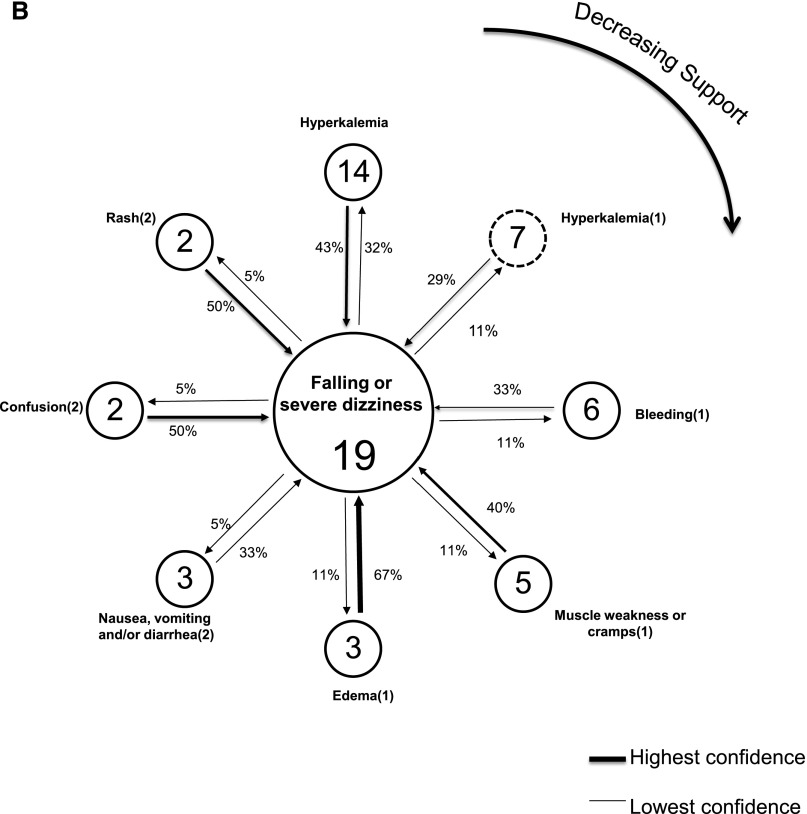
Link graphs depicting associations of hypoglycemia with other adverse safety events among diabetics, and associations of falling or severe dizziness with other adverse safety events among nondiabetics. (A) Displays adverse safety events related to the index (most common) adverse safety event of reported hypoglycemia (class I) among diabetics with at least one event (n=136). Nodes reflect individual event types and display the number of event occurrences, with arrow links representing the strength of confidence between each event and the index event. Confidence estimates are displayed for the co-occurring events proximate to the arrow representing the assumed directionality, for its computation. Dashed and solid node borders are class I and II events, respectively. The highest support estimate is for the node in the 12 o’clock position, with declining support emanating in a clockwise fashion. SBP, systolic BP. (B) Displays adverse safety events related to the index (most common) adverse safety event of reported falling or severe dizziness (class I) among nondiabetics with at least one event (n=49). Nodes reflect individual event types and display number of event occurrences, with arrow links representing the strength of confidence between each event and the index event. Confidence estimates are displayed for the co-occurring events proximate to the arrow representing the assumed directionality for its computation. Dashed and solid node borders are class I and II events, respectively. The highest support estimate is for the node in the 12 o’clock position, with declining support emanating in a clockwise fashion.
Figure 2.
Figure 2.
Link graphs depicting associations of hypoglycemia with other adverse safety events among diabetics, and associations of falling or severe dizziness with other adverse safety events among nondiabetics. (A) Displays adverse safety events related to the index (most common) adverse safety event of reported hypoglycemia (class I) among diabetics with at least one event (n=136). Nodes reflect individual event types and display the number of event occurrences, with arrow links representing the strength of confidence between each event and the index event. Confidence estimates are displayed for the co-occurring events proximate to the arrow representing the assumed directionality, for its computation. Dashed and solid node borders are class I and II events, respectively. The highest support estimate is for the node in the 12 o’clock position, with declining support emanating in a clockwise fashion. SBP, systolic BP. (B) Displays adverse safety events related to the index (most common) adverse safety event of reported falling or severe dizziness (class I) among nondiabetics with at least one event (n=49). Nodes reflect individual event types and display number of event occurrences, with arrow links representing the strength of confidence between each event and the index event. Confidence estimates are displayed for the co-occurring events proximate to the arrow representing the assumed directionality for its computation. Dashed and solid node borders are class I and II events, respectively. The highest support estimate is for the node in the 12 o’clock position, with declining support emanating in a clockwise fashion.

References

    1. Leape L, Berwick D, Clancy C, Conway J, Gluck P, Guest J, Lawrence D, Morath J, O’Leary D, O’Neill P, Pinakiewicz D, Isaac T, Lucian Leape Institute at the National Patient Safety Foundation : Transforming healthcare: A safety imperative. Qual Saf Health Care 18: 424–428, 2009 - PubMed
    1. Leape LL, Berwick DM: Five years after To Err Is Human: What have we learned? JAMA 293: 2384–2390, 2005 - PubMed
    1. McCannon CJ, Hackbarth AD, Griffin FA: Miles to go: An introduction to the 5 million lives campaign. Jt Comm J Qual Patient Saf 33: 477–484, 2007 - PubMed
    1. Seliger SL, Zhan M, Hsu VD, Walker LD, Fink JC: Chronic kidney disease adversely influences patient safety. J Am Soc Nephrol 19: 2414–2419, 2008 - PMC - PubMed
    1. Chapin E, Zhan M, Hsu VD, Seliger SL, Walker LD, Fink JC: Adverse safety events in chronic kidney disease: The frequency of “multiple hits”. Clin J Am Soc Nephrol 5: 95–101, 2010 - PMC - PubMed

Publication types