Wheezing phenotypes in young children: an historical cohort study
- PMID: 24557527
- PMCID: PMC6442292
- DOI: 10.4104/pcrj.2014.00008
Wheezing phenotypes in young children: an historical cohort study
Abstract
Background: Wheezing phenotypes in young children have usually been described on the basis of questionnaire surveys instead of prospectively doctor-diagnosed episodes, and have never been described in terms of incidence rates.
Aims: To identify wheezing phenotypes in the first three years and describe their incidence trends, and to investigate their relationship with asthma at six years of age.
Methods: Doctor-diagnosed wheezing episodes in the first 36 months and active asthma at six years were identified in a historical cohort of 3,739 children followed from birth in 29 primary care health centres in Spain. Wheezing phenotypes were identified by means of latent class analysis. Changes in incidence rates of wheezing were identified through joinpoint regression models and their predictive ability for asthma was analysed.
Results: One never/infrequent wheeze phenotype and three wheezing phenotypes were identified. There were two early phenotypes which started wheezing at a median age of six months, one of which was transient while the other had a heavy recurrence of episodes. A third phenotype exhibited a delayed onset of wheezing, a constant rise in incidence through the first 36 months, and a relationship with allergic asthma. These three phenotypes had a higher prevalence of active asthma at six years than the never/infrequent wheeze phenotype, but the classification had a weak predictive ability for asthma due to low sensitivity.
Conclusions: The use of incidence rates contributes to the clarification of the natural history of infant wheezing.
Conflict of interest statement
The authors declare that they have no conflicts of interest in relation to this article.
Figures
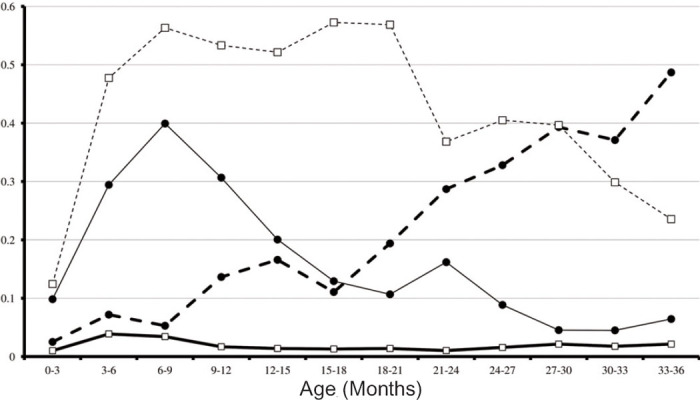
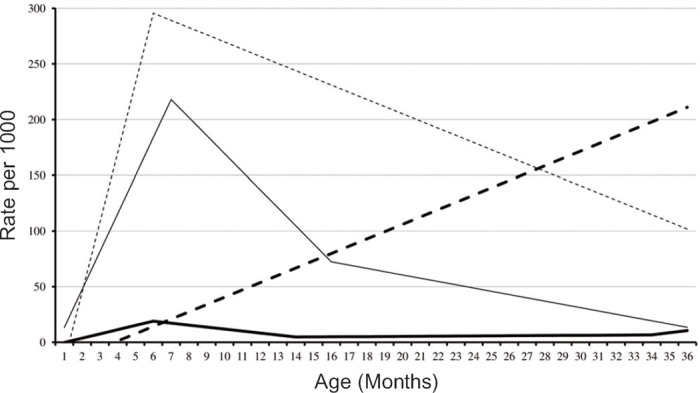
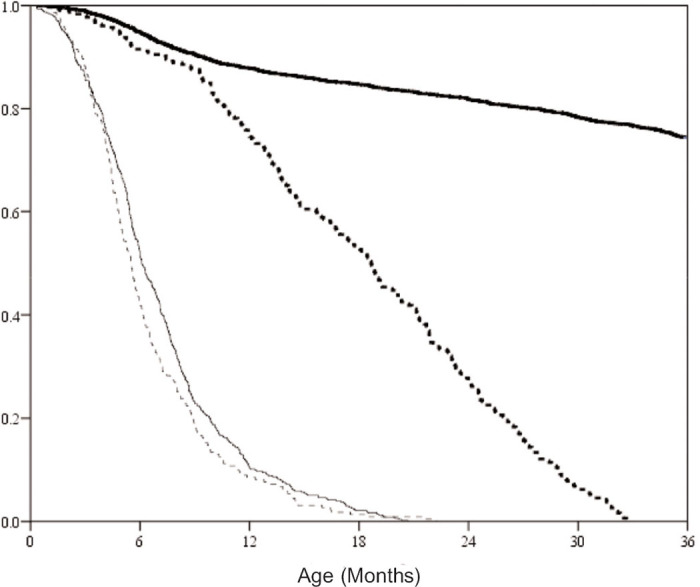
Comment in
-
Predicting the outcome of early childhood wheeze: mission impossible.Prim Care Respir J. 2014 Mar;23(1):10-1. doi: 10.4104/pcrj.2014.00010. Prim Care Respir J. 2014. PMID: 24553821 Free PMC article. No abstract available.
References
-
- Brand PLP, Baraldi E, Bisgaard H, et al. ERS Task Force. Definition, assessment and treatment of wheezing disorders in preschool children: an evidence-based approach. Eur Respir J 2008;32:1096–110. http://dx.doi.org/10.1183/09031936.00002108 - PubMed
-
- Mansbach JM, Espinola JA, Macias CG, Ruhlen ME, Sullivan AF, Camargo CA. Variability in the diagnostic labeling of nonbacterial lower respiratory tract infections: a multicenter study of children who presented to the emergency department. Pediatrics 2009;123:e573–81. http://dx.doi.org/10.1542/peds.2008-1675 - PubMed
-
- Martinez FD, Wright AL, Taussig LM, Holberg CJ, Halonen M, Morgan WJ. Asthma and wheezing in the first six years of life. N Engl J Med 1995;332:133–8. http://dx.doi.org/10.1056/NEJM199501193320301 - PubMed
-
- Bergmann RL, Bergmann KE, Lau-Schadensdorf S, et al. Atopic diseases in infancy. The German multi¬center atopy study (MAS-90). Pediatr Allergy Immunol 1994;5(6 Suppl):19–25. - PubMed
-
- Kurukulaaratchy RJ, Fenn MH, Waterhouse LM, Matthews SM, Holgate ST, Arshad SH. Characterization of wheezing phenotypes in the first 10 years of life. Clin Exp Allergy 2003;33:573–8. http://dx.doi.org/10.1046/j.1365-2222.2003.01657.x - PubMed
Publication types
MeSH terms
LinkOut - more resources
Full Text Sources
Other Literature Sources