Observational Study
. 2014 Aug;37(4):1158-66.
doi: 10.1007/s10753-014-9840-2.

Contrasting inflammatory responses in severe and non-severe community-acquired pneumonia

Affiliations
Observational Study

Contrasting inflammatory responses in severe and non-severe community-acquired pneumonia

Rafael Fernandez-Botran et al. Inflammation. 2014 Aug.

Abstract

The objective of this study was to compare systemic and local cytokine profiles and neutrophil responses in patients with severe versus non-severe community-acquired pneumonia (CAP). Hospitalized patients with CAP were grouped according to the pneumonia severity index (PSI), as non-severe (PSI < 91 points) or severe (PSI ≥ 91 points). Blood and sputum samples were collected upon admission. Compared to non-severe CAP patients, the severe CAP group showed higher plasma levels of pro- and anti-inflammatory cytokines but in contrast, lower sputum concentrations of pro-inflammatory cytokines. Blood neutrophil functional responses were elevated in CAP patients compared to healthy controls. However, neutrophils from severe CAP patients showed reduced respiratory burst activity compared to the non-severe group. Results indicate that patients with severe CAP fail to mount a robust local pro-inflammatory response but exhibit instead a more substantial systemic inflammatory response, suggesting that a key driver of CAP severity may be the ability of the patient to generate an optimal local inflammatory response.


Figures
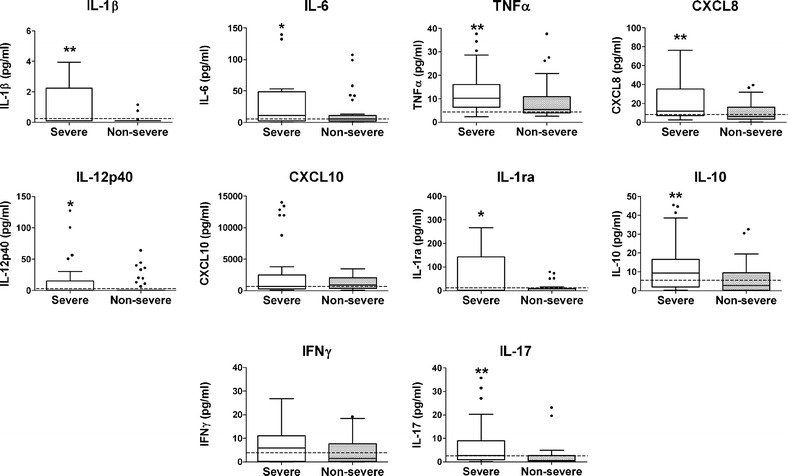
Fig. 1
Fig. 1
Plasma cytokine profiles in non-severe and severe CAP patient groups. Blood samples were obtained shortly after admission to the hospital and assayed for the indicated cytokines and chemokines. Box plots depict the 25–75 % interquartile range and the horizontal bar depicts the median. *p < 0.05; **p < 0.01. For comparison, the broken horizontal line represents the mean plus one SD of the values for the healthy control group. Median and IQR data are summarized in Supplementary Table 1.
Fig. 2
Fig. 2
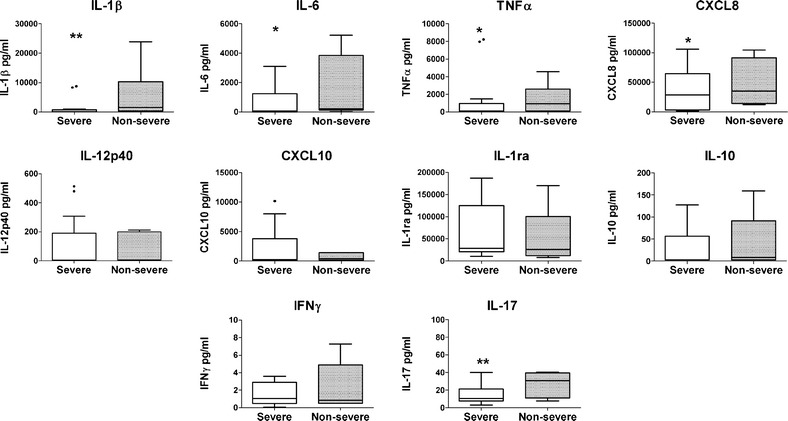
Sputum cytokine profiles in non-severe and severe CAP patient groups. Sputum samples were obtained shortly after admission to the hospital and processed and assayed for the indicated cytokines and chemokines. Box plots depict the 25–75 % interquartile range and the horizontal bar depicts the median. *p < 0.05; **p < 0.01. Median and IQR data are summarized in Supplementary Table 2.
Fig. 3
Fig. 3
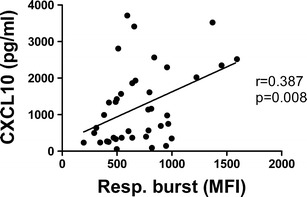
Correlation between the neutrophil respiratory burst and plasma levels of CXCL10.

References

    1. Armstrong G, Conn LA, Pinner RW. Trends in infectious disease mortality in the United States during the 20th century. Journal of the American Medical Association. 1999;281:61–66. doi: 10.1001/jama.281.1.61. - DOI - PubMed
    1. Almirall J, Bolibar I, Vidal J, Sauca G, Coll P, Niklasson B, et al. Epidemiology of community-acquired pneumonia in adults; a population-based study. European Respiratory Journal. 2000;15:757–763. doi: 10.1034/j.1399-3003.2000.15d21.x. - DOI - PubMed
    1. Craig A, Mai J, Cai S, Jeyaseelan S. Neutrophil recruitment to the lungs during bacterial pneumonia. Infection and Immunity. 2009;77:568–575. doi: 10.1128/IAI.00832-08. - DOI - PMC - PubMed
    1. Kolling UK, Hansen F, Braun J, Rink L, Katus HA, Dalhoff K. Leukocyte response and anti-inflammatory cytokines in community acquired pneumonia. Thorax. 2001;56:121–125. doi: 10.1136/thorax.56.2.121. - DOI - PMC - PubMed
    1. Borregaard N, Sørensen OE, Theilgaard-Mönch K. Neutrophil granules: a library of innate immunity proteins. Trends in Immunology. 2007;28:340–345. doi: 10.1016/j.it.2007.06.002. - DOI - PubMed

Publication types