


Red Ginseng-containing diet helps to protect mice and ferrets from the lethal infection by highly pathogenic H5N1 influenza virus
- PMID: 24558309
- PMCID: PMC3915332
- DOI: 10.1016/j.jgr.2013.11.012
Red Ginseng-containing diet helps to protect mice and ferrets from the lethal infection by highly pathogenic H5N1 influenza virus
Abstract
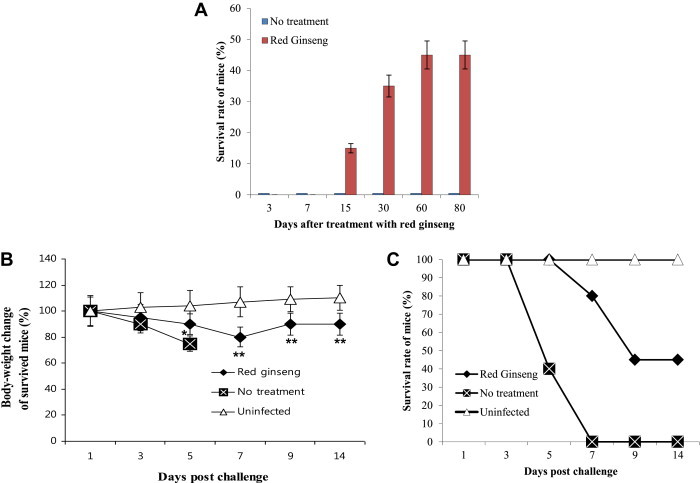
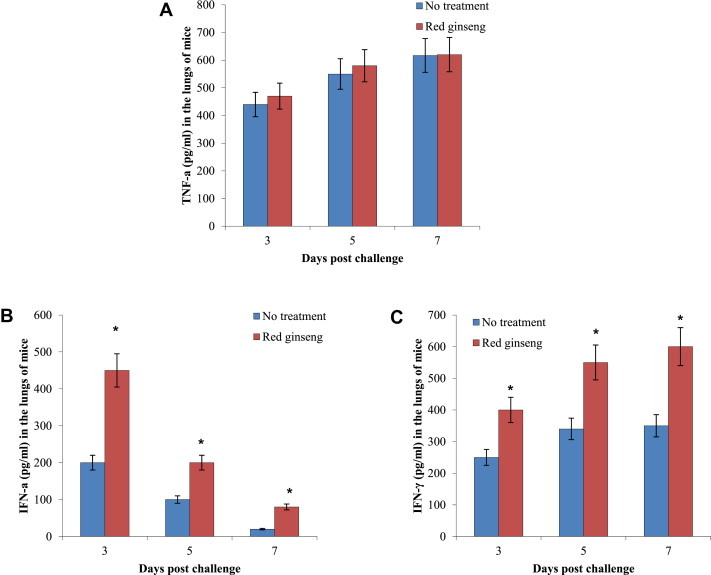
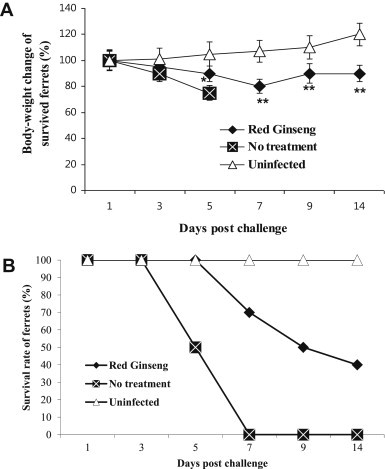
The highly pathogenic (HP) H5N1 influenza virus is endemic in many countries and has a great potential for a pandemic in humans. The immune-enhancing prowess of ginseng has been known for millennia. We aimed to study whether mice and ferrets fed with Red Ginseng could be better protected from the lethal infections of HP H5N1 influenza virus than the infected unfed mice and ferrets. We fed mice and ferrets with Red Ginseng prior to when they were infected with HP H5N1 influenza virus. The mice and ferrets fed with a 60-day diet containing Red Ginseng could be protected from lethal infections by HP H5N1 influenza virus (survival rate of up to 45% and 40%, respectively). Interferon-α and -γ antiviral cytokines were significantly induced in the lungs of mice fed Red Ginseng, compared to mice fed an unsupplemented diet. These data suggest that the diet with the immune-enhancing Red Ginseng could help humans to overcome the infections by HP H5N1 influenza virus.
Keywords: H5N1; Panax ginseng; influenza; interferon; pandemic.
Figures
References
-
- Hatta M., Kawaoka Y. The continued pandemic threat posed by avian influenza viruses in Hong Kong. Trends Microbiol. 2002;10:340–344. - PubMed
-
- Taubenberger J.K., Reid A.H., Krafft A.E., Bijwaard K.E., Fanning T.G. Initial genetic characterization of the 1918 “Spanish” influenza virus. Science. 1997;275:1793–1796. - PubMed
LinkOut - more resources
Full Text Sources
Other Literature Sources
Research Materials
Miscellaneous
