


The effects on tuberculosis treatment adherence from utilising community health workers: a comparison of selected rural and urban settings in Kenya
- PMID: 24558452
- PMCID: PMC3928331
- DOI: 10.1371/journal.pone.0088937
The effects on tuberculosis treatment adherence from utilising community health workers: a comparison of selected rural and urban settings in Kenya
Abstract
Introduction: Community Health Workers (CHWs) have been utilised for various primary health care activities in different settings especially in developing countries. Usually when utilised in well defined terms, they have a positive impact. To support Kenya's policy on engagement of CHWs for tuberculosis (TB) control, there is need to demonstrate effects of utilising them.
Objectives: This study assessed TB treatment adherence among patients who utilised CHWs in management of their illness in comparison to those who did not in urban and rural settings.
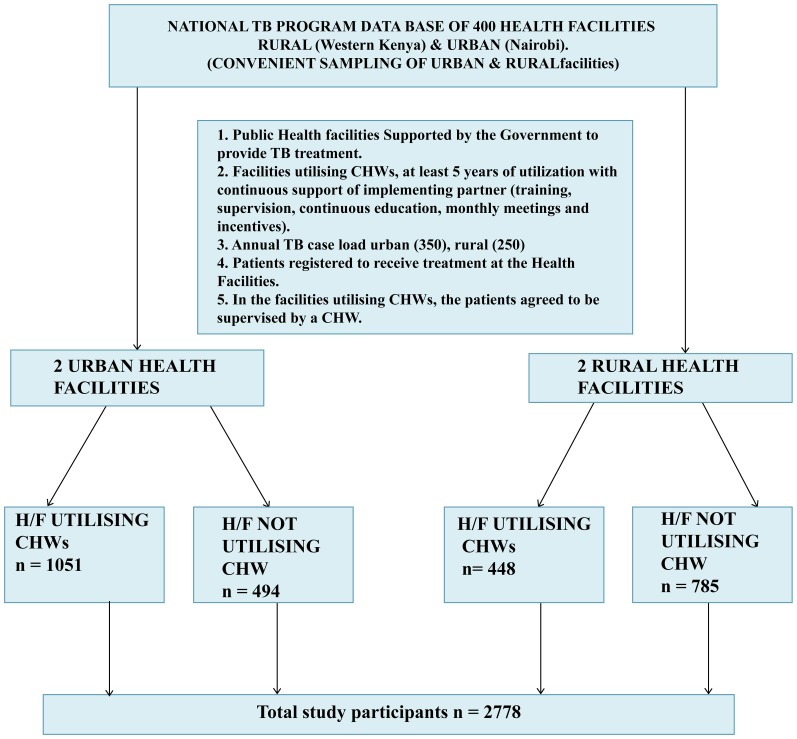
Methods: A retrospective cohort study was conducted in selected health facilities using standard clinical records for each TB patient registered for treatment between 2005 to 2011. Qualitative data was collected from CHWs and health care providers.
Results: The study assessed 2778 tuberculosis patients and among them 1499 (54%) utilized CHWs for their TB treatment. The urban setting in comparison with the rural setting contributed 70% of patients utilising the CHWs (p<0.001). Overall treatment adherence of the cohort was 79%. Categorizing by use of CHWs, adherence among patients who had utilized CHWs was 83% versus 68% among those that had not (p<0.001). In comparison between the rural and urban settings adherence was 76% and 81.5% (p<0.001) respectively and when categorized by use of CHWs it was 73% and 90% (p<0.001) for the rural and urban set ups respectively. Utilisation of CHWs remained significant in enhancing treatment adherence in the cohort with unadjusted and adjusted ORs; OR 2.25, (95% 1.86-2.73) p<0.001 and OR 1.98 (95% 1.51-2.5) p<0.001 respectively. It was most effective in the urban set-up, OR 2.65 (95% 2.02-3.48, p<0.001) in comparison to the rural set up, OR 0.74 (95% 0.56-0.97) p = 0.032.
Conclusion: Utilisation of CHWs enhanced TB treatment adherence and the best effects were in the urban set-up.
Conflict of interest statement
Figures
References
-
- Lariosa TR (1992) The role of community health workers in malaria control in the Philippines. Southeast Asian J. Trop. Med. Public Health. 23 (Suppl. 1), 30–35. - PubMed
-
- Newell JN, Baral SC, Pande SB, Bam DS, Malla P (2006) Family-member DOTS and community DOTS for tuberculosis control in Nepal: cluster-randomised controlled trial. Lancet 367: 903–909. - PubMed
-
- Brownstein JN, Lee RB, Dennison CR, Hill MN, Kim MT, et al. (2005) Community Health Workers as Interventionists in the Prevention and Control of Heart Disease and Stroke. Am J Prev Med 29(5S1): 128–133. - PubMed
-
- Love MB, Gardner K (1992) The Emerging Role of the Community Health Worker in California. Health Promotion Section, California Department of Health Services.
Publication types
MeSH terms
Grants and funding
LinkOut - more resources
Full Text Sources
Other Literature Sources
Medical
