


Evolutionary genetics of plant adaptation: insights from new model systems
- PMID: 24561539
- PMCID: PMC7659028
- DOI: 10.1016/j.pbi.2014.01.001
Evolutionary genetics of plant adaptation: insights from new model systems
Abstract
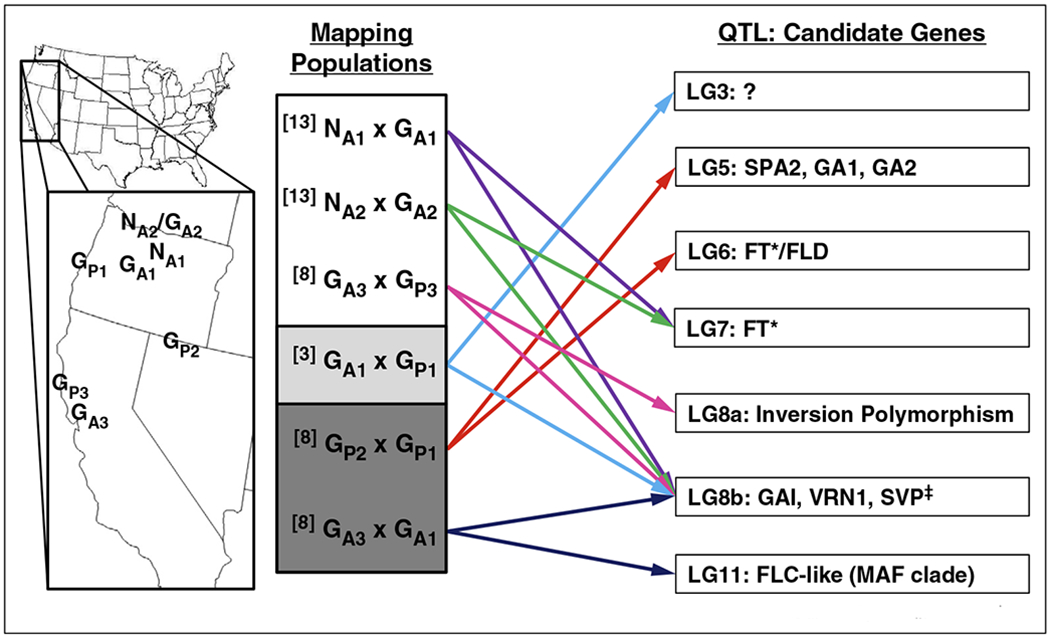
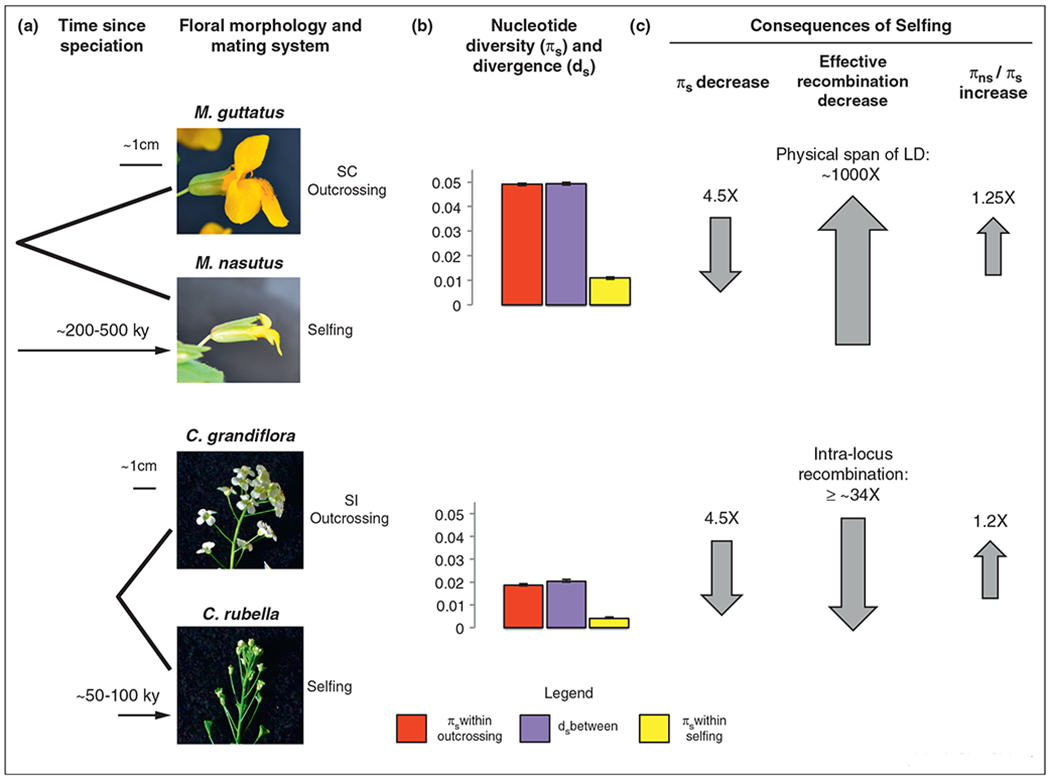
Flowering time and mating system divergence are two of the most common adaptive transitions in plants. We review recent progress toward understanding the genetic basis of these adaptations in new model plant species. For flowering time, we find that individual crosses often reveal a simple genetic basis, but that the loci involved almost always vary within species and across environments, indicating a more complex genetic basis species-wide. Similarly, the transition to self-fertilization is often genetically complex, but this seems to depend on the amount of standing variation and time since species divergence. Recent population genomic studies also raise doubts about the long-term adaptive potential of self-fertilization, providing evidence that purifying selection is less effective in highly selfing species.
Copyright © 2014 Elsevier Ltd. All rights reserved.
Figures
References
-
- Hereford J: A quantitative survey of local adaptation and fitness trade-offs. Am Nat 2009, 173:579–588. - PubMed
-
- Verhoeven KJF, Poorter H, Nevo E, Biere A: Habitat-specific natural selection at a flowering-time QTL is a main driver of local adaptation in two wild barley populations. Mol Ecol 2008, 17:3416–3424. - PubMed
-
- Andres F, Coupland G: The genetic basis of flowering responses to seasonal cues. Nat Rev Genet 2012, 13:627–639. - PubMed
Publication types
MeSH terms
Grants and funding
LinkOut - more resources
Full Text Sources
Other Literature Sources
