. 2014 Mar;40 Suppl 2(Suppl 2):S131-7.
doi: 10.1093/schbul/sbt179.

Bipolar and schizophrenia network for intermediate phenotypes: outcomes across the psychosis continuum

Affiliations

Bipolar and schizophrenia network for intermediate phenotypes: outcomes across the psychosis continuum

Carol A Tamminga et al. Schizophr Bull. 2014 Mar.

Abstract

Bipolar and schizophrenia network for intermediate phenotypes is a network of investigator-driven laboratories focused on developing phenotypes, genotypes, and biomarkers for psychosis. Over the last 5 years, the consortium has accomplished a dense phenotyping protocol using probands with a lifetime history of psychosis, their relatives, and healthy controls. This has established a library of biomarker information on individuals with schizophrenia, schizoaffective disorder, and bipolar disorder with psychosis. The founding goal of establishing disease biomarkers for current psychotic diagnoses has been poorly met, because the cognitive, electrophysiologic, eye movement, and brain imaging biomarkers did not regularly discriminate individuals with different DSM psychosis diagnoses. In future, we will use this biomarker information to establish a pathway to biomarker-based classification in psychoses.

Keywords: biomarkers; diagnoses; phenotypes; psychosis.


Figures
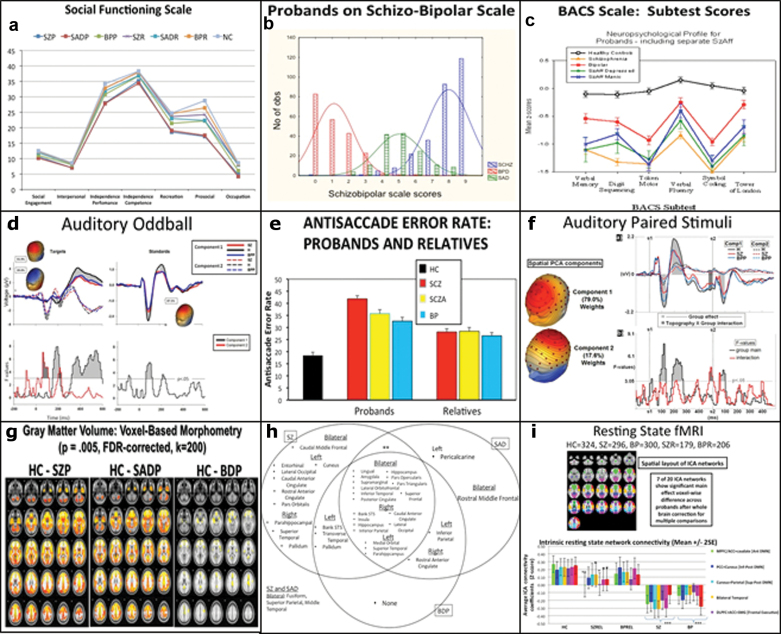
Fig. 1.
Fig. 1.
Multiple illustrative data from bipolar and schizophrenia network for intermediate phenotyping (BSNIP) study. (a) Social function quantified with the Birchwood Social Function Scale in the BSNIP sample. Details in reference . Schizophrenia (SZ) and schizoaffective disorder (SAD) groups were almost identical, while bipolar disorder (BDP) showed slightly higher scores. Relatives of all groups were modestly impaired. The patterns of impairment were similar across diagnostic groups. (b) The Schizo-Bipolar scale was developed from the SCID diagnostic criteria for these psychotic diagnoses. There was almost continuous overlap between these diagnoses with no point of rarity over this spectrum, lacking support for distinct illness groups based on phenomenology. (c) Cognition was measured with the BACS. Group scores are depicted for the diagnostic subgroups, showing the greatest impairment in the SZ group and the least in the BDP group with SAD in between, separated by severity; however groups did not show distinctive qualitative cognitive alterations from each other, except for the severity. (d) In the evoked potential auditory oddball paradigm, the patient groups (SZ and BDP) resembled each other rather broadly, with minimal, distinctive differences, discussed in reference . (e) The antisaccade error rates were increased in all patient groups, highest in SZ and lower in BDP, without any differences across relatives. Again, while severity differences were present, no other distinctions existed across diagnostic groups. (f) Differences between SZ and BPP groups are present after a pair auditory stimulus, including differences in both patient groups in baseline levels, especially before S2. (g) Using VBM analysis to determine grey matter volume, a distinctive difference between SZ/SAD, on the one hand and BDP on the other, emerged; specifically, SA and SAD groups demonstrated significant and widespread grey matter volume reduction, while the BDP showed very little grey matter reduction in any area. This would represent a difference between diagnostic groups of a qualitative as well as quantitative nature. (h) FreeSurfer showed a similar outcome, with grey matter reductions widespread in all cortical regions in SZ and SAD, while no distinctive reductions in BDP. (i). Resting state fMRI analysis shows a number of distinctive cerebral networks based on ICA, that were distinctive in some or all of the diagnostic groups. In general, these networks were different between all probands and all healthy controls.

References

    1. Kraepelin E. Dementia Praecox and Paraphrenia. Edinburgh, Scotland: E. and S. Livingston; 1919
    1. Bleuler E. Dementia Praecox or the Group of Schizophrenias. New York, NY: International Universities Press; 1950
    1. Greer PL, Greenberg ME. From synapse to nucleus: calcium-dependent gene transcription in the control of synapse development and function. Neuron. 2008;59:846–860 - PubMed
    1. Charney DS, Buxbaum J, Sklar P, Nestler EJ. Neurobiology of Mental Illness, 4th ed 2013
    1. Smoller JW, Craddock N, Kendler K, et al. Identification of risk loci with shared effects on five major psychiatric disorders: a genome-wide analysis. Lancet 2013; 381(9875):1371–1379 - PMC - PubMed

Publication types
