Review
. 2014 Feb 3:2:395-9.
doi: 10.1016/j.redox.2014.01.015. eCollection 2014.

Thiol-based H2O2 signalling in microbial systems

Affiliations
Review

Thiol-based H2O2 signalling in microbial systems

Susanna Boronat et al. Redox Biol. .

Abstract

Cysteine residues, and in particular their thiolate groups, react not only with reactive oxygen species but also with electrophiles and with reactive nitrogen species. Thus, cysteine oxidation has often been linked to the toxic effects of some of these reactive molecules. However, thiol-based switches are common in protein sensors of antioxidant cascades, in both prokaryotic and eukaryotic organisms. We will describe here three redox sensors, the transcription factors OxyR, Yap1 and Pap1, which respond by disulfide bond formation to hydrogen peroxide stress, focusing specially on the differences among the three peroxide-sensing mechanisms.

Keywords: Cys oxidation; H2O2 sensor; OxyR; Pap1; S. pombe; Yap1.


Figures
None
Graphical abstract
Fig. 1
Fig. 1
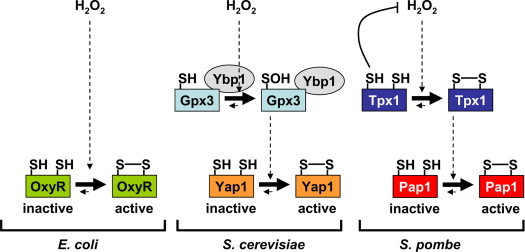
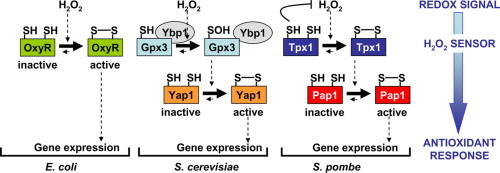
Scheme depicting the activation of OxyR, Yap1 and Pap1 upon H2O2 stress. Bacterial OxyR seems to respond directly to the oxidizing signal. The eukaryotic Yap1 and Pap1 transcription factors, however, do require the participation of upstream H2O2 sensors: the glutathione peroxidase Gpx3 and the peroxiredoxin Tpx1, respectively. See details in the text.
Fig. 2
Fig. 2
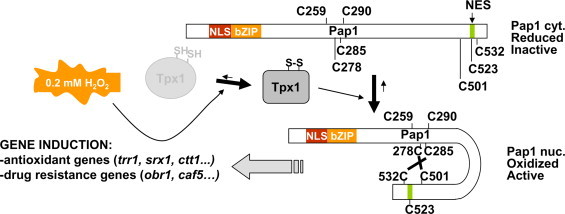
Schematic representation of Pap1 activation by H2O2. Upon moderate levels of peroxide stress (0.2 mM in the culture media), Tpx1 mediates disulfide bond formation in Pap1, which hinders the nuclear export signal (NES). Nuclear accumulation of oxidized Pap1 triggers transcription of both antioxidant and drug resistance genes. The relative positions of the seven cysteines residues (C) in Pap1 are indicated.
Fig. 3
Fig. 3
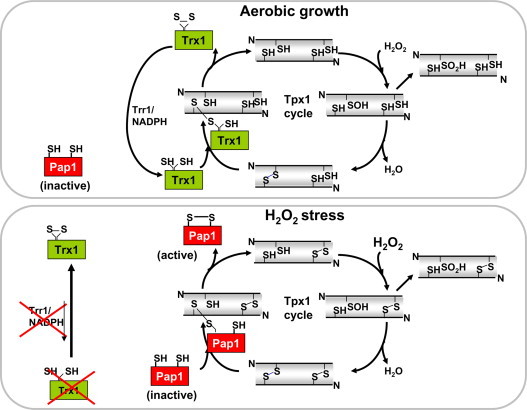
Scheme of the Tpx1 cycle. Upper panel: under aerobic growth conditions, reduced thioredoxin Trx1 breaks the intramolecular disulfide of Tpx1 by disulfide exchange leading to a transient intermediate Trx1-S-S-Tpx1 to finally release oxidized Trx1 and reduced Tpx1. Bottom panel: under mild oxidative stress, the Tpx1 cycle becomes saturated, reduced Trx1 is depleted and Pap1 acts as an alternative electron donor to Tpx1.

References

    1. Imlay J.A. The molecular mechanisms and physiological consequences of oxidative stress: lessons from a model bacterium. Nat. Rev. Microbiol. 2013;11:443–454. - PMC - PubMed
    1. Stewart E.J., Aslund F., Beckwith J. Disulfide bond formation in the Escherichia coli cytoplasm: an in vivo role reversal for the thioredoxins. Embo J. 1998;17:5543–5550. - PMC - PubMed
    1. Kadokura H., Katzen F., Beckwith J. Protein disulfide bond formation in prokaryotes. Annu. Rev. Biochem. 2003;72:111–135. - PubMed
    1. Garcia-Santamarina S., Boronat S., Calvo I.A., Rodriguez-Gabriel M., Ayte J. Is oxidized thioredoxin a major trigger for cysteine oxidation? Clues from a redox proteomics approach. Antioxid. Redox Signal. 2013;18:1549–1556. - PMC - PubMed
    1. Aslund F., Zheng M., Beckwith J., Storz G. Regulation of the OxyR transcription factor by hydrogen peroxide and the cellular thiol-disulfide status. Proc. Natl. Acad. Sci. USA. 1999;96:6161–6165. - PMC - PubMed

Publication types

MeSH terms

Substances

LinkOut - more resources