. 2014 Sep;26(9):1928-48.
doi: 10.1162/jocn_a_00596. Epub 2014 Feb 24.

Ventral striatum and the evaluation of memory retrieval strategies

Affiliations

Ventral striatum and the evaluation of memory retrieval strategies

David Badre et al. J Cogn Neurosci. 2014 Sep.

Abstract

Adaptive memory retrieval requires mechanisms of cognitive control that facilitate the recovery of goal-relevant information. Frontoparietal systems are known to support control of memory retrieval. However, the mechanisms by which the brain acquires, evaluates, and adapts retrieval strategies remain unknown. Here, we provide evidence that ventral striatal activation tracks the success of a retrieval strategy and correlates with subsequent reliance on that strategy. Human participants were scanned with fMRI while performing a lexical decision task. A rule was provided that indicated the likely semantic category of a target word given the category of a preceding prime. Reliance on the rule improved decision-making, as estimated within a drift diffusion framework. Ventral striatal activation tracked the benefit that relying on the rule had on decision-making. Moreover, activation in ventral striatum correlated with a participant's subsequent reliance on the rule. Taken together, these results support a role for ventral striatum in learning and evaluating declarative retrieval strategies.


Figures

Figure 1
Figure 1
Schematic of task events and conditions in the LDT. Each column depicts a time line of trial events for each condition of the experiment. During rule blocks, participants were provided a rule (top) that related two arbitrary semantic categories (e.g., boats and birds). On all trials (bottom), a prime image was presented followed by an SOA and then a target word string, which the participant identified as a word or nonword. For Expected trials (left), the category of the prime image predicted the category of the target word in accord with the rule. On occasional Unexpected trials (middle; 25% of Rule trials), the target came from the same category as the prime, which violated the rule. During Neutral blocks (right), trial events followed the same structure as for Rule blocks, except that there was no rule and the prime was a visual noise image.
Figure 2
Figure 2
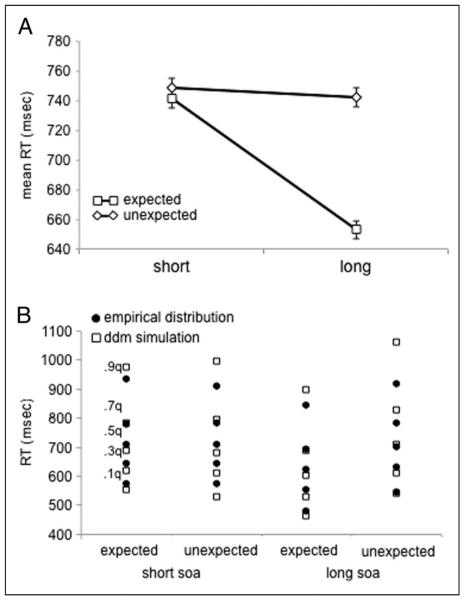
Behavioral and model simulation results from the LDT. (A) Expected and Unexpected conditions showed an interaction with SOA on RT such that participants were speeded for Expected conditions at the Long SOA. Error bars depict within subject standard error. (B) Five RT quantiles (.1, .3., .5, .7, .9) from the empirical RT distributions are plotted for the Expectation and SOA conditions (solid circles). Simulated RTs from the best fitting DDM model are plotted (open squares) for comparison. This model allowed drift rate and non-decision time to vary as a function of experimental condition. One thousand trials were simulated for each condition.
Figure 3
Figure 3
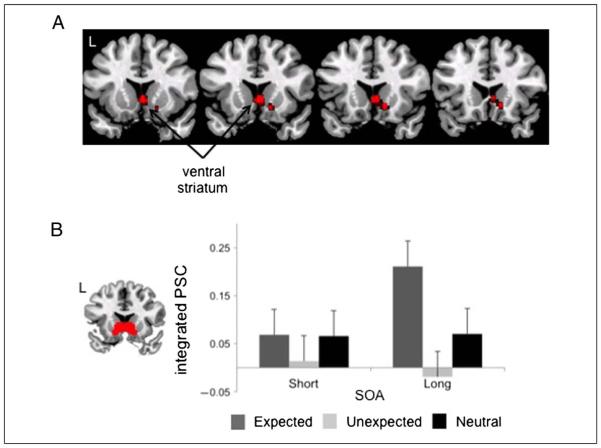
Effects of Expectation in ventral striatum. (A) The whole-brain voxel-wise contrast of Expected > Unexpected is plotted on coronal slices. To show the spread of activation, the contrast is plotted at p < .005 uncorrected. However, the peaks of activation in ventral striatum correct for multiple comparison over the whole striatal volume. (B) A large ROI covering ventral caudate and nucleus accumbens was constructed from previous studies of reinforcement learning and is shown at left in a coronal slice. Bar plot depicts the percent signal change integrated over a 4- to 10-sec window following presentation of the prime stimulus across Rule and Neutral conditions by SOA. Error bars show within-subject standard error.
Figure 4
Figure 4
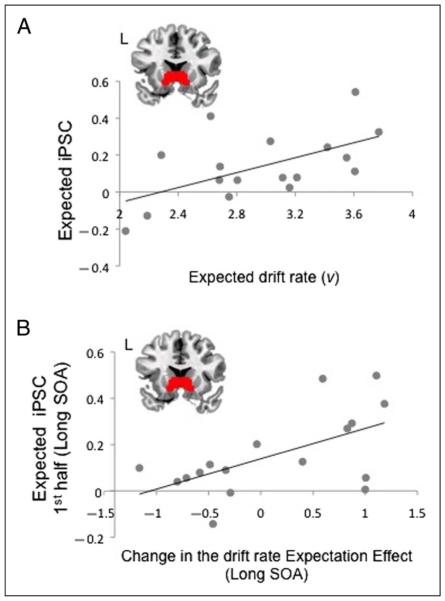
Correlations of ventral striatal activation with individual differences in drift rate. (A) Activation in the ventral striatum was positively correlated with individual differences in drift rate. (B) Activation in ventral striatum in the first half of the experiment was correlated with the shift in the Unexpected versus Expected difference in drift rate between the first and second halves of the experiment. The ventral striatal ROI, covering ventral caudate and nucleus accumbens, is shown on each plot.
Figure 5
Figure 5
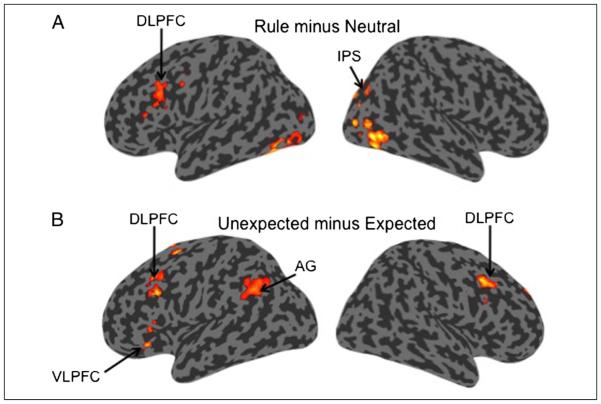
Whole-brain activation maps rendered on an inflated canonical surface. (A) The contrast of Rule > Neutral events yielded activation in a network of regions that included DLPFC and IPS. (B) The contrast of Unexpected > Expected yielded activation in DLPFC, VLPFC, and AG. All contrasts are thresholded at p < .05 (FWE cluster corrected).
Figure 6
Figure 6
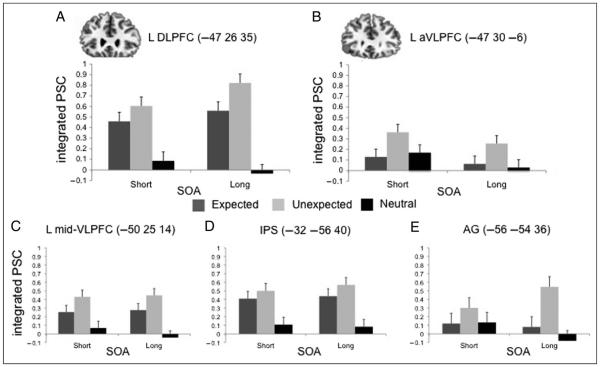
Plots of percent signal change in ROIs in prefrontal and parietal cortex. Bar plots depict percent signal change integrated over a 4- to 10-sec window following presentation of the prime stimulus. Plots depict Expected (dark gray), Unexpected (light gray), and Neutral (black) across SOA conditions. Results from ROIs in (A) DLPFC, (D) mid-VLPFC, and (C) IPS show similar patterns of Unexpected greater than Expected, with both Rule conditions greater than Neutral. By contrast, (B) aVLPFC and (E) AG show greater activation for Unexpected than Expected and Neutral. Error bars depict within subject standard error.

References

    1. Anderson JR, Milson R. Human memory: An adaptive perspective. Psychological Review. 1989;96:703–719.
    1. Anderson MC, Ochsner KN, Kuhl B, Cooper J, Robertson E, Gabrieli SW, et al. Neural systems underlying the suppression of unwanted memories. Science. 2004;303:232–235. - PubMed
    1. Atkinson RC, Shiffrin RM. The control of short-term memory. Scientific American. 1971;225:82–90. - PubMed
    1. Badre D. Opening the gate to working memory. Proceedings of the National Academy of Sciences, U.S.A. 2012;109:19878–19879. - PMC - PubMed
    1. Badre D, Doll BB, Long NM, Frank MJ. Rostrolateral prefrontal cortex and individual differences in uncertainty-driven exploration. Neuron. 2012;73:595–607. - PMC - PubMed

Publication types