


The effect of umbilical cord cleansing with chlorhexidine on omphalitis and neonatal mortality in community settings in developing countries: a meta-analysis
- PMID: 24564621
- PMCID: PMC3847355
- DOI: 10.1186/1471-2458-13-S3-S15
The effect of umbilical cord cleansing with chlorhexidine on omphalitis and neonatal mortality in community settings in developing countries: a meta-analysis
Abstract
Background: There is an increased risk of serious neonatal infection arising through exposure of the umbilical cord to invasive pathogen in home and facility births where hygienic practices are difficult to achieve. The World Health Organization currently recommends 'dry cord care' because of insufficient data in favor of or against topical application of an antiseptic. The primary objective of this meta-analysis is to evaluate the effects of application of chlorhexidine (CHX) to the umbilical cord to children born in low income countries on cord infection (omphalitis) and neonatal mortality. Standardized guidelines of Child Health Epidemiology Reference Group (CHERG) were followed to generate estimates of effectiveness of topical chlorhexidine application to umbilical cord for prevention of sepsis specific mortality, for inclusion in the Lives Saved Tool (LiST).
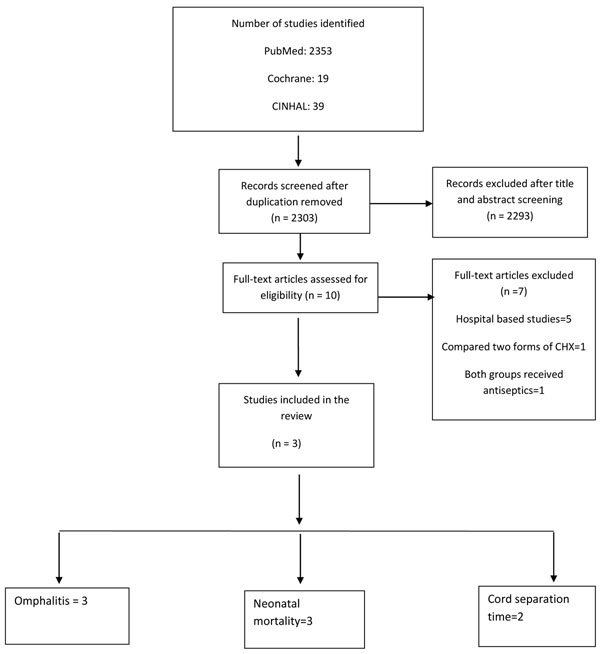
Methods: Systematic review and meta-analysis. Data sources included Cochrane Central Register of Controlled Trials (CENTRAL) in the Cochrane Library, PubMed, CINHAL and WHO international clinical trials registry. Only randomized trials were included. Studies of children in hospital settings were excluded. The comparison group received no application to the umbilical cord (dry cord care), no intervention, or a non-CHX intervention. Primary outcomes were omphalitis and all-cause neonatal mortality.
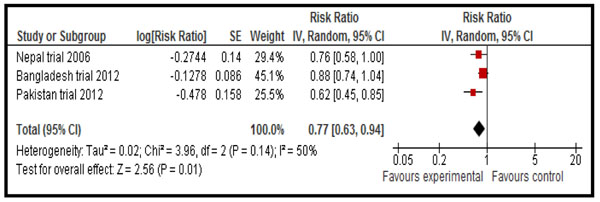
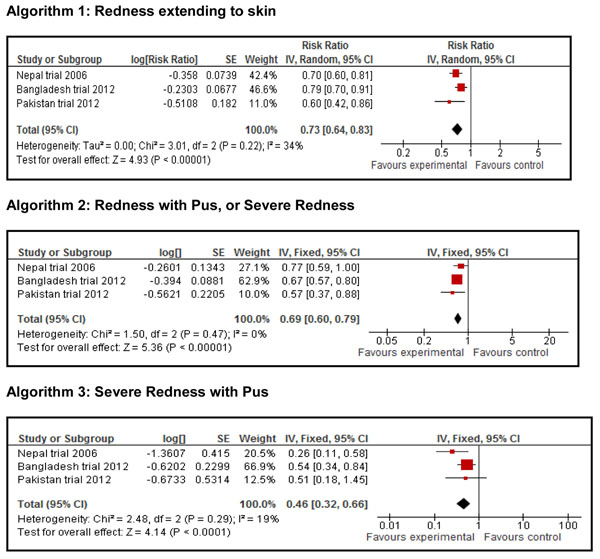
Results: There were three cluster-randomised community trials (total participants 54,624) conducted in Nepal, Bangladesh and Pakistan that assessed impact of CHX application to the newborn umbilical cord for prevention of cord infection and mortality. Application of any CHX to the umbilical cord of the newborn led to a 23% reduction in all-cause neonatal mortality in the intervention group compared to control [RR 0.77, 95 % CI 0.63, 0.94; random effects model, I2=50 %]. The reduction in omphalitis ranged from 27 % to 56 % compared to control group depending on severity of infection. Based on CHERG rules, effect size for all-cause mortality was used for inclusion to LiST model as a proxy for sepsis specific mortality.
Conclusions: Application of CHX to newborn umbilical cord can significantly reduce incidence of umbilical cord infection and all-cause mortality among home births in community settings. This inexpensive and simple intervention can save a significant number of newborn lives in developing countries.
Figures
Similar articles
-
Umbilical cord antiseptics for preventing sepsis and death among newborns.Cochrane Database Syst Rev. 2013 May 31;2013(5):CD008635. doi: 10.1002/14651858.CD008635.pub2. Cochrane Database Syst Rev. 2013. PMID: 23728678 Free PMC article.
-
Chlorhexidine skin or cord care for prevention of mortality and infections in neonates.Cochrane Database Syst Rev. 2015 Mar 5;2015(3):CD007835. doi: 10.1002/14651858.CD007835.pub2. Cochrane Database Syst Rev. 2015. PMID: 25739381 Free PMC article.
-
Umbilical cord cleansing with chlorhexidine in neonates: a systematic review.J Perinatol. 2016 May;36 Suppl 1(Suppl 1):S12-20. doi: 10.1038/jp.2016.28. J Perinatol. 2016. PMID: 27109088 Free PMC article.
-
Prevention and Treatment of Neonatal Infections in Facility and Community Settings of Low- and Middle-Income Countries: A Descriptive Review.Neonatology. 2025;122(Suppl 1):173-208. doi: 10.1159/000541871. Epub 2024 Nov 12. Neonatology. 2025. PMID: 39532080 Free PMC article.
-
Antimicrobial dressings for the prevention of catheter-related infections in newborn infants with central venous catheters.Cochrane Database Syst Rev. 2016 Mar 23;3(3):CD011082. doi: 10.1002/14651858.CD011082.pub2. Cochrane Database Syst Rev. 2016. PMID: 27007217 Free PMC article.
Cited by
-
Health care providers' perspectives regarding the use of chlorhexidine gel for cord care in neonates in rural Kenya: implications for scale-up.BMC Health Serv Res. 2017 Apr 26;17(1):305. doi: 10.1186/s12913-017-2262-8. BMC Health Serv Res. 2017. PMID: 28446176 Free PMC article.
-
National chlorhexidine coverage and factors associated with newborn umbilical cord care in Bangladesh and Nepal: a cross-sectional analysis using household data.Matern Health Neonatol Perinatol. 2024 Jun 7;10(1):12. doi: 10.1186/s40748-024-00182-8. Matern Health Neonatol Perinatol. 2024. PMID: 38845007 Free PMC article.
-
Determinants of clean birthing practices in low- and middle-income countries: a scoping review.BMC Public Health. 2020 May 1;20(1):602. doi: 10.1186/s12889-020-8431-4. BMC Public Health. 2020. PMID: 32357872 Free PMC article.
-
Neonatal Care in Low- and Middle-Income Countries: A Fresh Look.Neonatology. 2025;122(Suppl 1):1-4. doi: 10.1159/000543956. Epub 2025 Feb 4. Neonatology. 2025. PMID: 39904328 Free PMC article. No abstract available.
-
The effect of a clinical decision-making mHealth support system on maternal and neonatal mortality and morbidity in Ghana: study protocol for a cluster randomized controlled trial.Trials. 2017 Apr 4;18(1):157. doi: 10.1186/s13063-017-1897-4. Trials. 2017. PMID: 28372580 Free PMC article. Clinical Trial.
References
-
- Capurro H. The WHO Reproductive Health Library. Geneva: World Health Organization; Topical umbilical cord care at birth: RHL practical aspects : RHL practical aspects (last revised:30 September 2004)
-
- Smith CK. Some traditional umbilical cord care practices in developing countries. Midwifery Today Int Midwife. 2009. pp. 12–13. - PubMed
Publication types
MeSH terms
Substances
LinkOut - more resources
Full Text Sources
Other Literature Sources
Medical
